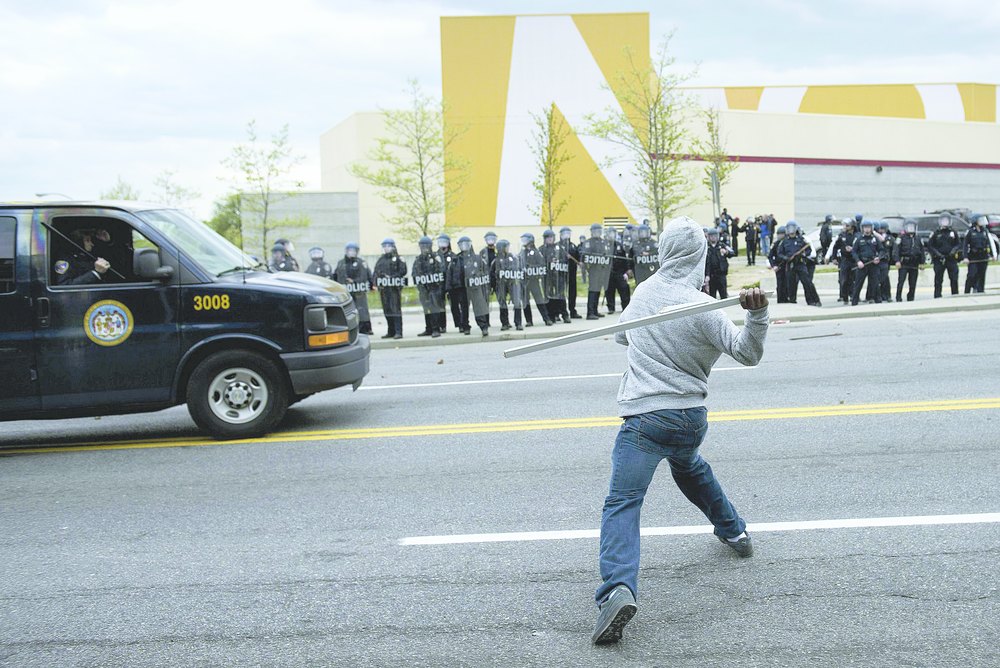


Baltimore, April 28: Baltimore erupted in violence yesterday as hundreds of rioters looted stores, burned buildings and at least 15 police officers were injured following the funeral of a 25-year-old black man who died after suffering a spinal injury in police custody.
As Baltimore residents recoiled from the rioting and looting that struck largely in the west of the city yesterday, the police said officers were deployed overnight alongside weary and harried firefighters to ensure their work was not disrupted by people with "no regard for life".
As dawn broke, the city was relatively calm compared with the violence that had left 15 officers injured - six seriously - from thrown bottles, rocks and bricks, as well as dozens of businesses, homes and cars damaged or destroyed by looting or arson. It is not known how many protesters were injured.
The police also reported that two persons had been shot, each in the leg, in separate incidents overnight. One victim, a woman, was shot on Fulton Avenue near where some of the worst rioting and looting had occurred hours earlier. The other victim, a man, was shot about two miles west of the Mondawmin Mall.
At the Mondawmin Mall, where the rioting began, a few police cars sat in the parking lot early this morning, but the protesters seemed long gone. The police said a flier circulated on social media had called for a period of violence yesterday afternoon to begin at the Mondawmin Mall and to move downtown toward City Hall.
Members of the National Guard began to deploy in the city just after daybreak today. Wearing tan and earth-green military fatigues and driving sandy-colour humvees, they took up posts around the city's Western District police station, the scene of earlier protests. More than a hundred National Guard members with rifles lined the street in front of Baltimore's inner harbor.
Near the debris-strewn corner of Pennsylvania and North Avenues, scene of some of the worst rioting yesterday, including the incineration of a police car and the looting of a drugstore, state police troopers in riot gear were lined up in a human barrier across two intersections as the sky began to lighten. No protesters were visible.
Some people had begun to clean up, with a pick-up truck full of scrap metal parked near one line of police officers.
But fire engine sirens could still be heard and acrid smoke wafted from some of the areas hardest hit by arsonists who have left the Baltimore Fire Department stretched to its limits. One early-morning fire struck a large pawnshop in a commercial strip on the west side of the city, and several fire companies were called to put out the blaze.
State and city officials said they hoped that measures scheduled to be put into effect would reduce the chances of a repeat of yesterday's unrest, where the police acknowledged that, at least early on, they had been outflanked and outnumbered.
By the early hours of today, it was clear that in addition to the many rioters fuelled by fury over the death of Freddie Gray there were many other residents who, while similarly upset by Gray's death, were also troubled by yesterday's violence.
These included members of Gray's own family, who said he would not have approved of the rioting. As well as people like Katrina Carter, who grew up near the Mondawmin Mall, a place, she said, "where they had pageants, and everything you could do with kids".
Standing in the mall's parking lot late last night, Carter said she understood the anger of the teenagers who had thrown rocks and bricks at the police. "I'm 38, but had I been 12, I probably would have been out there," she said. But she said the teenagers needed to learn a better way to protest.
"They need to understand how to push pens, not people," she said.
Gray's death on April 19 has opened a deep wound in this majority-black city, where the mayor, Stephanie Rawlings-Blake, and the Baltimore police commissioner, Anthony W. Batts - both of whom are black - have struggled to reform a police department that has a history of aggressive, sometimes brutal, treatment of black men. Gray was chased and restrained by police officers on bicycles at Gilmor Homes on the morning of April 12; a cellphone video of his arrest showed him being dragged into a police van, seemingly limp and screaming in pain.
The police have acknowledged that he should have received medical treatment immediately at the scene of the arrest and have also said that he rode in the van unbuckled.
After his arrival at the police station, medics rushed him to the hospital, where he slipped into a coma and died. His family has said that 80 per cent of his spinal cord was severed, and that his larynx had been crushed.
The death spawned a week of protests that had been largely peaceful until Saturday night, when demonstrators scuffled with officers in riot gear outside Camden Yards, the baseball park.
The authorities attributed the scattered violence that night to outsiders who, Rawlings-Blake said, "were inciting," with "'go out there and shut this city down' kind of messaging".
But the violence yesterday was much more devastating and profound, a blow for a city whose leaders had been hoping Gray's funeral would show its more peaceful side. At the New Shiloh Baptist Church, Gray lay in an open white coffin, in a white shirt and tie, with a pillow bearing a picture of him in a red T-shirt, against a backdrop of a blue sky and doves.