 |
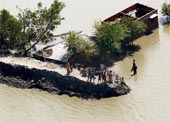
| Embankments have been neglected in the last 150 years. Pictures by Amit Datta, Bishwarup Dutta and Sanjoy Chattopadhyaya |
Chief minister Buddhadeb Bhattacharjee has asked the people to cast their votes for the right cause in the 2011 elections. No, it’s not the Assembly polls, though he is sure to have that in mind too. He is here asking people to vote for the Sunderbans.
The area is an entry in a competition for the New Seven Wonders of Nature worldwide. Some may think it’s absurd to ask for such a status for a group of vanishing islands, shrinking as they are under the impact of climate change. Especially after Cyclone Aila, the Sunderbans require immediate and constant attention, not a title, many feel.
“The wonder status is fine, but will the Sunderbans actually survive 30 years from now?” asks Sunderbans expert Tushar Kanjilal.
Sailen Sarkar, the Bengal environment minister, echoes the concern. He recently urged central environment and forest minister Jayram Ramesh to raise the issue of the Sunderbans at the Copenhagen summit on climate change in December.
Of the 102 islands that constitute the Sunderbans, 54 have human settlements while the remaining 48 are inhabited by wild animals, or whatever is left of them. With the water level rising, one island after another is going under water. First it was Lohachara, now it’s the turn of Ghoramara.
But there’s such a thing as a silver lining. What if the Sunderbans are elected as one of the seven natural wonders? Though the UNESCO world heritage site status for the Sunderbans didn’t help much, the “wonder” status just might bring, along with more tourists, more attention and more funds, and may save the Sunderbans, as the east Calcutta wetlands were saved from “development” following the Ramsar listing.
Metro casts its vote for the Sunderbans. But when a visitor goes now, what does he see?
 |
| A Royal Bengal tiger in the Sunderbans |
Tigers
After Aila, tigers have begun to stray more. According to wildlife experts it can be linked to even less food in the forest areas. So, tourists have a greater chance of seeing a tiger now, though it may be one of the last ones.
The Sunderbans were long touted as the home of the largest number of tigers in any forest in the country, with the figure hovering around 250. But the recent census in 2006, the result of which has been kept on hold under objections from the state forest department, apparently found that the number could be less than 100.
The survival of tigers is linked to proper forest management and availability of prey. Otherwise the forest department may remain, but the forest will vanish. Poaching is rampant. There are other smaller, but persistent, problems: the divisional forest officer in South 24-Parganas has been in the same post for more than 10 years. Let’s hope the international focus will stop the Sunderbans from doing a Sariska and the day will not arrive when visitors will have to be content with life-size tiger statues.
 |
| The depleting mangrove cover |
Mangroves
The Sunderbans are said to be the largest mangrove forest in the world, but the visitor may have to suspend his disbelief. Many feel that the impact of Aila was so devastating because of the shrinking mangrove cover. “Wherever we could keep mangroves, the area survived,” says Gopal Mondal, a school teacher from Chotomollakhali, a Sunderban island.
The mangroves are disappearing faster from the Indian side than the Bangladesh side. The deforestation has a long history in the Sunderbans. In 1875 W.W. Hunter wrote in his Sunderbans: A Statistical Account of Bengal that more than 3 lakh tonnes of firewood were transported from the Sunderbans to Calcutta and 24-Parganas in 1872-73!
The felling continues. Sunderban expert Kumud Ranjan Naskar says more than 2,000sq km of mangrove forest was cleared in the last 100 years to accommodate human settlements. About 54 islands have been cleared of forest to a large extent.
The solution: planting of more mangrove species and stopping deforestation. That is easier said than done, but if it is not done soon, the Sunderbans will hardly be green.
 |
| A family living in a boat after Cyclone Aila razed its hut last year |
The people
Tourists may miss the tigers and mangrove species, but nearly 4.5 million undernourished men and women are on display.
The villages lack basic facilities and infrastructure. People here were traditionally engaged in agriculture, fishery, collection of honey or livestock management, but earning a livelihood was always tough. After Aila, whatever livelihood they had has been lost. The land, which absorbed so much salt water, will not be arable for a few years in some places.
The undivided Sunderbans in 1772 had nearly 3 lakh people. The figure rose steadily over the years. According to Anup Matilal, who with Alapan Bandyopadhyay has written the book The Philosopher’s Stone on Sir Daniel Hamilton, the Scottish businessman who started the co-operative system in Gosaba island, Hamilton first began a structured settlement in Gosaba in 1903. The first census in 1951 showed about 14.5 lakh people lived on the Indian side of the Sunderbans. The population has now touched 45 lakh.
Perhaps the wonder status will finally ensure a master plan for the Sunderbans and its people to ensure livelihood and basic services. Otherwise one of the world’s biggest migrations can happen from the Sunderbans. The migration has already started. The Sunderbans are exporting cheap labour and domestic help to all parts of the country. The area is extremely vulnerable to trafficking of young girls and women.
 |
The sea
A study by the oceanographic studies centre in Jadavpur University has predicted that tidal surges and the consequent damage will intensify by 2020. “About 70,000 people will become climate refugees and 230,000 people will be affected in all,” said Sugato Hazra, who heads the centre.
The Bay of Bengal will not let the Sunderbans be. Global warming has enraged the sea and it will make inroads into land.
The sea level rise in and around the Sunderbans is the highest in the country and much above the global average. Tropical storms are becoming more frequent and severe, like Aila.
But Aila’s effects could have been less devastating if there were proper embankments. Embankments to islands are vital to the survival of those living in them as every 12 hours a high tide lashes the islands and the water level goes many feet above ground level.
“Why can’t you build embankments like the ones Bangladesh has built?” an Aila victim had asked the chief minister.
Kanjilal could not agree more. “Bangladesh has built most of the embankments using technology from the Netherlands and they are much stronger than those in the Indian Sunderbans,” said Kanjilal.
Little technology has been used in the construction of the earthen embankments in the Indian Sunderbans. They were originally built by the zamindars who got the land from the British and are as old as the human habitation on the islands, which dates back to the 1850s. The embankments, however, have hardly been maintained in the last 150 years.
Hamilton understood it a hundred years ago. “The trustees will be very careful to see that the embankments of Gosaba are always kept in first class order,” reads his will.
The Sunderbans here, like their Bangladesh counterpart, may be helped by a series of interventions, such as the closing of river arms to stop flooding, building of river dykes and construction of large sluices to regulate the tidal water flow. But those, apart from being extremely costly, are also not foolproof.
Constant upgrade of present embankments may be a better solution, feels Kanjilal. Concrete embankments were considered but most experts found it unacceptable because of the possibility of these becoming unstable with constant undercutting by river current. However, strengthening embankments with fly ash, an idea floated by the state environment department, is presently being considered.
“The central team has visited the place and considered the fly ash option and they seem to be agreeable with the idea,” said Biswajit Mukherjee, a senior official of the department who visited Sunderbans a number of times post Aila.
On Saturday, Union railway minister Mamata Banerjee inaugurated rail tracks from Canning to Basanti. Perhaps the “wonder” status is on its way too.
Towers of change
The Sunderbans are changing irreversibly. Mangroves are depleting but mechanised boats rule, mud-built embankments are weakening but migration to the mainland is steadily going up. People who never thought of leaving the Sunderbans after family members were killed by tigers are now leaving because their villages are sinking. The number of tigers may be below 100 but number of towers with mobile connectivity are in thousands. One is connected even sitting in a mechanised boat right in the middle of the river. There is no electricity on major stretches, only solar lights could be found in a few thousand households that could afford them.