
One question had been following Agnitra Ghosh like a shadow ever since he read The Shadow Lines three years ago. On Thursday evening, he finally had his answer.
Agnitra: May I please ask you a question?
Amitav Ghosh: Okay, but a short one please.
Agnitra: Did you put a little bit of yourself in Tridib?
Amitav Ghosh: ( Hint of a smile) No. No, I didn't.

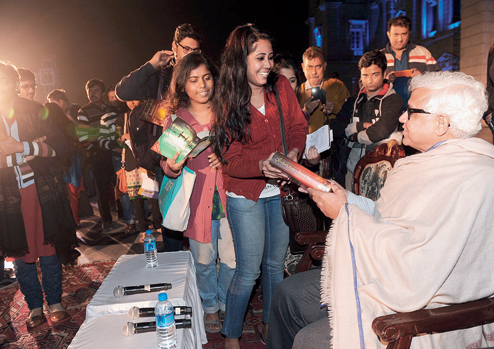
The fanboy moment came during an impromptu book-signing after the inaugural session of the Tata Steel Kolkata Literary Meet 2016, being held in association with Victoria Memorial Hall and The Telegraph till January 26.
"I had read that Amitav Ghosh had based the character of Tridib on an actual person, so I wondered if it was him. Tridib's perspective of life is so original. He has really stayed with me," said the 24-year-old.
Southern Avenue resident Neeta Das was on a different mission: to request Ghosh to "write more books, quickly".
"My eyesight is not that good anymore. So I save my eyes only for his works. I urged him to write quickly because I have nothing to read anymore," the 53-year-old architectural historian said.

Be it a character written 28 years ago or the impassioned plea of a historian fan, history was quite the flavour of the evening on Thursday. Before meeting his fans and patiently signing each novel, notebook or hastily acquired scrap of paper, Ghosh discussed 'The history in fiction and the fiction in history' with historian-author Mukul Kesavan and academician Supriya Chaudhuri, moderated by Jayanta Sengupta, the curator of the historic Victoria Memorial.
Chaudhuri said history and fiction were bound together by narrative, while Kesavan spoke about the differences between the narratives of the two. Leo Tolstoy was invoked by the trio, repeatedly, with Ghosh pointing out not only how War and Peace came to decide how Russian history would be narrated, but also how Tolstoy was wrong in suggesting that history had no narrative at all.

Ghosh also spoke about the difficulty a writer of Indian historical fiction like him faces because our history is so poorly documented in "plausible" fiction. "I do hope people will start telling stories about the Indian past, because I think to leave it only to historians is irresponsible," he said, drawing much laughter from under mufflers, hoodies and shawls in the audience.
It was the promise of a riveting discussion that drew Arijit Das to Victoria Memorial despite the chill. "It's hard to come across nights like this in Calcutta. Some very relevant points were made," said the Sanskrit College student.
Friday to Tuesday promise more such nights and days at the literary meet, with sessions on everything from mythology and crime to architecture and feminism.

Neeta Das, architectural historian
Full schedule: www.kolkatalitmeet.in
No passes required
Is Amitav Ghosh the greatest writer of historical fiction? Tell ttmetro@abpmail.com