An art exhibition is doing the rounds internationally that is by a Salt Laker, created at her Salt Lake studio, and on the subject of Salt Lake.
Jayashree Chakravarty of BG Block had her work featured at the Musee des Arts Asiatique museum in Nice, France, between September 2016 and February 2017 titled “Life will never be the same” and it was about the changing environment of the township she calls home. The exhibition was held in collaboration with the Kiran Nadar Museum of Art, New Delhi, ICCR, the Embassy of India in France and Akar Prakar gallery in Calcutta.
“The area encompassing present-day Salt Lake, Bagmari and the Bengal Chemical junction was a village named Kuchinan back in the 18th century. Since then, it has weathered calamities, landfills and settlements,” says Chakravarty, who was born in Tripura in 1956, but moved to BG Block with her parents in 1982.

Living history
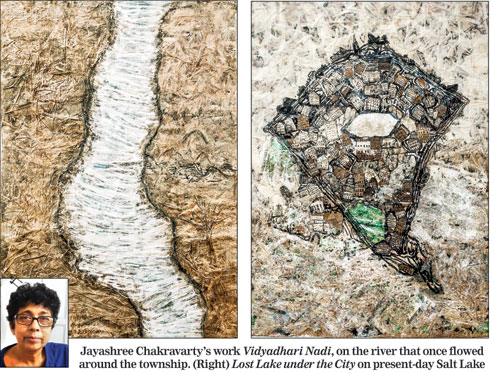
Kuchinan, Chakravarty has found, had got inundated by the Hooghly in an earthquake or tsunami-like calamity and this was the birth of the marshlands and bheris. Fishing communities lived here till the 1960s when chief minister Bidhan Chandra Roy initiated the landfill and Salt Lake eventually took shape. The Vidyadhari river flowed through these parts in the 1700s but dried up down the years.
When Chakravarty visited Calcutta from Tripura in the 60s, she remembers seeing labourers dumping mud on these lands and when she moved to BG Block in the 80s she remembers a vast expanse. “There was tall grass, few houses and lots of light and wind. We would see water creatures like snakes and snails as well as insects and jackals.”
“But gradually it got congested and claustrophobic. One can’t complain as the idea was always to accommodate people but now all pockets of the township don’t receive enough light and ventilation, causing plants to wither and people to suffer tremendous heat. Natural growth is uprooted from our parks and artificial objects installed in the name of beautification,” says Chakravarty. “It’s as if they’re telling the trees they are not allowed to be. I just hope in future they don’t fill the wetlands behind Sector V.”
The social set-up of Salt Lake got her thinking too, particularly the helplessness of the many senior citizens here. “The first generation that came here aged quickly and moved on,” says Chakravarty, whose own parents passed away after long-suffering illnesses. “In those days, I would take my dog for a walk and notice weeds cleared from gardens and dumped on the roads. Eventually cars would run over them and the fresh leaves would start changing form. Rainwater would fade their colours, dust would settle on them and finally they would dry up and get brittle. I could see the parallel with my mother’s deteriorating health.”

An artist’s touch
Over the last 10 years Chakravarty has worked to give artistic expression to the changing landscape of the township and her personal equation with it. She shows the Vidyadhari river in its heyday and as a dying stream later on. She shows the resilient weeds trying to survive after the calamity and shows butterflies and insects sticking together in the face of an endangered habitat. She shows the transition from marshland to sand-land and finally the map of Salt Lake filled in with a concrete jungle.
Chakravarty uses natural and organic materials like leaves, seeds, jute, cotton fabric and tissue paper for the works, mostly scavenged from around her house. They are in the form of scrolls, panels, 3D installations…
Her next exhibition titled “Unfolding Kuchinan” would be put up at New Delhi’s Kiran Nadar Museum of Art later this year. Another exhibition titled “Earth as Heaven: under the canopy of love” would be up at Musee Guimet in Paris. “They are all on the same trail of thought,” she says. “There is still so much untouched and unexplored that I shall continue working on this field.”
Brinda Sarkar