 |
 |
 |
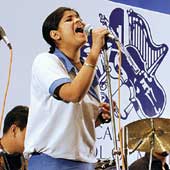
| In Tune: They came, they made music and they conquered. Nimble fingers flying over guitar strings or soulful voices singing of lost love, there was talent aplenty among the little ones and teens at the Calcutta School of Music Young Talent Contest. Pictures by Pradip Sanyal |
At any talent competition, the exciting preliminaries exude a sense of anticipation and nervousness that sustains the process no matter how many aspirants fall by the wayside. It?s a lesson in progress and struggle towards perfection: if you haven?t made it, try again.
Entering its 90th year and as part of its anniversary celebrations, the Calcutta School of Music hosted a Young Talent Contest in association with TTIS (The Telegraph in Schools) to encourage schoolchildren?s musical skills.
Beginning with the preliminaries on September 17, the finals were held at ITC Sonar Bangla. Three panels of adjudicators for the three categories of the contest consisted of leading musicians. Haimanti Shukla, Buddhadeb Dasgupta, Jayati Bagchi and Kumkum Bhattacharya judged the Indian music vocal solo and group. Anita Mehta, Rev Noel Sen and Annika Shwenk did the honours for the western classical categories and Pam Crain, Anjum Katyal and Gopa Ghosh were the judges for western popular solo and group.
In the vocal categories, there was a significant lack of male contestants, who made up for it in the instrumental section. All three age groups in the Indian vocal solos (junior, middle and senior) displayed maturity in technique, choice of music and vocal range and power. The group offerings, however, seemed to pale in comparison, with the exception of Dolna Day School and Ballygunge Shiksha Sadan.
The western classical solo category was impressively varied in choice of instruments, with piano, violin and guitar candidates. There were some outstanding entries who succeeded in projecting an element of style and showmanship in their performances, like pianists Souptik Majumdar of The Future Foundation School in the junior division and Rupayan Basu from La Martiniere for Boys in the senior division, and guitarist Raktim Ray from Dolna.
The popular English vocal soloists of the junior and middle categories fell short of expectations with an unimaginative choice of numbers, save a few exceptions.
The senior age group, though, had some great singing, like Tanya Sen from GD Birla Centre for Education and her three scintillating accompanists (two young men on the guitar and one on the drums), who stole the show with Drowning in the Sea of Love.
In the group category, there was a little decline in quality with the exception of Dolna Day School and Ballygunge Shiksha Sadan, both showing imagination, style and harmony.
The enthusiasm and involvement of all participants is important for the future of musical education in schools. We look forward to the contest being an annual one.
(Young Metro thanks music critic Fauzia Marikar for this contribution)
Destination north
When their friends will be thronging the streets of Calcutta, taking part in Puja revelry, they will be in the Capital to entertain people (many their own age) for the same occasion. On October 16, The Singing Fingers Group will depart for its destination. Barring two, one in college and the other being director Arunava Roy Gosthipaty, all others in the seven-member group are school students.
Over four days, the youngsters will perform in nine pujas across New Delhi, Haryana and UP. They will start off in Gurgaon on October 18. In Haryana, The Singing Fingers Group will also perform in Durga Bari, one of the most well-known pujas in north India. Next, Noida. Delhi is the last stop, where they will perform at the famous Chittaranjan Park puja, Greater Kailash, Patparganj and others.
?It?s going to be about two to three shows per day. So it?ll really be a tough task,? says Arunava. They will be performing what they do best ? ballet-painting, music-painting, origami and puppet shows. While ballet-painting and music-painting are two new art forms where the three (music, painting and dance) are performed simultaneously, origami is the Japanese art of paper-folding, which will be done to the sound of music.
Since they are going to perform with the likes of Calcutta Choir and singer Sreeradha Bandopadhay, the youngsters are preparing in right earnest. They have been working hard for the past three months. Practice has been on different aspects, from physical training ? running, breathing and meditation ? to canvas creativity.
The programme will take about an hour, with 22 minutes for ballet-painting, in which the image of Durga with a slight touch of chhau dancers will be put up on the canvas. Music-painting will take about 14 minutes, four minutes for origami and the rest for the puppet show. If everything goes according to plan, The Singing Fingers Group will be back in Calcutta on October 26, having made the Pujas memorable for out-of-towners.
Subhajoy Roy,
1st year English, Asutosh College
 |
| Clean Chit: Under-privileged children from Jawaharlal Nehru Vidyapith clean up a park as part of the initiative by Rotary Club of Calcutta Midtown to launch an Interact Club in the school. Picture by Sanjoy Chattopadhyaya |
Beyond boundaries
When 400 youngsters from 18 Indian cities and two countries come together to learn, care, share and party, the result is bound to be explosive. That?s what happened at the AIESEC National Leadership Development Seminar (NLDS) 2004 in Delhi from September 18 to 24. AIESEC is the world?s largest student-run voluntary organisation, whose work is to further peace and fulfilment of individual potential through cultural exchange among its member base of 89 countries and 750 campuses. AIESEC India holds NLDS only for its new recruits. I took the plunge with 18 others. Here is an account of what happened.
September 18: Led by our local committee president Varun Mimani, we arrive in the afternoon after a 30-hour journey. The hotel is infested with AIESECers. Things fall into place at the opening plenary, where the member committee president Kartikeyan Sharma and his team break the ice. The high point is standing up on chairs to give a thunderous reception to the nine participants from the Interest Group in Pakistan who arrive at night after a Lahore-Delhi bus ride. All-night parties follow.
September 19: Despite sharing a room with six girls from different cities, we reach the morning plenary on time. Kartikeyan and co. take centrestage. Learning, introspection and discussions fill the day. I talk terrorism with my Pakistani counterpart, Mida. We dance six hours at night. Roomy female gossip ensures we tuck in at 5 am.
September 20: My Chennai roommate?s Tamil accent wears off on me! Scramble from bed into the plenary. TCS enters into a historic partnership with AIESEC India (AI), with the promise of absorbing 445 interns annually. AI is the the most successful chapter after Germany. We are divided into fictitious local committees (FLCs). High point ? getting elected FLC president. Talent Night unleashes the skills of dancers, singers, mimics and elocutionists. Hats off to Siddharth, a rapper from Pune who floors us with an on-the-spot number.
September 22: The plenary, people, variety, roll calls, jives and the learning... All FLC?s undertake mock assignments. Prom date hunt intensifies. The camels down gallons of water mixed with Manchurian gravy and Tabasco sauce, for the big night. Midnight ? the mother of all championships, the sculling challenge. ?Thumbs on the table, chin on the table, face the tumbler, and go!? Five people on either side of the table down masala cola at lightning speed. Chennai beats Jaipur to be champs.
September 23: ?It?s up to you?, the AIESEC global brand, is launched and the mega tie-up with Godrej announced. AI will be hosting the international congress in 2005. Prom night beckons. My date studies engineering in Jaipur, but he forgets to bring me chocolates, has two left feet and prefers football to dancing. So we change dates all night. Perfect pairs, dancing under the stars, till dawn.
September 24: The Delhi guys won?t let us sleep. Storming into the rooms early in the morning, turning on the TV full blast, stealing bouquets and chocolates, they greet us on the last day. Sessions go on. We jive and shout. Fictitious elections are held. I present my speech with five others. Closing plenary goes on till 2 am. All are crying. No one wants to leave. I cried when our Pakistani friend invited us to her land, saying she would be there to take care of us. Emotions run high, no one sleeps. We exchange email IDs, hug, cry and celebrate friendships. A group of 10 starts singing John Denver?s Leaving on a jet plane. The circle grows to accommodate all 400. We sing...
September 25: Time to leave. Tired, nostalgic, but peaceful and happy. Photographs, hugs, promises and we are off, breaking into songs and sobs. Only six days, but we got a glimpse of what AIESEC has in store. The NLDS magic is over, but has left a legacy. We AIESECers are now raring to go.
Madhumita Das,
AIESEC, Kolkata Chapter, 2004
 |
| Party for a Cause: Enthusiastic party animals from city schools danced long and hard all evening, at Incognito, Taj Bengal, recently. Ignious 2004, a night of fun, was organised by Auric Showbiz, a group from National High School (Boys). The proceeds were handed over to the NGO Sanlaap. Picture by Sanjoy Chattopadhyaya |
Helping hands
Last week, Young Metro had published a story on Pranaadhika Sinha, who has started a youth group, Right Now Kolkata, to fight child sexual abuse, having been a victim herself. Owing to the huge response from readers, here are her email addresses, for those who want to get in touch: pranaadhika@gmail.com and rightnowkolkata@gmail.com.
However, Pranaadhika has a point to make: ?It has come to my notice that certain aggrieved parties have confused, and therefore taken offence, to the article titled ?Courageous Crusader? (October 8) owing to similarity between the name of my youth group, Right Now Kolkata (RNK), and Right Now, a registered society in Pune. Although I was previously associated with this group (the Calcutta Chapter), I opted out and created Right Now Kolkata as my youth group. I would like to clarify that RNK is a youth group, not a registered NGO, and that it has no connection with either the Pune or Calcutta chapter of Right Now. We are different groups working for a common cause and I look forward to both groups taking the issue seriously and working towards ensuring that the right people get justice rather than sidelining it with malicious attempts at slander.?
project report
 |
Mission education
He is England?s minister for schools, and he was here in India, including Calcutta, to study the the Indian education system. David Miliband (picture left by Sanjoy Chattopadhyaya) stopped by in the city on October 8 to meet chief minister Buddhadeb Bhattacharjee, after a series of meetings with people working in the field of education and human resource development. The Labour Party MP visited educational institutions like Vivekananda Mission School in Joka, the government-run South Suburban Branch School in Ballygunge, Garden for Children school run by Calcutta Social Project, Future Hope?s Home and Education Centre and The Heritage School, as well as the Vivekananda Education Society?s Ajanta Project in a slum on Diamond Harbour Road and Brahmo Balika Shikshalaya School in Rajabazar, which is implementing the state?s computer education programme. Miliband?s trip is part of a British government initiative to forge closer ties with India. The UK government?s Department for International Development supports several education projects in the country.