Pakistan sees ‘positive signal’ from Iran on US peace talks: Source
Pakistan is confident it can get Iran to attend talks with the United States, a senior Pakistani government official told Reuters on Monday.
"We have received a positive signal from Iran. Things are fluid but we are trying that they should be here when we start the talks tomorrow or a day after," the source said, speaking on condition of anonymity.
The source added Pakistan is actively engaged with Tehran and Washington as U.S. President Donald Trump's ceasefire deadline looms.
Vance still in US, uncertainty over Pakistan trip for Iran talks: Source
Vice President JD Vance is still in the United States and has not yet departed for Pakistan, a source familiar with the matter told Reuters, as prospects for a second round of negotiations with Iran remain unclear.
President Donald Trump has said he would send a U.S. delegation to Pakistan for additional talks before a ceasefire is set to expire in the coming days. Iran is considering attending the peace talks, a senior Iranian official told Reuters on Monday, but no decision had been made.
It was unclear if other members of a U.S. delegation were en route or already in Islamabad for talks.
The New York Post earlier reported that Vance, White House envoy Steve Witkoff and Trump's son-in-law Jared Kushner were on their way to the talks. The three participated in the first round of talks to end hostilities that began with U.S.-Israeli attacks on Iran on February 28.
Russian foreign minister Lavrov, Iran's Araghchi discuss ceasefire; Tehran assures safe passage via Hormuz
Russian Foreign Minister Sergei Lavrov held a phone conversation with his Iranian counterpart Abbas Araghchi on Monday, Russia's Foreign Ministry said.
Lavrov reiterated the need to uphold the ceasefire and stressed the importance of continued diplomatic efforts, while the Iranian side confirmed its readiness to do everything in its power to ensure the uninterrupted passage of Russian ships and cargo through the Strait of Hormuz.
Seized Iranian ship likely carrying equipment deemed dual-use by US: Maritime security sources
The Iranian-flagged container ship Touska, which was boarded and seized by US forces on Sunday, is likely to have what Washington deems dual-use items that could be used by the military onboard, maritime security sources said on Monday.
The small container ship, which is part of the Islamic Republic of Iran Shipping Lines (IRISL) group that has been hit with US sanctions, was boarded on Sunday off the coast of Iran's Chabahar port in the Gulf of Oman and last reported its position at 1308 GMT, according to ship-tracking data on the Marine Traffic platform.
The US Central Command said Touska’s crew failed to comply with repeated warnings over a six-hour period, and that the vessel was in violation of a US blockade.
The security sources, who declined to be identified, said their initial assessments were the vessel was likely to be carrying dual-use items after a voyage from Asia.
They did not go into details on the items. US Central Command has listed metals, pipes and electronic components among other goods that could have a military as well as an industrial use and could be captured.
EU to widen Iran sanctions to those who block Hormuz
The European Union will expand the criteria of its Iran sanctions to include those responsible for blocking the Strait of Hormuz, which has been largely shut for nearly two months upending global energy and commodities markets, two EU diplomats said. Tehran effectively closed the strait after US-Israeli strikes on Iran began on February 28, cutting off roughly one-fifth of the world's oil and liquefied natural gas supplies. More than a dozen tankers sailed through Hormuz after Iran briefly declared it open on Friday, but the ceasefire agreement was thrown into jeopardy after the United States seized an Iranian cargo ship as it maintained its own military blockade of Iranian ports.
"There was a political agreement among ambassadors that we indeed would change the criteria in Iran's sanctions regime so that we could also list persons and entities that are responsible for the obstruction of the freedom of navigation in the Strait of Hormuz," one of the diplomats said.
A second diplomatic source said the European External Action Service would need a few weeks to prepare any new listings. The EEAS is in charge of placing people and companies under sanctions while the European Commission handles sector-wide restrictions. In January, the EU designated Iran's Revolutionary Guards (IRGC) as a terrorist organisation and in March it listed Iranian officials for human rights violations.
Trump: Israel never talked me into war with Iran
President Donald Trump said on Monday that Israel did not persuade him to attack Iran, after news reports that Israeli leader Benjamin Netanyahu influenced the US president's decision.
Vance, US team en route to Islamabad for Iran talks, Trump says
Vice President JD Vance and the US delegation is set to land in Pakistan within hours for talks on Iran, President Donald Trump told the New York Post in an interview on Monday, adding that he would willing to meet with Iranian leaders himself if progress is made.
Iran 'positively' reviewing US peace talks participation; no decision yet, official says
A senior Iranian official said on Monday that Tehran is positively reviewing its participation in potential peace talks with the United States but that no final decision has been made.
The Iranian official said positive efforts are underway by mediator Pakistan to end the US blockade and to ensure Iran's participation in the peace talks.
A Pakistan source involved in the talks said the two-week ceasefire ends on April 22 at 8 pm EST.
Israel, Lebanon to hold second round of talks in Washington on Thursday, Israeli media says
The second round of talks between Israel and Lebanon will take place on Thursday in Washington, several Israeli media outlets reported on Monday.
It will mark the first talks between the two countries since a 10-day ceasefire took effect on Thursday.
Lebanese Parliament Speaker Nabih Berri said the United States is making an effort to extend a 10-day ceasefire between Israel and Lebanon, the pan-Arab Asharq al-Awsat cited him as saying on Monday.
Berri spoke to the newspaper after a meeting with the U.S. ambassador to Lebanon, Michel Issa.
UAE says it dismantled terrorist cell linked to Iran
The United Arab Emirates said on Monday it had dismantled a terrorist cell linked to Iran and arrested its members over a plot to undermine stability, state news agency WAM reported.
WAM said that the cell members carried out recruitment and mobilisation operations, with the aim of gaining access to sensitive sites.
China's Xi in phone call with Saudi Arabia's Crown Prince, calls for normal passage of ships through Hormuz
Chinese President Xi Jinping called for normal passage of ships through the Strait of Hormuz to be maintained, in a phone call on Monday with Saudi Arabia's Crown Prince Mohammed bin Salman held as Beijing steps up efforts to help end the Iran war.
China is concerned over renewed instability around the strategic waterway, as a US-Iran ceasefire came under fresh strain after the US seized an Iranian cargo ship and Tehran signaled it would not join new peace talks for now.
China is the main buyer of Iranian crude. Iran has largely closed the strait to ships other than its own since the United States and Israel launched the war in February, while Washington has imposed a blockade of Iranian ships since last week.
China advocates an immediate and comprehensive ceasefire, and insists on resolving conflicts in the Middle East through political and diplomatic channels, state news agency Xinhua cited Xi as saying.
"The Strait of Hormuz should remain open to normal passage, as this serves the common interests of regional countries and the international community," he told the Saudi leader.
Israel uncovers Iranian network that planned to attack Baku-Tbilisi-Ceyhan pipeline
Israel on Monday said it had uncovered an Iranian network that had planned to attack a pipeline carrying crude oil from Azerbaijan to the Mediterranean as well as Israeli and Jewish targets in Azerbaijan.
In a joint statement, the Mossad and Shin Bet intelligence agencies said a plan by Iran's Islamic Revolutionary Guard Corps to attack the Baku-Tbilisi-Ceyhan pipeline through Georgia to Turkey several weeks ago had been thwarted.
The cell had also planned attacks on Jewish and Israeli targets in Azerbaijan including the Israeli embassy and a synagogue in Baku, as well as leaders of the Jewish community in Azerbaijan, the agencies said.
Iran's foreign ministry did not immediately reply to a request for comment.
Members of the cell, who were in possession of explosive drones and fragmentation charges, were arrested by Azerbaijani authorities.
"To realise their intentions, the cell worked to gather intelligence on targets using various methods, including physical surveillance and photography, all under direct orders from their handlers in Iran," the statement said.
"This exposure, alongside strenuous intelligence investigation and operational activities on the ground, led to the uncovering of the secret terrorist network that has been established within the IRGC and its chain of command."
It said the cell was led by Rahman Moqadam, who also served as the head of IRGC intelligence's Special Operations Division, or Unit 4000.
Moqadam was killed last month during Israeli air strikes, part of an air war waged on Iran by Israel and the United States since February 28.
Israel faces 'clear war crime' allegations over destruction in south Lebanon villages
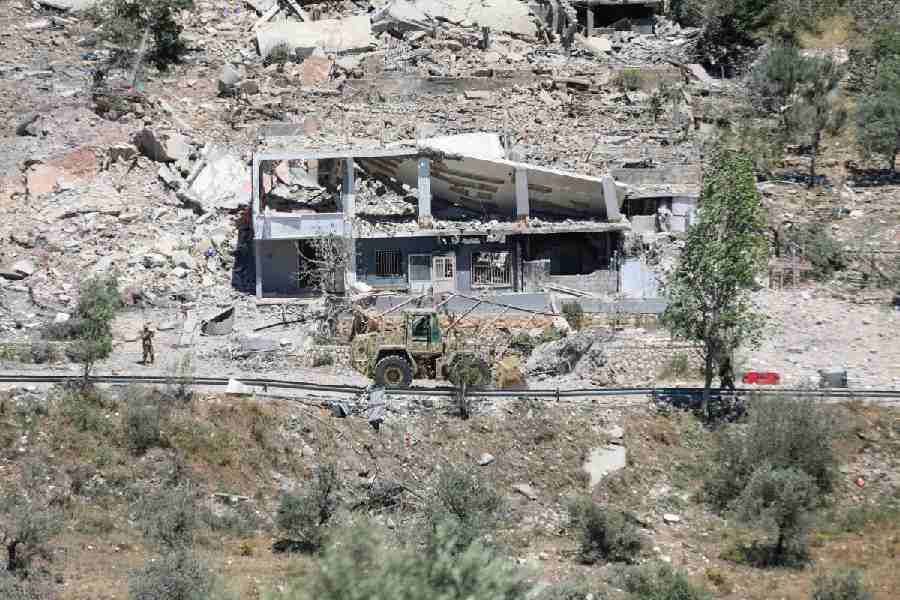
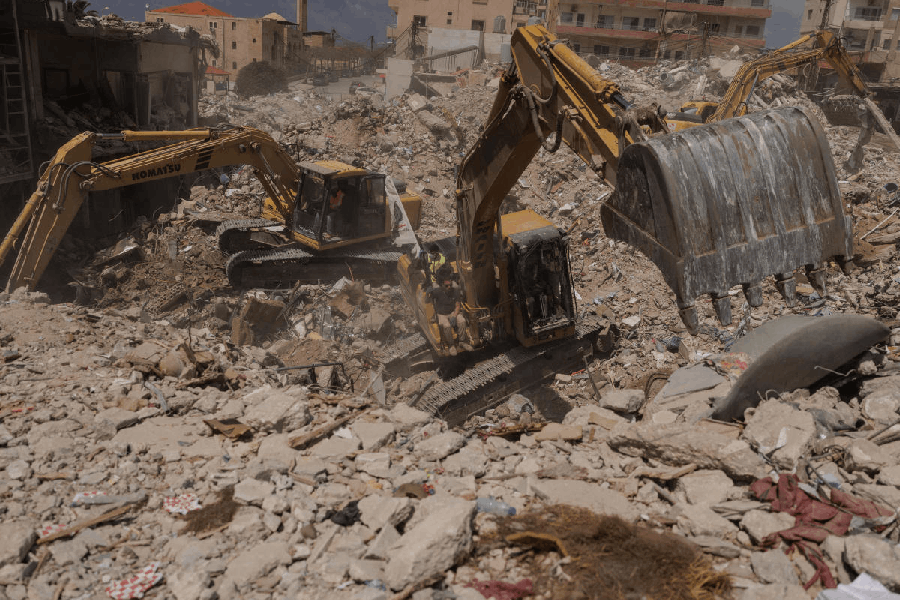
Israeli forces have carried out varying degrees of destruction in 39 villages in southern Lebanon since a ceasefire in the war with Hezbollah last week, a senior Hezbollah-allied politician said on Monday.
Ali Hassan Khalil, a top aide to Lebanon's Parliament Speaker Nabih Berri, said the powerful explosions carried out by Israeli forces had destroyed civilian homes in the south and this amounted to "a clear war crime".
The Israeli military has said it is acting against Hezbollah infrastructure in the south.
Lebanon says it is drawn into war it did not choose, vows to assert sovereignty: Report
Lebanon’s Foreign Minister said that the country “was dragged into a war it did not choose” and that the government is committed to “regaining control over decisions of war and peace and imposing its sovereignty by its own will over the entire Lebanese territory,” as reported by Al Jazeera.
Shipping traffic remains at virtual standstill through Hormuz
Shipping traffic through the Strait of Hormuz remained at a virtual standstill on Monday with just three crossings in the space of 12 hours, according to shipping data.
The oil products tanker Nero, which is under British sanctions for Russian oil activities, left the Gulf and was sailing through the Strait, according to satellite analysis from data analytics specialists SynMax and tracking data from the Kpler platform.
Two other ships - a chemical tanker and a liquefied petroleum gas (LPG) tanker - sailed into the Gulf through the critical waterway separately on Monday, the data showed.
The LPG tanker, Axon I, was under separate U.S. sanctions for Iran trading activities.
A ceasefire between the United States and Iran appeared in jeopardy on Monday after the U.S. said it had seized an Iranian cargo ship that tried to run its blockade and Tehran vowed to retaliate, refusing for now to join new peace talks.
"Recent weeks have brought several false starts, and although some form of resolution is likely at some point, the timing of any durable breakthrough remains highly uncertain," ship broker Clarksons said in a note on Monday.
Israel condemns soldier's desecration of crucifix in south Lebanon
Israel's foreign minister and military on Monday condemned the desecration of a crucifix smashed by an Israeli soldier in a southern Lebanese village home to Christians.
A photo that emerged online over the weekend shows a soldier taking the blunt side of an axe to a fallen sculpture of Jesus on the cross. It was posted by Younis Tirawi, who describes himself as a Palestinian reporter and has also posted images of Israeli soldiers' apparent misconduct in Gaza.
Reuters verified the location of the image as Debel, one of the few villages in southern Lebanon where residents remained through an Israeli military campaign against the Iranian-backed Hezbollah militia that began on March 2 after the group fired rockets at Israel in support of Iran.
The cross was part of a small shrine in the garden of a family living on the edge of the village, said Fadi Falfel, a priest in Debel.
"One of the Israeli soldiers broke the cross and did this horrible thing, this desecration of our holy symbols," he said.
Foreign Minister Gideon Saar said the soldier's actions were disgraceful and shameful. "We apologize for this incident and to every Christian whose feelings were hurt," Saar said on X.
The Israeli military said the incident was being investigated.
"The IDF (Israel Defense Forces) views the incident with great severity and emphasises that the soldier's conduct is wholly inconsistent with the values expected of its troops," the military said. "The IDF is working to assist the community in restoring the statue to its place."
Debel is one of dozens of villages in south Lebanon now under effective Israeli occupation. Israel and Lebanon on Thursday agreed to a U.S.-brokered ceasefire intended to halt fighting between Israel and Hezbollah.
"We have every kind of crisis," Falfel said.
"We thought the ceasefire would bring us some relief but we’re still surrounded, unable to travel to and from the town. There are some houses on the edge of town that we’re barred from accessing."
Israeli military officials say they are working with aid agencies to meet the humanitarian needs of Debel and other villages.
Trump says he will consider advice from Pakistan's Munir on Hormuz blockade: Report
US President Donald Trump told Pakistan's army chief Asim Munir that he would consider Munir's advice on the Strait of Hormuz blockade being a hurdle to peace talks with Iran when the two spoke by phone, a Pakistani security source said on Monday.
Iran's Baghaei says no plan yet for second round of negotiations with US
Iran's Foreign Ministry spokesman Esmaeil Baghaei said there is no plan for a second round of negotiations with the US for now.
Baghaei added in a press conference that the US has shown it is "not serious" about pursuing the diplomatic process and that it committed aggressive acts and violated ceasefire provisions.
Gaps over Iran's nuclear work remain, senior Iranian source says
Differences over Iran's nuclear programme still remain, a senior Iranian source told Reuters on Monday, as Iran and the United States try to reach a lasting peace with the two-week ceasefire ending soon.
The senior Iranian source said that Tehran's "defenSive capabilities", including its missile programme, are not open to negotiation with the United States.
"Continuation of the US blockade on the Strait of Hormuz undermines the peace talks," the source sad.
Pakistan intensifying diplomatic efforts to ensure US-Iran talks go ahead on Tuesday
Pakistan has intensified diplomatic contacts since Sunday with Washington and Tehran to ensure talks proceed as soon as tomorrow, officials tell AP.
Pakistan’s Interior Minister Mohsin Naqvi met US Chargé d’Affaires Natalie Baker at the US Embassy in Islamabad today.
The meeting focused on strengthening Pakistan-US relations and preparations for a second round of talks scheduled to take place in Islamabad this week, Naqvi’s office says.
The statement did not specify when the talks are expected to begin.
Naqvi briefed Baker on security arrangements, saying special measures had been taken to ensure the safety of visiting delegations.
“We have made comprehensive security arrangements for our distinguished guests,” Naqvi says in the statement.
Baker offered appreciation for Pakistan’s role in easing regional tensions and efforts to facilitate dialogue.
Separately, Pakistan’s Prime Minister Shehbaz Sharif spoke by phone late Sunday with Iranian President Masoud Pezeshkian, Sharif’s office says in a statement that did not mention the planned talks.
Authorities began closing key roads and stepping up security in the capital Islamabad over the weekend, particularly around a luxury hotel where the delegations are expected to meet.
Authorities deployed troops at checkpoints, closed tourist sites, and instructed major hotels to limit bookings to ensure availability.