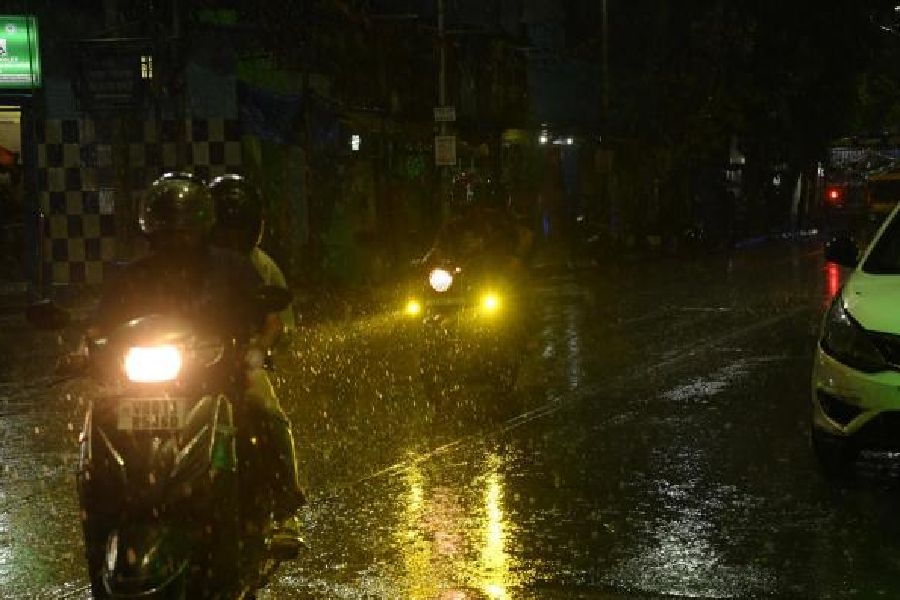
A Nor’wester thunderstorm on Wednesday evening broke the nearly 10-day dry spell in Kolkata, with weather officials predicting at least 200 to 300 mm of downpour overnight.
The Regional Meteorological Centre (RMC) had issued a red alert warning on Wednesday for western districts of Bengal, heavy showers and lightning.
“The Nor’Wester that hit Howrah, North and South 24 Parganas, East Midnapore has travelled to Kolkata with accompanied wind speeds of approximately 70 kmph," said RMC head H.R. Biswas. “Over the course of the night, we can see up to 200 or 300 mm of rainfall,” he added.
By 8:15 pm gusty winds and drizzles started in the city, likely to intensify overnight according to weathermen. Parts of central Kolkata reported water logging within an hour.
The city has been grueling under a week and a half long dry spell leading up to polling day for the second phase of the Bengal Assembly elections.
Tuesday saw a minor shower, while the majority of Wednesday remained cloudy and windy while city folk lined up at polling booths, ahead of the evening thunderstorm outbreak.
By 7 pm, Alipore recorded 1.6 mm of rainfall, Salt Lake received around 2 mm, while central Kolkata saw only 0.2 mm.
Along with daytime minor showers, a drop in vehicles because of polls improved Kolkata’s air quality on Wednesday, with the AQI (Air quality index) sliding from ‘moderate’ to ‘good’ within a 24 hour period.
Meteorologists attributed the cleaner air to this sudden change not only to reduced vehicular emissions but also to light rainfall that occurred after a prolonged dry spell of nearly 10 days. Despite the uneven distribution, the showers were enough to aid pollutant dispersion, especially when combined with breezy and cloudy conditions throughout the day.
“Having very few vehicles on the roads on election day definitely helps improve air quality, but rainfall has a bigger impact,” said Sourish Bandhopadhyay, scientist at RMC.
AQICN data showed that by 7 pm, Rabindra Sarobar registered an AQI of 39, while Padmapukur in Howrah reported an even lower reading of 31. Both stations showed a drop of at least 40 points compared to the previous day’s levels.
This was before an evening thunderstorm, meaning the restricted vehicles street activity alone helped clean up the city’s air.
According to some aggregators, the AQI dropped as much as 60 points within a 24 hour period, by Wednesday evening.
The twin effect of election stillness ending with a burst of rainfall finally brought relief to Kolkata from a spell of heat and humidity, and air pollution, with mercury likely to plunge several notches by Thursday from the maximum temperature of 32.2 degrees Celsius of Wednesday.