Two school programmes sought to draw children back to books and real-life connections, both of which are fast eroding in an increasingly screen-dominated world.
Phir Se Kitab, an initiative by Mahadevi Birla World Academy, was designed to nudge children towards reading beyond their textbooks — even if it meant compelling them to pick up a book.
At the heart of the inter-school fest, held last month for students of Classes III to V, was Beastly Tales from Here and There by Vikram Seth. All competitive events revolved around the poems in the collection, and each of the 14 participating school teams was required to have read the prescribed pieces.
“It is because children are not reading and everything around them is visual that they lack imagination,” said Nupur Ghosh, vice-principal of Mahadevi Birla World Academy. “A book can generate so many ideas. Even after children finish reading a story, it stays with them. That same story can inspire a student to ideate.”
Among the rounds was the radio play competition. Students had to
borrow an idea from one of the poems and dramatise it.
One team did a contemporary adaptation of The Crocodile and the Monkey, reimagining it in the world of online scams. Their performance showed how a gullible individual can fall prey to digital fraud and how intellect and presence of mind are essential to avoid being deceived.
Another team drew from The Frog and the Nightingale, using the poem to explore how jealousy disguised as authority and showmanship can silence genuine talent — a theme that, students said, resonates not only in literature but also in classrooms and on stage.
In a different event, participants were asked to blend elements, using the setting of one poem and the characters of another to compose an original verse. The exercise tested creativity as well as critical thinking and close reading, Ghosh said. “It required them to read the poems thoroughly,” she added.
If Mahadevi Birla school turned to literature to spark imagination, Sri Sri Academy focused on restoring interpersonal bonds.
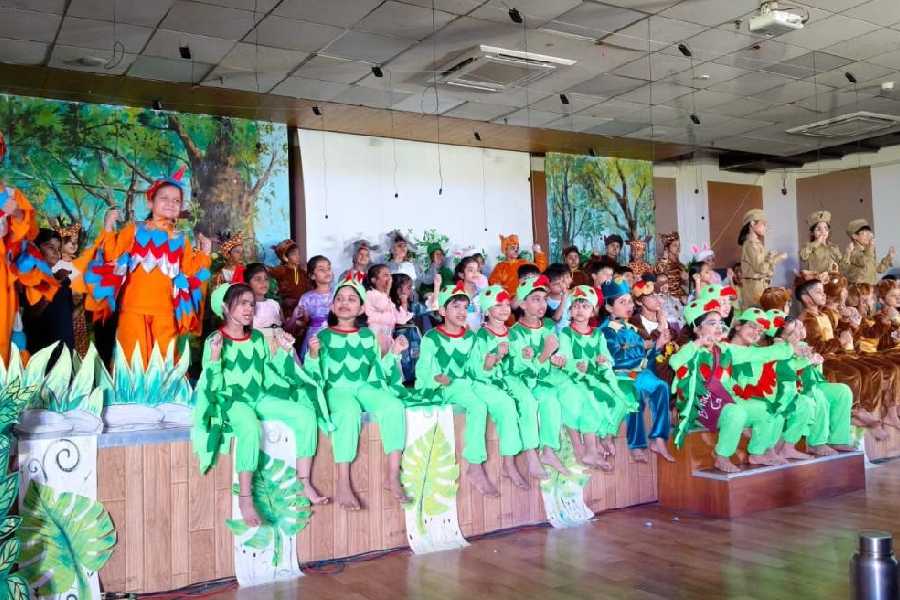
The school organised a concert titled Joy Beyond Screen for children from Kindergarten to Class II, aiming to foster real-world connections at an early age.
Teachers of Sri Sri Academy scripted a play that opened with a parrot lamenting that children no longer talk to one another, preferring instead to stay glued to their screens.
When the parrot flies off to the forest in search of conversation, it discovers that even the monkeys are engrossed in mobile phones — devices they had picked up from a group of picnickers.
“The message was more for parents, to reiterate the importance of real-life connections over screen time,” said Gargi Banerjee, principal of Sri Sri Academy.
“Our idea is to look beyond the screen and bring books back into their lives.”
Psychotherapist and school counsellor Farishta Dastur Mukerji underscored the role schools play in strengthening children’s offline engagement, particularly through reading.
“Reading takes you into a fantasy land, where the reader creates their own mental images of what the author is trying to convey. There is also an element of wish fulfilment in stories,” she said.
Beyond imagination, reading builds essential skills.
“It strengthens vocabulary, focus and patience — areas where many children struggle today. Reading makes all of this happen at once, often without us even realising it,” she said.
At Mahadevi Birla World Academy, the commitment to reading has extended into classroom policy.
Junior school teachers have been instructed to dedicate the class teacher’s period to reading and discussion, rather than curriculum-related tasks.
“They must read with the children and discuss the text, not scan it and display it on a smart screen,” Ghosh said.
“Reading is a skill adults have allowed children to forget. It is our responsibility to help them rediscover the habit.”