 |
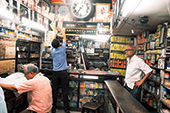
| The Lenin Sarani art materials shop. Picture by Bishwarup Dutta |
Businessman, philanthropist, scion of the famous Dutt family of Hatkhola — the late Abinash Chandra Dutt was all that and more. He also set up Abinash Chandra Dutt Paints at 1 Lenin Sarani in 1888, making it the oldest paint and art materials shop in the city.
After suffering huge losses in the spice trade in the mid-19th century, the Dutts started off as retailers of household and industrial paints. They were among the first in the country to establish trade relations with the West.
From the early 20th century, the family establishment had been stocking goods from house paint manufacturers like Pinchin Johnson, Wilander’s and London Varnish.
The Dutt enterprise also pioneered its brand of wooden easels in eastern India, starting off in 1923 under the guidance of the late Jahar Lal Dutt, who had toured the factory of the legendary art material suppliers Reuben’s in Germany.
He returned to the country with the knowledge of easel making. “At that time, our shop offered two varieties of easels, both made of Burma Teak,” says Abinash Dutt’s grandson and the current proprietor of the shop, 66-year-old Pradip.
Abinash Chandra Dutt Paints started importing world-class art materials around the same time, with the advent of a new breed of artists from the Government College of Art & Craft. Selling products of English brands like the Winsor & Newton, the shop became a pivot in the development of the city’s art fraternity.
“Abinash Dutt’s shop built a reputation by forging relationships with individual artists. They have always taken care to cater to each artist’s specifications,” says artist Ramananda Bandyopadhyay.
Though he hasn’t been to the Lenin Sarani address for years, Bandyopadhyay — one of the last representatives of the Bengal school — acquired most of his Japanese flat brushes from Dutt’s shop. “I bought a lot of fine watercolours from the shop as well,” he recalls.
According to Pradip, Satyajit Ray used to frequent the shop in the Sixties.
“As an art college student, I used to often visit Dutt’s shop. They had a wide range of tones not easily available elsewhere,” says artist Samir Aich. These days, Aich, like many of his peers, gets his art supplies through individual dealers.
The breakthrough for Dutts’ easels came in the late-1980s, when Abinash Dutt’s grandson Aloke toured England as a special guest for Winsor & Newton, acclaimed as manufacturers of quality wooden easels, and learnt the technicalities of the craft.
In 1988, Aloke set up Art & Wood Enterprises, a sister concern of Abinash Dutt’s company, and started manufacturing easels of the latest designs in an Ahiritola factory.
The company now offers 12 varieties of easels, each in three sizes. Specialities include the briefcase easel, the traditional mustang easel with a seating facility and the folding bench box easel. Kala Bhavan, Santiniketan and the Academy of Fine Arts, Calcutta, are the major clients.
With the import floodgates opening at the turn of the century, Abinash Chandra Dutt Paints has seen competition increase manifold.
A slew of stores in the city now stock a wide array of art materials that were once available only at the Lenin Sarani address.
“The imported brands are steeply priced. While we cater to some of the best-known artists from the city, art students form the bulk of our buyers. And not every one can afford such products,” says Pradip.