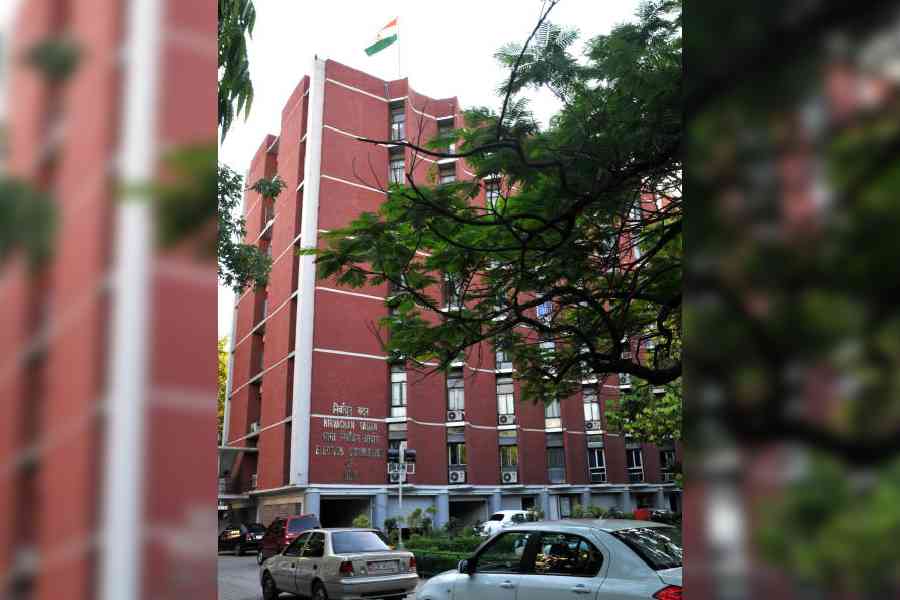
The Election Commission (EC) on Monday appointed one senior IAS officer from Delhi as a special roll observer in each of the five divisions in Bengal for the ongoing special intensive revision (SIR) of the voter list in an apparent move to monitor the upcoming hearing and verification exercise that would follow the enumeration process.
According to the orders issued by the EC on Monday, Kumar Ravi Kant Singh, a joint secretary in the ministry of defence, was appointed as the special roll observer for the Presidency division, while Krishna Kumar Nirala, a joint secretary in the ministry of information & broadcasting, will be deployed in the Burdwan division.
Pankaj Yadav, a joint secretary in the department of rural development, was appointed as the special roll observer in the Jalpaiguri division, while Alok Tiwari, a joint secretary in the economic affairs department under the ministry of finance, would work as the special roll observer in the Malda division. The roll observer for the Midnapore division will be Niraj Kumar Bansod, a joint secretary in the ministry of home affairs.
The special roll observers will be responsible for ensuring that no eligible elector is left out and no ineligible name is included in the rolls. The special roll observers would discharge their duties till the publication of the final electoral roll.
Sources on the poll panel said the appointment of the officers came soon after the chief minister had announced that the state government would start operating camps across Bengal to help the electors, who would require documents, during the hearing process.
"Appointment of these officers is clearly to monitor the hearing and verification exercise that would follow the enumeration process. The EC is clearly very sensitive about the hearing and verification process in Bengal, as several erroneous entries were made during the enumeration process," said a source.
Another official said that the poll panel was eager to prepare error-free electoral rolls and that it depended heavily on the hearing and verification process.
Several irregularities were found in the uploaded enumeration forms. These were identified by the EC's IT team, and the CEO's office was asked to rectify the faults by carrying out a reverification of the forms.
"A progeny mapping had to be done afresh as more than 30 lakh voters had linked 2002 voters as their parents, even though they mismatch with their parents named in the 2025 rolls, in an apparent bid to avoid hearing. These could have been averted had the officials worked properly. If similar mistakes continue during the hearing and verification, ineligible voters' names will be included in the electoral rolls," said the official.
According to the administrative structure in Bengal, divisions are clusters of districts. Appointing the special roll observers in the divisions means the EC has put the district magistrates under its scanner.
"Now, the activity of each of the DMs, who are the district election officers, will be under the scrutiny of these senior officials. This was done only to avoid errors that occurred during the enumeration process because of the fault of the BLOs as well as district officials, intentionally or unintentionally," said the official.
According to a source on the poll panel, the EC was laying stress on the hearing and verification process, as it was estimated that more than one crore voters across the state could be called in for hearing and verification of their documents. All those who could not establish their links with the 2002 rolls would have to explain why their or their parents' names were not in the electoral rolls of 2002.
They will have to submit documents to support their claims. This process is important because verifying the documents would be an uphill task.
"If the documents are not checked properly, ineligible voters' names would be included in the rolls. This is why the EC has deployed special observers to monitor the exercise closely," said a source.