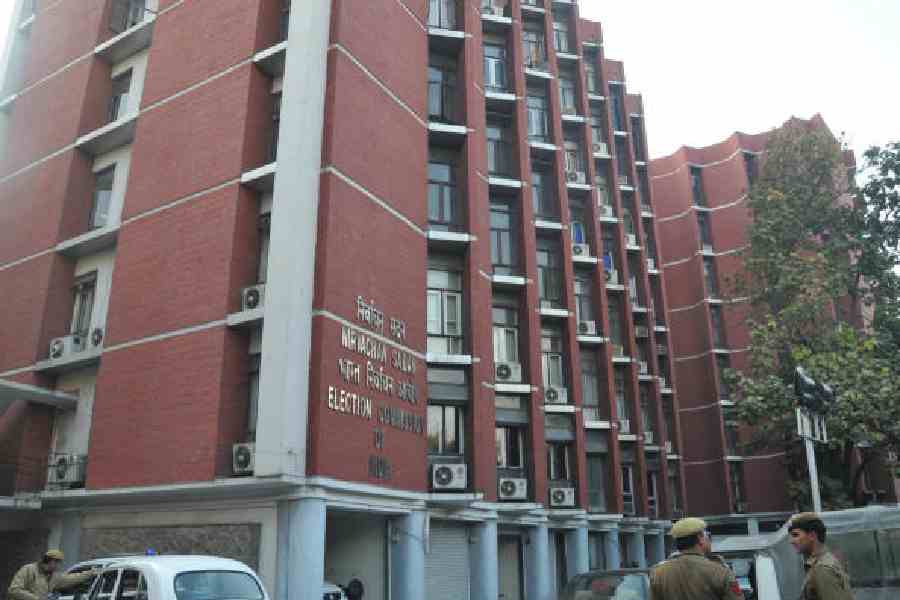
The conflict between Nabanna and the Election Commission could intensify over the list of 8,505 group B “officers” sent by the state government, as the poll panel is likely to engage only a section of them in the SIR exercise, citing majority of them are not officers.
Sources on the poll panel said primarily they went through the list and found that a majority of the names on the list were not of officers and were of the employees, like lower division clerks, upper division clerks and typists.
“Only those who are in the rank of officers or specifically gazetted officers will be engaged in the ongoing SIR exercise,” said an EC officer.
Soon after the list of the 8,505 names was sent to the poll panel on Monday evening, the EC officials raised questions over the names, saying the UDC, LDC or typists couldn’t be called officers.
Gazetted officers are generally high-ranking officers in Groups A and B whose appointments are published in the official state gazette. Mainly, WBCS officers, police officers in the DSP rank and above, doctors at government hospitals and professors at government colleges are considered gazetted officers.
Countering the argument, Nabanna on Tuesday evening issued a press note saying the “list of Group ‘B’ employees submitted to ECI is strictly in accordance with the existing pay-level criteria as notified by the Finance Department, Government of West Bengal, vide Memorandum No. 2160-F(J)WB dated 06.10.2020”.
Sources in the Nirvachan Sadan said the Supreme Court had clearly mentioned that the state should send 8,505 Group B officers/officials on deputation to the EC.
“The EC was at liberty to shortlist the names sent by the state through a scrutiny of their bio-data and work experience. But the primary criterion was that they should be in the officer rank. The list has a majority of employees in the posts of LDC, UDC or typists, who cannot be termed officers by any means,” explained a poll panel source.
The sources on the poll panel also said that even though the government claimed that the employees were in the group B category, as their pay level was equivalent to that of group B officers, they couldn’t be considered officers, as their roles were different from those of officers.
“In administrative paralance, officers hold high positions with decision-making powers and supervisory duties while employees perform broader operational or clerical tasks under supervision. So there is a clear difference between the two sets,” said an official.
He also said an LDC or UDC’s pay scale could be similar to that of an officer after serving a long period.
“But their roles would never be changed to supervisory or decision-making. The government actually has tricked everybody by sending the list full of employees’ names, maybe at par in scale with group B officers, instead of gazetted officers,” the official added.
Another official said the employees couldn’t play the roles of micro-observers or AEROs as those were of a supervisory and decision-making nature. Sources said if the majority of the “officers” sent by the state remained unutilised, it would be an embarrassment for Nabanna.
“The ruling dispensation was against the deployment of central government officers as micro observers. It felt that if the state government officers or employees could be engaged in the positions, they would not be as harsh as the central government officers while preparing the final voter list. Now, if the majority of them remain unused, the state government could knock on the doors of the Supreme Court again.
But the EC sources said they would have enough reasons to explain in court why only officers from the list could be engaged in the SIR duties.