 |
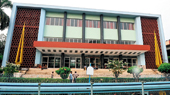
| Picture of neglect: Rabindra Sadan. Picture by Pradip Sanyal |
Rabindra Sadan, now shabby, was built on a plot of 28,000 square feet at the cost of Rs 45 lakh. The then chief minister BC Roy had invited Jawaharlal Nehru to lay the foundation stone on the occasion of Tagore’s centennial year on May 8, 1961. The 1,101-seat auditorium came with a stage 35 feet wide, 40 feet deep and 72 feet high.
The stage had two revolving discs, a wide cyclorama or backdrop and a music pit. Rooms were allotted for a library for dance and drama and a museum of musical instruments on its first and second floors. But neglect and the shifting of the library collection to Bangla Akademi transformed these rooms to storage for junk. Finally the library area was leased out to Shishu Kishore Akademi for its “temporary” office in 2007.
When the hall, then called Rabindra Smarani, opened in 1966, prominent names from the world of culture, such as Satyajit Ray, Bishnu Dey, Debiprasad Roy Chowdhury, Suchitra Mitra, Tapas Sen, Sarajubala Devi and Manmatha Roy, submitted a written plea that the new building be handed over to an autonomous body that would also create a national theatre centre. They requested that the state bear the expenses of developing this centre.
Nothing came out of it, however, as the hall continued to function as a mere auditorium. Rabindra Sadan initially functioned under the higher education department as a self-sustaining organisation that would maintain itself on the revenue it generated. The hall was used for various government programmes, including theatre and jatra. Troupes from all over India and abroad came to perform.
But in 1986 the Left government brought Rabindra Sadan under the state information and culture department. Its bank account was transferred to Bangla Akademi and the collection of books and rare manuscripts, such as those of Tagore, was taken away to the Bangla Akademi library. Rabindra Sadan became mainly the host of a few annual Tagore festivals. The hall was hired by various organisations and office clubs.
Who controlled it during the Left regime?
After it was brought under the information and culture department, the state paid all salaries and handed out funds for festivals hosted.
What were its high and low points down the years?
High: Be it Bolshoi ballet or Utpal Dutta’s Tiner Talowar (which made good use of the revolving discs), major cultural events have been and still continue to be held at Rabindra Sadan. The French embassy wants to bring its dance world tour to Rabindra Sadan this November.
Low: There are no funds for regular upkeep. Walls need paint and repair, the corridors are littered with garbage. No sweepers have been appointed for Rabindra Sadan, which tries to make do with three casual workers who double as stage-hands.
What are the primary challenges the organisation faces today?
Funds: Little has been done to upgrade the structure. A sum of Rs 12.5 lakh a year barely covers the festivals. During the Left regime, the revenue generated by the hall, about Rs 20 lakh a year, went to the state government, which was supposed to pay the PWD for upkeep. But for the last two years it has not done so. What little maintenance is being carried out is an act of love by PWD officials.
Staff: There are 22 workers, mostly unskilled. Around 10 hands are needed for the auditorium alone. No one has been recruited for 15 years. When employees retire their posts fall vacant. The posts of caretaker, sound operator and night guard have been vacant for some time. Daily wagers are employed, which often results in unsatisfactory work. Cops keep an eye on the place at night.
Quality control: Selection of programmes and singers for festivals should be done with greater care.
Culture hub: There is a lot of space within the building for seminars and museums. Rabindra Sadan has a great image in the minds of most Bengalis and is known to many outside the state too. This should be exploited. Not just a Suchitra Mitra memorial museum, planned after the singer’s demise, but tributes to other renowned singers and performers should also be housed on the premises.
Central grant: Despite offers from the Union culture ministry no one from the state has applied for help to transform the Rabindra Sadan compound into a world-class cultural complex. During Tagore’s 150th year celebrations this could give it a new lease of life.
New ideas: Many feel there is a stagnation of ideas about what is shown and how. The new committee is expected to change that and also provide Rabindra Sadan with worldwide links.
Archive: Rabindra Sadan has a rare collection of long playing records and other documents stacked among the junk in a room that was once the archive. Restoration and preservation are urgently needed.
Metro speaks to singer Sumitra Sen, who has been appointed chairperson of Rabindra Sadan
 |
You have been a member of the Rabindra Sadan committee before being appointed its chairperson. Have you felt that the Left government has ignored its needs and possibilities?
Don’t know whether they ignored us or not but they certainly did nothing to help. Rubbish korechhe (they did nothing)!
Ensuring proper screening of artistes will be a top priority for you.…
Yes, over the years there was great injustice in the selection procedure. Many talented artistes were overstepped by those with party influence. As a result the programmes suffered.
Do you think Rabindra Sadan can grow into a culture hub? What plans do you have in mind?
Of course it can be a centre of national importance. I have various plans for museums, an archive, exchange programmes… but I don’t want to speak before we have our meeting. We are involved in organising a big Baishe Srabon event with the Tagore 150 years celebration committee.