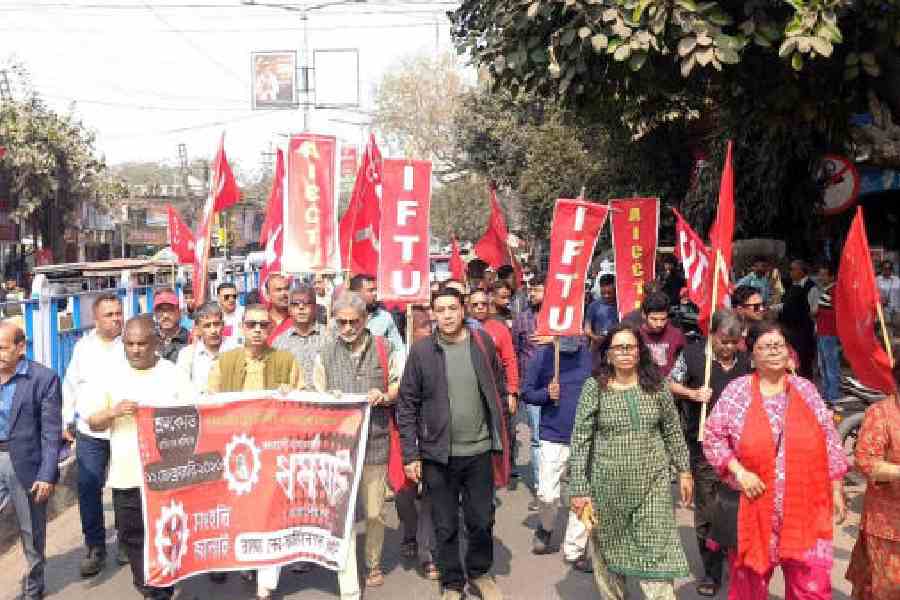
The nationwide industrial strike on Thursday called by the joint forum of central trade unions evoked partial response in Bengal, with work affected in some banks and industrial zones.
Called in protest of “anti-worker, anti-farmer” policies, especially the four new Labour Codes set to be effected from April 1 this year, the strike was supported by the Left Front and Leftist employees’ federations. Joining the strike, trade unions, including CITU, AITUC and UTUC, also made a “save Bengal” call.
Routine operations in several public and private sector banks in the state, except the State Bank of India, were affected owing to the strike.
The industrial belt, particularly the jute belt in North 24-Parganas, Hooghly and Howrah witnessed mixed responses. Daily functioning was suspended in at least 12 of the 59 jute mills of the state.
The tea belt in north Bengal, however, did not face any impact.
In the jute belt, workers of the North Shyamnagar Jute Mill in Bhadreswar of Hooghly, Hukumchand Jute Mill, Kamarhati Jute Mill, Nadia Jute Mill joined the strike, among others. In many jute mills across North 24-Parganas and Hooghly, mill authorities issued notices about work suspended owing to insufficient labour force. However, the strike had no impact on shut jute mills.
Authorities of Kolkata Port said cargo handling and other port activities, including loading and unloading, continued as usual.
In other major industrial belts like Durgapur, Kalyani and Haldia, the strike made no impact, even though workers demonstrated in those belts in its support.
Due to higher secondary examination that began on Thursday, the transport sector was kept beyond the purview of the strike considering the commuting needs of
examinees.
In north Bengal, the strike’s effect was minimal. Industrial estates remained open, so did the tea belt. In Jalpaiguri, the bandh supporters tried to close down some central government offices and banks, but eventually, only the branch of a private bank closed down while others remained open throughout the day.
Leaders of the Bank Employees Federation of India claimed the strike was “successful” as services in most public and private sector banks were hit, although SBI employees did not directly participate in the strike.
Nabendu Dasgupta, the Bengal chapter president of AICCTU-affiliated Bengal Chatkal Mazdoor Forum, acknowledged “poor response” in the strike mainly for two reasons — closed jute mills and start of HS exams.
“Most jute mills in the state are closed due to non-availability of raw materials. Moreover, higher secondary examination that began on Thursday also contributed to a poor response to the strike. Nevertheless, despite the closure of many jute mills, workers demonstrated in front of their mills on Thursday, expressing their solidarity with the movement,” Dasgupta said.
He rejected the possibility of political pressure on the workers to abstain from the strike by state and central governments.