 |
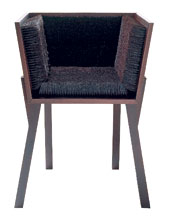
| The black chair displayed at Birla Academy of Art & Culture |
An exhibit that stands out at the exhibition, Somewhat Different, focusing on contemporary design in Europe at the Birla Academy of Art & Culture is a grim black chair bristling with horse hair that Dali would have loved. It could be an instrument of torture, an erotic machine, or it could even have been designed to make the person sitting on it feel ticklish. The man out of whose brain it has emerged is Oliver Vogt, a professor of product design at Kunsthochschule Kassel in the University of Kassel, Germany.
He is here in connection with his research on “small-scale architecture” — anything from tents to shelters — and he is fascinated by Calcutta’s shanties, where private life spills out on the street. His interest in micro-architecture has taken him to the Sunderbans to have a look at Aila-hit villages for a future project.
Vogt’s teacher was Hans (Nick) Roericht, who was involved in designing the Munich Olympics, whose work Vogt describes as a “follow-up of Bauhaus”. His own designs are marked by such remarkable precision of thought and execution that one may be tempted to underestimate the lateral thinking and play of imagination that went into devising them.
The chair, for example, was a project he did with the state-funded blind people’s institute, whose earlier products — brushes of every conceivable kind, brooms and wickerware — were not only outdated but whose presentation was also quite poor. When Vogt volunteered to revamp its look in 1998, the institute was not earning any money. After a year of research, 40 designers from all over Europe were working with him, and when the new range of products was exhibited at the big consumers fair in Frankfurt, it was snapped up by Murray Moss, who is said to have reintroduced high-end design to New York, and Japanese dealers, both of whom were not aware of the background of the products.
Eyes twinkling, Vogt says of his exhibit: “There is a play with words. There is always ‘hair’ in ‘chair’. The chair was sold mostly in France. Design doesn’t have to cry. My approach was humorous. The blind people liked it very much for they didn’t have to depend on charity any longer.”
When he started working on his own in the early 1990s, he began to redesign brands and helped out with the creative part of a business — everything from the way the company does marketing, and how it communicates through advertising. “Each product is like the business card of a company and redesigning could involve consultations with the CEO.”
Vogt has designed furniture, including castors with brakes that are costly by any standard, porcelain that tries to break out of the mould imposed by convention and habit, and hardy borosilicate glass.