Samserganj in Murshidabad has 49,000 Hindu voters in a constituency with an electorate of a little over 1.6 lakh. But the front-runner to win the April 23 elections is an 83-year-old BJP candidate who, until a year ago, had no realistic path to victory. To understand how that happened, you need two numbers and one riot.
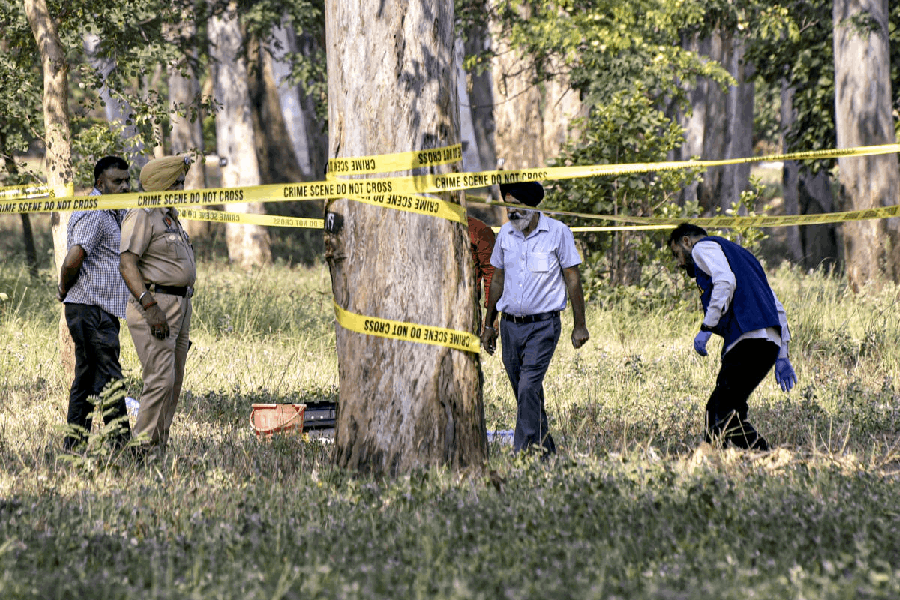
The riot came first. In April last year, Haragobinda Das and his son Chandan Das were dragged from their courtyard in Jafrabad village and hacked to death. Dozens of houses were torched. Hundreds of villagers — mostly women — fled to Parlalpur High School in Malda. The violence drew chief minister Mamata Banerjee to the village; she ordered a police camp set up and sanctioned ₹1.20 lakh each for around 100 families whose homes were looted or gutted.
The makeshift camp remains. The faith does not.
“The burn marks are still there,” said Mamata Ghosh, a 35-year-old homemaker from Betbona and one of over 100 women who had fled to Malda. “I have received money to rebuild my house, but we have no faith in the state government. Without the BSF, we would fear another attack.” She returned home only after the deployment of the Border Security Force (BSF) was assured. The nightmare of last year, she said, has not left her.
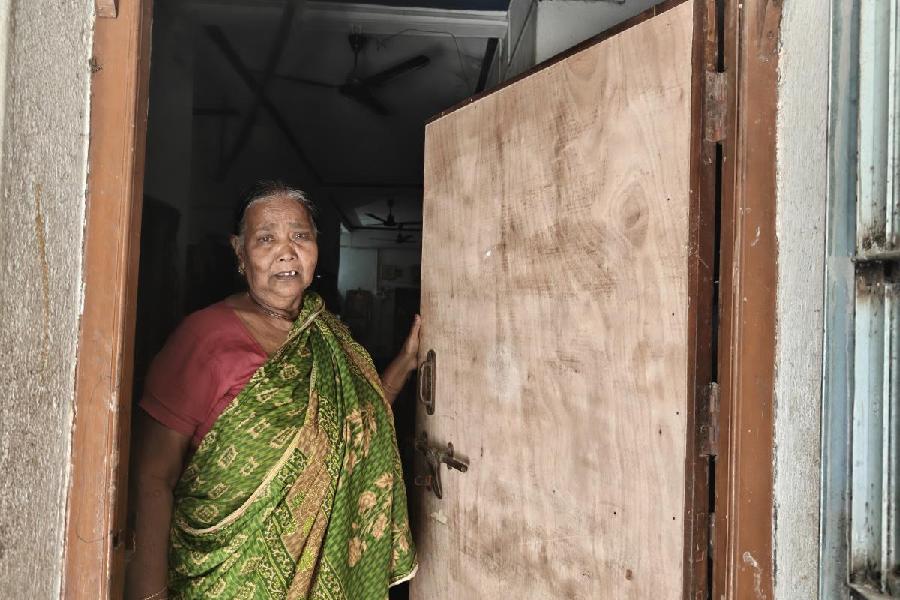
Parul Das, widow of Haragobinda, spoke from the same doorway that was broken open before her husband and son were killed. Four BSF jawans now stand guard outside around the clock. She did not hesitate when asked how she would vote.
“Suvendu Adhikari stood by us. We have no option but to take shelter with the BJP to save our lives and livelihood,” she said.
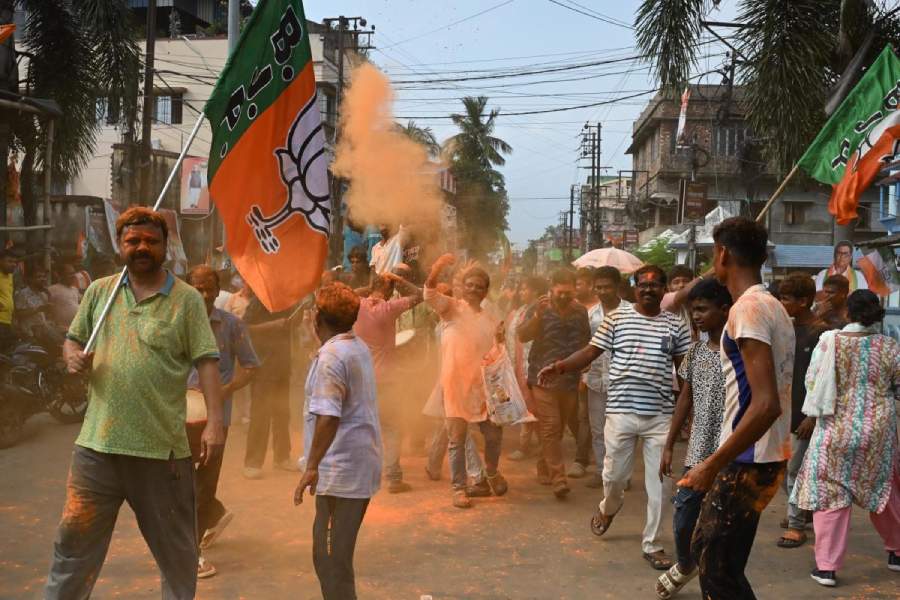
This is the texture of Hindu consolidation in Samserganj, 265km from Calcutta. BJP leaders estimate that at least 98 per cent of the constituency’s 49,000 Hindu voters are now behind the party — a near-total consolidation that, by their own admission, would have been unthinkable before the riot.
Most Hindus this correspondent spoke to were openly and visibly aligned with the BJP.
Multiple sources describe Samserganj as a constituency that has become a model for understanding how even a “miracle” could happen for the BJP if two key factors — Hindu consolidation and vote deletions — work in tandem, particularly where a split in Muslim votes remains possible.
Sasti Charan Ghosh, the party’s 83-year-old candidate and its oldest in this election, is matter-of-fact about his chances.
“After calculating the SIR deletions and post-riot Hindu consolidation, there is enough logic for me to win,” he said, declining to elaborate on the arithmetic.
The arithmetic, however, is not difficult to read.
Before the special intensive revision of electoral rolls, Samserganj had 2,52,881 voters — roughly 20 per cent Hindu, 80 per cent Muslim. The SIR process has since removed 91,616 names: 16,841 in the first round as ASDD (absentee, shifted, duplicate and dead) voters, and a further 74,775 during adjudication. The constituency now has 1,61,265 eligible voters — 49,000 Hindu and 1,12,265 Muslim. The Hindu share has risen from 20 per cent to 30 per cent.
Sabar Institute, which has tracked SIR deletion data since the process began, has been closely studying Samserganj as a case study in how deletions reshape electoral equations.
Researcher Sabir Ahamed is careful to separate the electoral outcome from the democratic cost. “Such deletions have occurred in many constituencies where community vote share may now shift. Whatever the result, going to the polls with a large number of voters removed — many for minor reasons during adjudication — is deeply unfortunate,” said Ahmed.
The second variable in the BJP’s equation is Opposition fragmentation. In the 2024 Lok Sabha polls, the Congress and the Trinamool Congress together commanded over 80 per cent of the vote in Samserganj — 43.76 per cent and 36.53 per cent respectively — while the BJP scraped 15.09 per cent. Congress candidate Isha Khan Choudhury built a lead of 13,814 votes from this segment alone under the Maldaha Dakshin seat.
This time, the Congress and the Left are contesting separately. The Left-backed ISF candidate’s nomination was cancelled on technical grounds; the Left has since quietly decided to back Congress candidate Mohammed Najme Alam. But alongside Trinamool and the Congress, six Muslim Independents have also entered the race — meaning eight candidates in total are now competing for 70 per cent of the vote.
“In 2024, most Hindu voters backed either the Congress or the TMC. That will not happen now,” said a BJP leader. “A split in Muslim votes, combined with near-total Hindu consolidation, gives us a real chance — even with only 30 per cent of the electorate.”
A senior BJP leader acknowledged the challenge. The Congress held this ground firmly as recently as last year, and the party’s organisational presence in Samserganj is not negligible. Consolidation, he said, may be necessary but is not sufficient.
Trinamool is dismissive of the BJP’s calculations. “Let them dream,” said Trinamool candidate Mohammed Noor Alam. “Muslims here have understood they were targeted by the deletions. They will not split their votes the way they did in 2024. This seat is ours.”
Whether the Muslim vote holds or fractures will decide Samserganj on April 23. But the constituency has already illustrated something larger: how a riot, a revision process, and a fragmented Opposition can together transform a seat that was once unthinkable for the BJP into one it can — and does — dream of winning.