 |
Milan Mela, touted as Calcutta’s answer to Delhi’s Pragati Maidan, is a brick-and-mortar mess barely one-and-a-half months before Buddhadeb Bhattacharjee’s beloved book fair gets underway on the Bypass fairground.
In another two-and-a-half weeks, the city’s permanent fairground will get a logo selected from a shortlist of 64 top entries sent by designers from across the country. Posters and flex billboards screaming “Calcutta’s international meeting place” and “seven lakh square feet to showcase whatever you want” are already all over the place. What isn’t anywhere near ready is the basic infrastructure required to host an event of the scale of the Calcutta Book Fair.
A recce by Metro on the sidelines of Thursday’s logo-shortlisting process and a cardiologists’ conference revealed glaring gaps in infrastructure that would probably need a Commonwealth Games-like troubleshooting effort to spare the city the blushes.
Nandini Chakravorty, the CEO of the West Bengal Trade Promotion Organisation, claimed the Milan Mela complex “will be ready within a fortnight”. But officials overseeing work didn’t sound half as optimistic.
“As you can see, there is still a lot to be done. This year’s book fair is set to be the biggest (entry will be free) and we are racing against time to get at least the basic infrastructure up and running,” said an official of the WBTPO.
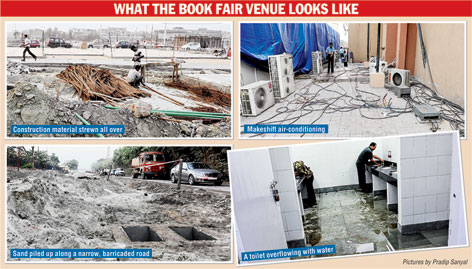
In stark contrast to the hangars hosting the cardiologists’ conference, the construction activity across the 18.4-acre fairground presented a picture of chaos. A large stretch of land was being readied to lay a road. Dust hung heavy in the air as workers carrying sand in small baskets scurried towards the concrete mixers dotting the site. Iron rods and cables lay scattered all over.
A worker standing near the main gate pointed to a dusty road when someone asked the way to Phase I, resembling an oasis with its paved pathway and landscaped lawns decorated with fountains. The sight may have made the chief minister happy as he walked in to inaugurate the 62nd annual conference of the Cardiological Society of India in the afternoon, but he didn’t quite get to hear what he would have wanted to.
Amal Kumar Banerjee, the president of the cardiological society, couldn’t hide his disappointment at the lack of “modern facilities” and told Bhattacharjee so. “Calcutta needs a convention centre with all modern facilities. It is very difficult to organise seminars and conventions. This is a demand on behalf of the medical community,” he said.
The chief minister replied that the government had “initiated” a project in Rajarhat but a court order had stalled work.
But what’s stopping the government from completing the Milan Mela project nearly three years after work started?
According to officials, poor planning and lack of co-ordination between various wings of the government was the reason why work had progressed little.
The floor of the only men’s toilet that Milan Mela now has was overflowing with water on Thursday. The fire-safety boxes meant to hold extinguishers had water bottles placed inside. Electric cables lay dangerously exposed outside the makeshift tents. The open-air theatre had lungis hanging from a clothesline.
Inside one of the hangars, hired air-conditioners were mounted on high iron tables with naked wires jutting out at some places.
In a corner of hall number 2, iron rods jutted out of a gaping hole on the floor
“Of what use is such a huge place without basic facilities like clean toilets, drinking water, a well-equipped convention centre and proper parking lots?” questioned a delegate.
The WBTPO has spent Rs 45 crore on Phase I and set aside another Rs 9 crore for Phase II of the Milan Mela project.
“Phase II will have a lot of open spaces with water bodies interspersed with the paved layout. There will be nine food kiosks and other public utilities. We want to utilise the whole space so that the revenue earned from it is ploughed back into Milan Mela. We are already booked till 2013,” declared CEO Chakravorty.
Market research veteran Shiloo Chattopadhyay, one of those invited to draw up a shortlist of entries for the logo competition, said Milan Mela’s success would depend on the quality of infrastructure rather than anything else. “If infrastructure is not in place, then nothing will work. What we have tried doing by inviting applications for this logo from all over the world is take a step into a new world where Bengal will be viewed differently,” Chattopadhyay said.
The 2009 book fair was marked by lighting glitches with several stalls being plunged into darkness during the first few days of the event.