Beyond our first and second homes in our homeland lies a liminal space that comforts us, confronts us, shapes us, and becomes a home beyond home. St+art Kolkata x TRI Art & Culture explores and presents this space in their ongoing exhibition — ADDA: The Third Space, on till January 4. Inspired by the ‘adda culture’ that is gradually fading from the streets and corners of Calcutta, the multidisciplinary exhibition awakens the six senses with its visual, aural and olfactory prompts. Emerging and mid-career artists, including some national and internationally renowned names, are reminding citizens of that liminal space that holds the spirit of the land. Interestingly, the Ballygunge art gallery, which turns two this month, literally explored the ‘third space’ of its premises and have taken the exhibits beyond the designated gallery rooms.
It all starts with the façade of the young gallery that comes to life with KHATRA’s ‘A Threshold Opening’. It becomes a typographic doorway attracting participants and non-participants with its eclectic colours and a fun Bengali saying — ‘joto kotha toto moja — egging everyone to participate unconsciously.
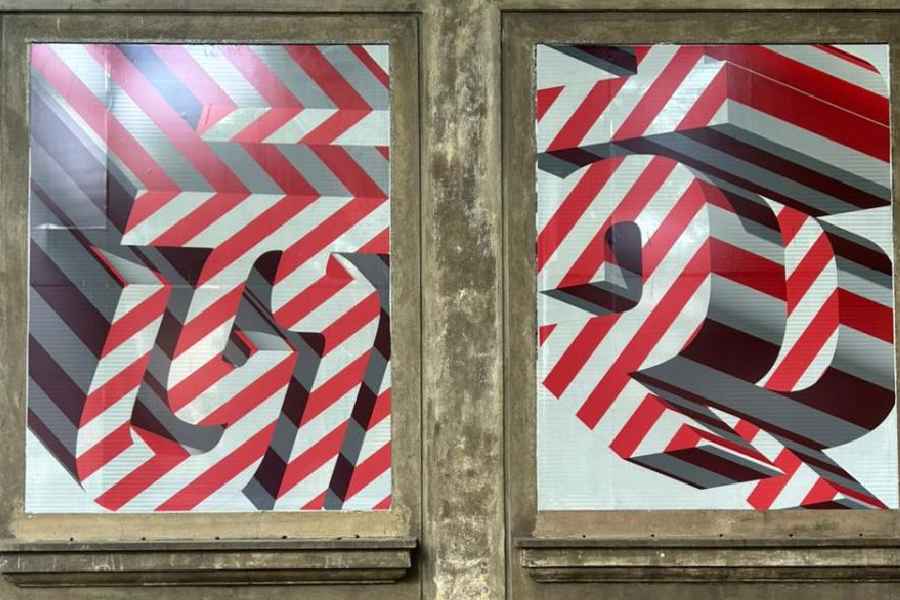
Khatra’s ‘A Threshold Opening’
The public art that remains active 24x7 wakes up further at night as the lenticular prints interact with the city’s light. The stairwell, which usually hears the mundane footsteps rushing up and down, witnessed long pauses. ‘For A Masquerade of Mirage’ by Nabi commands to stop and admire the large mask hanging from the ceiling, drenched in colours and folk traditions. Delhi-based Nabi’s practice draws from mythologies and popular iconography and is known for his bold artistry.
The walls of the staircase too have turned into a canvas for Akash Raj Halankar, the Goa-based artist whose practice blurs the line between structure and sensibility. His ‘Shifting Perspectives on Sight through Coloured Pyramids’ is a visual treat as it plays with the spectrum of colours, taking cue from Asian Paints’ Chromacosm, a repository of over 5,000 shades.
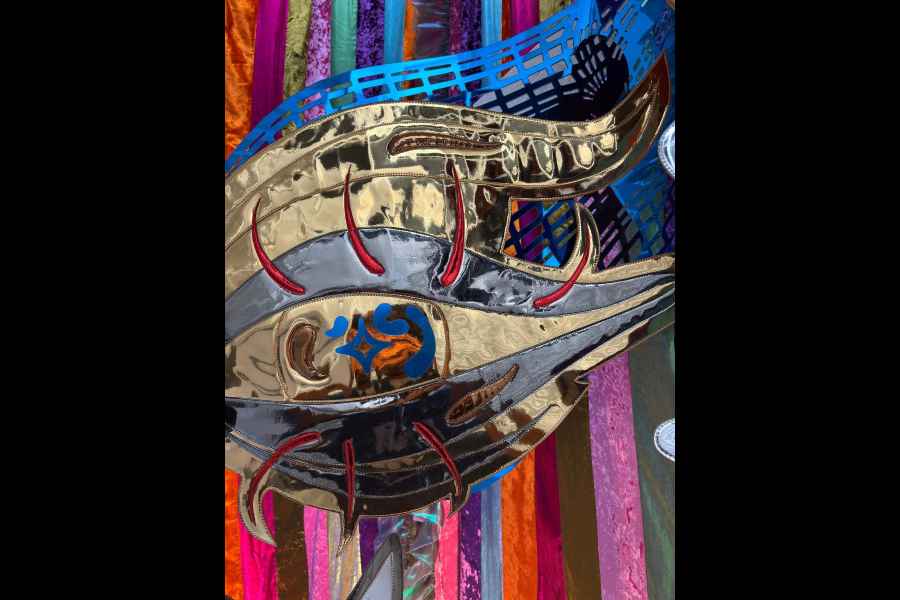
Bani’s ‘For a Masquerade’
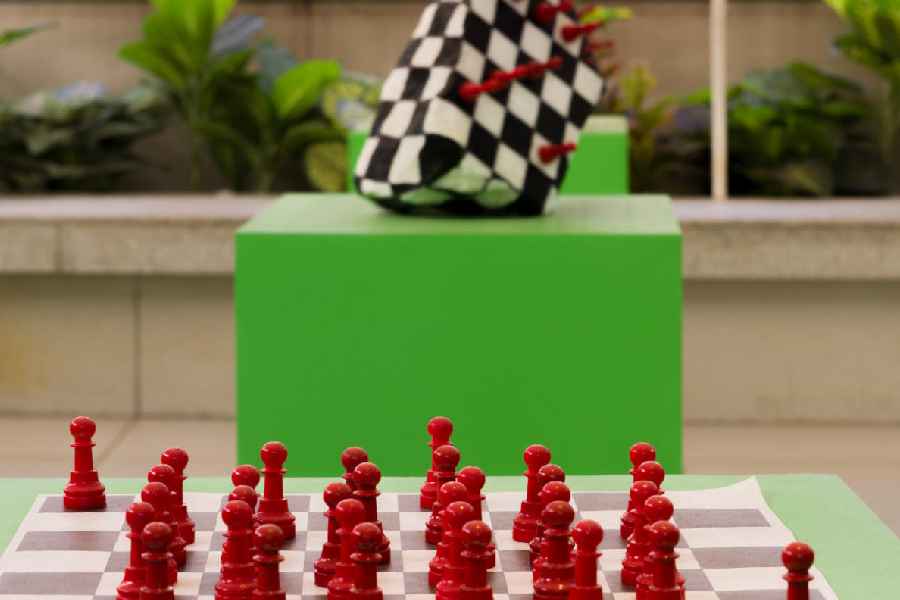
The gallery’s terrace, a space full of possibilities and dreams, is reimagined by Sethu(ram)an and Padmanabhan J aka Beatnyk who bring the familiar boardgame in black and white to TRAI with ‘To Pawn A Listening For Porous Futures’. It reimagines the game, and hierarchies dissolve in the unique chess boards as competition is replaced by collective play, as music and audio notes form a new thought process.
ADDA: The Third Space also spills to the outdoor space, where Anikesa Dhing’s ‘Towards An Archive of Taste’ teases the senses with its pop colour and high dose of nostalgia. Think candies, bubble gum, street snacks and kitsch objects as time capsules.
The main gallery space on the ground floor features ‘Into The Shared Bed’ by How Are You Feeling Studio by Doyel Joshi and Neil Ghose Balser that takes one to the most comfortable and intimate space in the house — the bed. A large bed with a floral bed sheet surrounded by a rich shade of scarlet invites to sit, lie down, converse or drift into a deep thought.
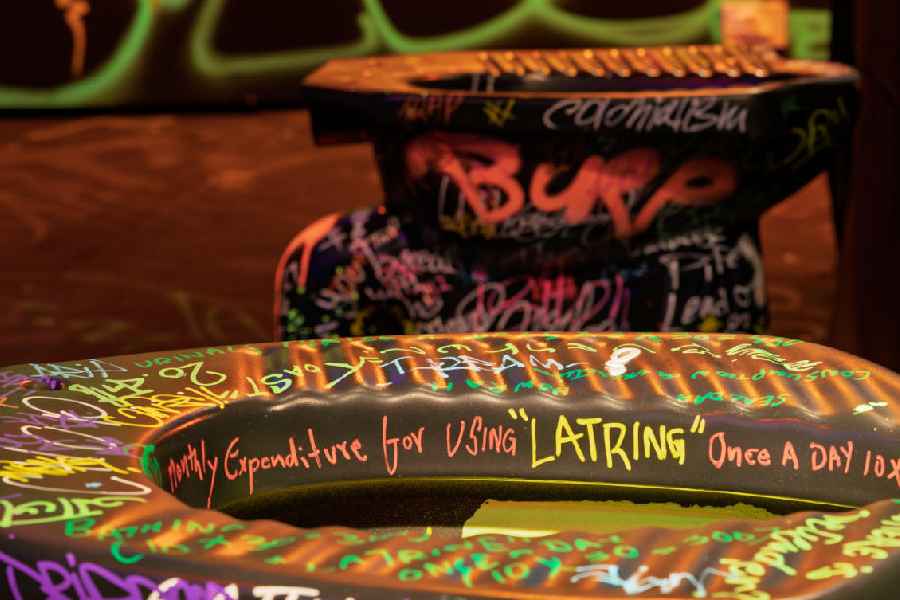
‘Exposing Scratches and Smells in Every Corner’ by Deep Adhikary and Ishita Dey
The final room that takes over all the senses and welcomes everyone not as a viewer but as a participant is ‘Exposing Scratches and Smells in Every Corner’ by Zero India, Deep Adhikary and Ishita Dey. The hybrid space is where the boundaries of kitchen and toilet blur. The graffiti-heavy room heightens the olfactory and visual senses and together with them the memory is engaged in topics of gender roles in society, labour, care and survival.
Farah Khatoon
Pictures courtesy: TRAI