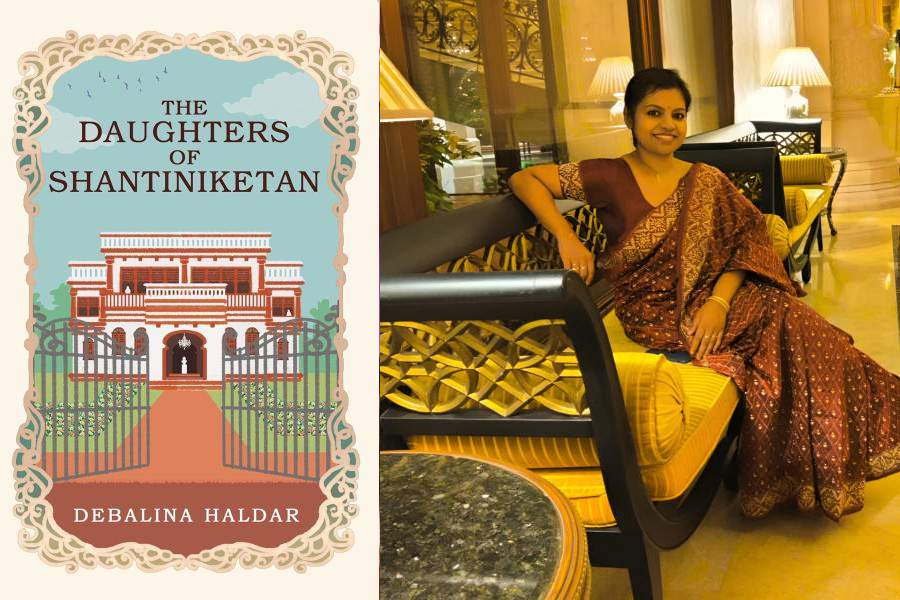
What happens when love, artistic freedom and generational change collide with tradition in a household built on cultural reverence? That is the question at the centre of Debalina Haldar’s book The Daughters of Shantiniketan, which explores how devotion to the legacy of Rabindranath Tagore can be both a source of inspiration and a force of confinement.
The story unfolds inside the imposing mansion of a powerful aristocratic Bengali family that prides itself on being the guardian of Tagore’s cultural legacy. In their home — inevitably itself called Shantiniketan — reverence for the poet borders on doctrine. The patriarchs dictate the rules, the family’s reputation must remain spotless, and the women learn early that obedience is expected.
This calm facade begins to crack when the family’s dutiful granddaughter falls in love with a bohemian singer who dares to reinterpret Tagore’s songs for a modern audience. His presence unsettles the carefully maintained order of the household, igniting debates about artistic freedom, authenticity and the right to reinterpret tradition.
Haldar explains that the roots of the story are based on her own life. “My grandmother, Charu, and my paternal aunt, Binu, were two women whose lives and loves left an indelible mark on my own,” she tells us. “They were the ones who first made me see Tagore not as a distant, revered figure of Bengal’s past, but as someone whose words have meaning in my daily life, in the most mundane activities… someone who is close.”
Those early experiences inspired the novel’s central theme. “I wrote this novel with the theme of tradition and freedom in mind,” Haldar adds. “And when I looked at the tender overlap of the two, I could not think of anyone but Tagore.”
The tensions that shape the family in the novel echo the author’s memories of growing up in Calcutta in the 1990s and early 2000s. During that time, Bengali music was witnessing the rise of jibonmukhi gaan, or life-oriented music, a genre that emphasised everyday experiences and social commentary.
“We were beginning to witness a slow change in the kind of music that was being made,” Haldar recalls. “It was new and free-spirited," she says, adding that the cultural movement sparked debates even within her own household. “I still remember we had an essay topic in school — ‘If we are now listening to 'life-ward' music, were we listening to 'death-ward' music for so long?’ In my impressionable young mind, this conflict settled deeply, and I used to have long discussions with my family on this subject.”
Those arguments eventually informed the fictional Roy family, where members hold sharply opposing views about preserving Tagore’s musical tradition. Haldar says that the book's family structure allowed her to explore multiple perspectives within the same cultural framework.
“A family narrative is an effective literary tool,” she explains. “The Roy family provided a common aristocratic, Tagore-worshipping upbringing with deep-set traditional notions. From that common ground, I could generate multiple points of view that could reveal individual honesty and virtue.”
Although the novel is rooted in Bengali cultural debates — particularly the anxiety among purists over the “correct” rendition of Tagore’s music — Haldar believes the conflict it depicts is universal. “There exists an undeniable anxiety in the Bengali intelligentsia over the ‘purity’ of Rabindrasangeet,” she says thoughtfully. “But today this tradition-freedom conflict exists in the mindset of people across communities and generations.”
In the novel, the character Bolai, the love interest of the protagonist, embodies the clash between preservation and reinvention. A carefree musician who modernises Tagore’s songs, he becomes both a catalyst for change and a source of controversy within the Roy household.
“Bolai represents freedom,” Haldar explains. “He believes in artistic independence and regards that as his tribute to music and Tagore. He is like a fresh whiff of air in the heated and conceited environment of Shantiniketan.”
While writing the book, Haldar immersed herself in the lives of women connected to Tagore’s own family. Works such as Daughters of Jorasanko and studies of Kadambari Devi revealed to her stories of rebellion within the poet’s own household.
“I found women and their silent rebellions in those books,” she says. “Women from Tagore’s own family — how brave they were to stand against the looming patriarchy in every brick of the house and yet create a place of their own. That moved me deeply.”
Through this layered portrait of a family — and the women within it — The Daughters of Shantiniketan becomes a story about inheritance in its many forms: cultural, emotional and artistic. In Haldar’s telling, the question is not whether tradition should endure, but how it must evolve if it is to remain alive for the generations that follow, which is equally important.
Subhalakshmi Dey