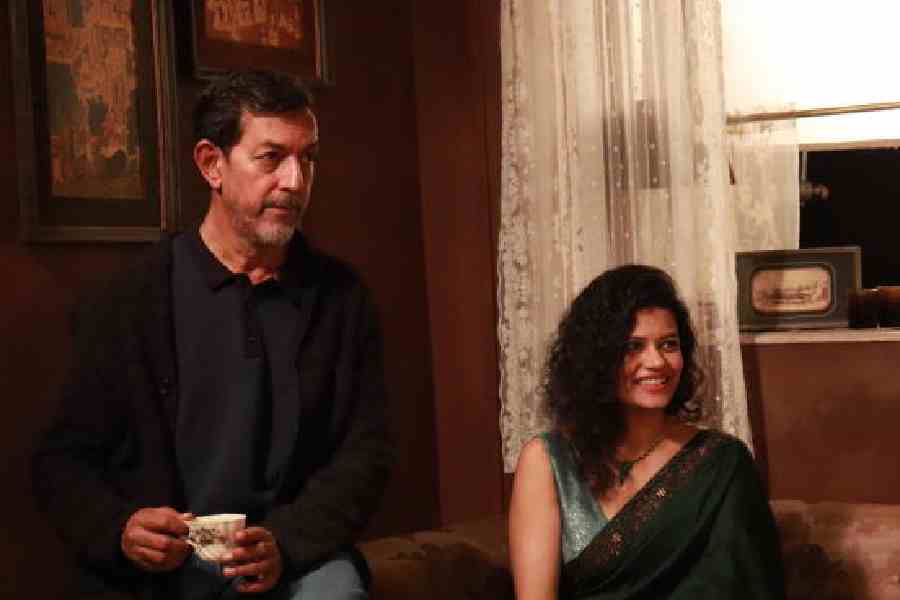
Rajat Kapoor is out with his ninth directorial venture, Everybody Loves Sohrab Handa, where he has got together an ensemble cast featuring Vinay Pathak, Ranvir Shorey, Saurabh Shukla and Koel Purie, among others. The writer-actor-director speaks about the murder mystery, streaming on Zee5, and his tryst with Shakespeare on stage.
The title Everybody Loves Sohrab Handa creates the image of a person who’s popular but he’s the one getting murdered! What’s the storyline of the film?
There are 15 friends and relatives who come for a party, and that night one of them is murdered. Of course, the suspects are these people who were there. It’s more about relationships and those dynamics than about the murder.
The trailer produced a sense of claustrophobia — the noises were too loud, the walls pressing in…
Well, we did try to create a sense of chaos — very ordered chaos — to make it really feel like a party, and to have the audience become a part of that party. That’s why there were overlapping dialogues and visuals.
In an interview, you had said that in Ankhon Dekhi, another film you had directed, the walls change colours with the seasons. How mindful were you here of the atmosphere?
Atmosphere is very much a part of the film and the emotion that you’re trying to create. It comes out through the setting, the colours, the costumes, textures and lighting. All that helps to create feelings. So, production, production design, camera, and then sound — they all work towards the same result — to get the right emotions.
You have got a splendid cast. Is it due to a comfort level that you go back to the same set of actors, or are they so good that you have to have them on board?
You can’t cast somebody just for comfort level. That will be really stupid, because that will be dishonest to the film that I’m making, and I have at least 50 very dear actors friends in Mumbai. But you don’t see everybody in my films. These people that you see in my films are there because they are, first of all, phenomenal actors, and second, they fit the role. Not because they’re my friends. Of course, everybody I work with becomes a friend. Like Koel Purie was not a friend before Mixed Doubles, but now she is. I have worked with Sadiya Siddiqui, Palomi (Ghosh). Neil Bhoopalam and Saurabh Shukla before. So, yeah, they’re all friends in that sense. I’m very grateful that they want to work with me.
Tell us about the main characters.
There are 18 actors in this film. The central character is Sohrab Handa, who’s very dynamic. You don’t see such forceful characters often. Raman and Jayanti are the hosts of the party, whose wedding anniversary it is. They are wonderfully shaded. I’ll be lying to say that this character is better than the others. Each one of them is very well shaded, and they all have their worlds.
What made you write Everybody Loves Sohrab Handa?
The idea was to do a murder mystery. The excitement was to see if I can crack the genre. Then as one develops it, one tries to find something new within the tropes of the genre.
You had debuted as a director with a crime thriller as well, with Private Detective: Two Plus Two Plus One, a 1997 feature film.
It was very different to this. This is a murder mystery, a whodunit. That was about a murder but was not a whodunnit.
This is your ninth film. How difficult is it to get a film on the floor?
It’s very hard these days because people’s habits have changed. For independent cinema, for our kind of films, it’s become more difficult now, but I’m hopeful, and I think things will change again after a couple of years. The fact that I’ve been able to make nine films, however long it took me, however hard it was, exactly as I wanted, makes me very grateful. My journey over the last 25 years has been phenomenal. I have nothing to complain about.
You had found a financier over Twitter for Ankhon Dekhi; RK/RKay was crowd-funded. What about this one?
This one was produced by Applause Entertainment.
You feature both as an actor and director in the film, as in most of your directorial ventures. How does your experience in front of the camera influence the way you direct actors?
I think it must have, when I started acting. I have learnt a couple of things about actors. I learnt that actors can be vulnerable, so I treat them with more love now than I did earlier.
Do you find it difficult to act in your own projects?
No, for me, it’s not challenging. You just have to do that job in front of the camera and then come back and take charge.
Films like Ankhon Dekhi and Mithya have very distinct tonal identities. How do you decide the visual and narrative grammar for each project?
Every film has its own universe, and you want every film that you do to be different from everything else that you’ve done, right? Mixed Doubles. RK/Rkay, Ankhon Dekhi, Mithya, Kadakh — every film has its own world that it lives in. The process is quite organic. You have a script, you have an idea, and then when you’re going into production, all of us — the production designer, the cameraman, the costume designers — sit for two-three months, and we go over the film every day till we start imagining what we want to do. So it’s really a collaboration. Slowly we arrive at that universe, and then we start working towards it. It’s not arbitrarily decided. After a couple of months, you start coming to a kind of a conclusion. Till then, you just talk and try things. Everybody presents their ideas and views. Slowly, as a team, you arrive at something.
It’s interesting that you say so, because your films feel organic and unscripted at times. How much room do you leave for improvisation?
Lots, lots, lots. There’s not so much in terms of dialogues, but lots in terms of blocking and movement. The dialogues remain untouched but there’s always a scope of improvisation there also. But I would say 96-97 per cent is written. Two to three per cent is improvised.
If one goes strictly by box-office success, Rajat Kapoor would be known for films like Bheja Fry and Drishyam. But if you had to choose three projects which gave you the most satisfaction as an actor, which would you name?
As an actor, I’d say there’s a film called Mantra, which not many people have seen, I like that. I enjoyed my work in Khauf very much and in Lootere (web series). Bheja Fry too was fun in every way.
Music has never been important to you in the process of storytelling, right?
Not in my films, but in the films of the 50s, I think they were very important. And I love those films, whether they’re of Raj Kapoor, Vijay Anand or Guru Dutt. They have amazing songs. And those films, which used the songs, did so as part of the narrative. That was amazing.
When do we see you next in Calcutta?
September, I think. We are coming back with Macbeth (What’s Done is Done, a clown-led adaptation of Macbeth).
The play is part of the series that you have been working on of seeing Shakespeare’s world through the point of view of clowns. What got you started along that path?
Well, a series was not the initial idea. I had done a play called C for Clown in 1999. That was my first project with clowns. Then I got excited about the idea of clowns doing a classical text. That’s how we tried to handle it. That became interesting. And I thought what if we have just one clown? That became Nothing Like Lear. And then, I thought, what if we have a series on Shakespeare — all done by clowns. How will that be? And then that’s how the plays came along.
Shakespeare often introduces a figure like the Fool in King Lear, who might be the jester but is actually the sagest voice. Did that make you think of exploring the clown’s viewpoint?
There is a fool in Lear and there’s a fool in As You Like It, which also we used. Shakespeare was also well aware of the possibilities of a fool.
What comes next from you?
There’s a film that we’re hoping to make this year, and there is a new play coming up this year.
I will talk about them when the time comes.