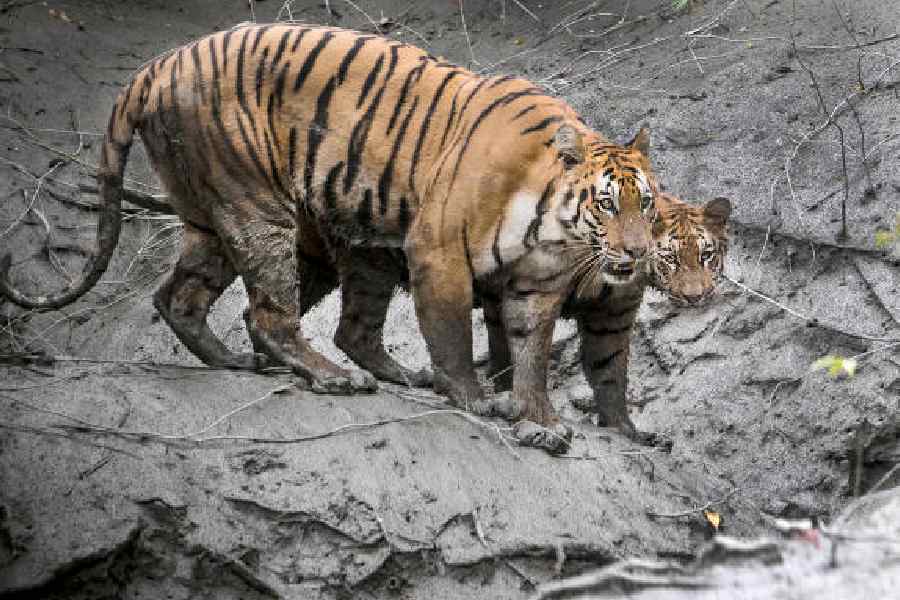
The Sunderban National Park is situated on the southernmost part of the Gangetic delta, the world’s largest prograding delta. Experts say that this entire zone is covered by as many as four layers of sediments transported and deposited by the rivers Ganges, Bidyadhari and Matla that flow through the region of over 6,000 years of stable geotectonic phase. And this supports a mammoth mangrove forest spread over India and Bangladesh, of which the Indian part covers about 4,200sq km bounded on the east and west by the River Hariabhanga and the River Muriganga, respectively.
For its deltaic situation and its typical characteristics, Sunderban Tiger Reserve is distinguished as one of a kind among India’s tiger reserves. This bio-diversity hotspot is also safe haven for 260 kinds of birds, 58 kinds of mammals, 56 different reptiles, and 65 kinds of crabs, among others. Plus, 52 types of birds migrate from different parts of the world to the Sundarbans in winter. But more than anything else, the Sundarbans stands out from all other mangrove forests because of presence of the Royal Bengal Tiger.
And that is what we were in search of on the second day of our trip there. Along with my fellow photographers, we were aboard Shardul, the motorboat assigned to us for our day-long safari by Nityananda Chowkidar, our reliable guide to our trip of the Sunderbans. The sky was intimidatingly overcast with slate-dark clouds when we began our journey from Bali island. We were utterly apprehensive about the looming threat of a heavy thunderstorm on our way, which might upset our day’s safari. After half an hour’s journey, reaching the vast sweep of Panchamukhi, we found our trepidation turning into reality. The sky virtually cracked open.
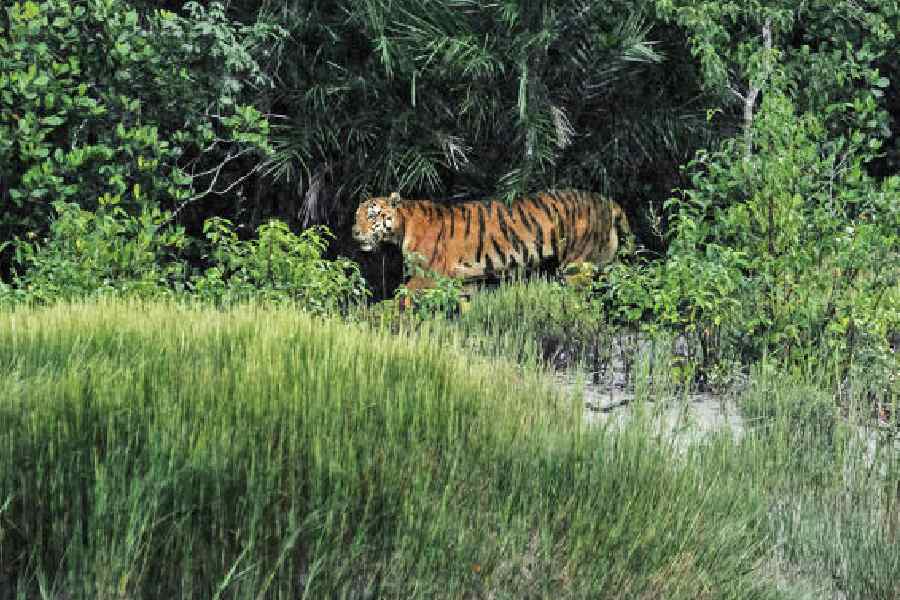
Boroma takes shelter in from the rain
The low rumble of thunder in no time turned into a torrential downpour. Lightning seared the horizon. Raindrops struck the tin roof of the vessel like volleys of pebbles, and visibility all around shrank almost to nothing. The huge otherwise placid expanse of Panchamukhi turned extremely restless and terribly wild, gusts of water-soaked winds lashed the boat and left all of us completely drenched in no time. Large waves incessantly rocked the boat from side to side. It was perfectly atmospheric and just right for a sighting of the Royal Bengal Tiger.
In a while, the rain let up and things started clearing up in the vast expanse of Panchamukhi. As our boat took a left turn to enter a broad canal, the fragrance of rain-soaked earth hit us. Now, the sun was beginning to peep through the clouds and the thick rain-washed mangroves on either side of the canal wore a breathtaking emerald green with the water on the leaves adding a bit of sparkle.
Nityananda said that he has often seen a heavy downpour precede a tiger sighting in the Sunderbans. That made us very upbeat that the trip would probably go well. Gliding slowly along the placid water of the canal, our vessel took a half-parabolic turn following its course. And right at that moment someone sitting on the right flank of the boat yelled: “Tiger, tiger.” To our utter bewilderment we saw right at the edge of the mangrove thickets a tigress sitting with her cubs in an absolute regal mood. It was like a dream come true and it stood still for us for the next few seconds, just like a movie freeze-frame!
As soon as we could get over our initial dumbstruck state, we yanked out our cameras and the our shutters burst into a frenetic staccato. By then, the tigress sensing our presence or hearing our unintended loud whispers, instantly stood up on its feet and came out in open along with its two wide-eyed cubs right on top of alluvial muddy mounds laid bare by the low-tide water and started strolling over it for a few seconds, and, in no time, entered the forest to vanish into its darkness, possibly to escape our prying presence.
We were completely awestruck by the sight of not just one, but three tigers at a time. We were more than happy to learn from Nityananda that the tigress we just happened to see was none other than the current great matriarch of the Sajnekhali Wildlife Sanctuary area, the ever graceful ‘Boroma’.
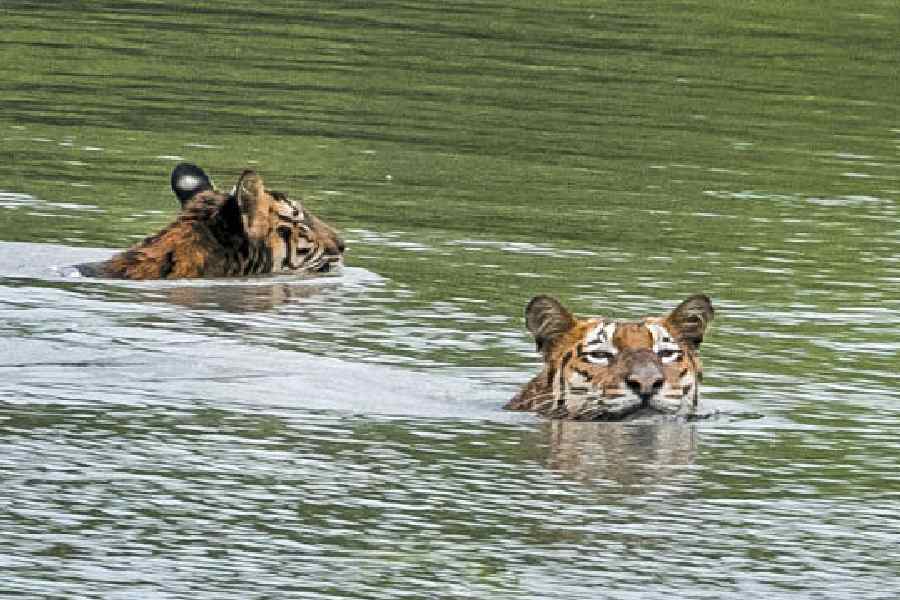
The vigilant mother
The Royal Bengal Tiger, an enigmatic apex predator, has always been at the centre of attention and discourse for conservation scientists and nature observers for the enormous adaptability it has shown over centuries to cope with the most challenging impediments this mangrove habitat poses for its sustenance, both ecologically and environmentally. An almost uninhabitable muddy water-logged ground condition heavily restricts not only the tiger’s free and smooth movement in the forest but also does not give it the scope of stalking and chasing prey.
The Sunderban archipelago and its brackish water, shifting tides causing inundation of entire forest land twice a day, makes the alluvial soil overlay the tangled roots of various mangrove plants, making it extremely soft and muddy to traverse on. These are some of many impediments the tiger encounters in course of its day-to-day existence here. The factors like low prey-base, fragmented character of the Sunderban landmass interspersed with countless creeks and canals full of saline water have contributed to a large extent in turning the tigers of the Sunderbans into adept swimmers.
That, in itself, is an excellent example of the tiger’s extreme power of adaptability to suit with the fragmented nature of the Sunderban islands. Looking at the enormity and degree of successful adaptation, the Sunderban tiger has gone through the ages to ultimately survive in a brutally unforgiving eco-system of the delta. This is in itself a testimony to its exceptional power of endurance and its exemplary ability to evolve to suit changing needs, say experts.
Being the repository of a unique eco-system in the world, the Sunderbans had the honour of being declared as a Natural World Heritage Site by the Unesco in 1987. The Sunderban Biosphere Reserve has also been included as the second of the three biosphere reserves of India by Unesco in 1989.
Meanwhile, unfortunately for Boroma and fortunately for us, her path was broken by as many as four creeks which the tigress and her cubs would unavoidably need to swim across to reach their ultimate destination of a much denser forest spread. So, we got the golden opportunity of photographing them in real-time swimming mode, a chance that very rarely comes to wildlife photographers, especially in the Sunderbans.
Anticipating where they were headed, Nityananda drew on his years of experience and allowed our boat to drift along in the same direction that Boroma was going and placed it just at the mouth of each of the creeks the tigress and her cubs would be swimming across. We were quite amazed at Nityananda’s acumen at predicting what Boroma and her cubs would do.
The narrow labyrinthine creeks and waterways of Sunderban unfold its mesmeric tapestry of aquamarine hues. Its post-low-tide sun-soaked mudflats are usually found to be swarming with foraging waders like whimbrels, Eurasian curlews, plovers of numerous types on the one hand and wriggling mud-skippers and crawling red fiddler-crabs on the other. Especially during the spring, its vast brackish blue-green water swarms with shaded mangrove leaves of different hues that create a pleasing treat for the eyes. The unvarying tidal activities involving the entire length and breadth of this forest round the year, is another typical feature of the Sunderban Biosphere Reserve.
This huge congregation of mangrove forming the entity called Sunderban National Park, with all its disparate amazing features, always had a bewitching effect on me. The magnetic pull of its splendour coupled with my strong craving for a gleam of its ever-elusive regal inhabitant, the Bengal tiger, compelled me to make as many as 13 dedicated trips to the Sunderbans over a span of 15 years. In this long span of time, the islands had most generously unveiled its rich reserve of staggering variety of birds, both denizens and migratory kinds, reptiles of different kinds including wonderful sights of its estuarine crocodiles, huge and small, basking on its mudflats like relics of ancient age, smooth-coated otters in a frolicking mood, the monitor lizards gravitating in their typical semi-erect sprawling gait, even sightings of another highly secretive member of the feline family — the jungle cat — in an absolutely nonchalant mood. But never ever had the forest endowed me with even a fleeting glimpse of its prime treasure that I had always looked for, although there were several incidents of narrowly-missed sights.
Not this time. Boroma, the charming matriarch, appeared first on the upper edge of the bank of the next creek, a picture of poised elegance and resilience. She started gently descending into the moss-green high-tide water of the forest creek followed by her two cuddly cubs. They swam across it holding out only upper part of their head along with their noses out of the water and in no time reached the other side of the creek, leaving behind ripples on the water. The impact of the unprecedented spectacle made me completely speechless since it was my maiden sighting of tiger in the Sunderbans. My mind was still swinging back and forth between thrill and disbelief, though my camera shutter kept on firing to capture their subsequent journey.
The speed and deftness of tigers’ swimming prowess really stunned me. Meanwhile, the tigress family swam fast and smooth to reach the other bank of the next creek. But Boroma kept her majestic gait on, without pausing even for a moment, towards the next creek. The same set of events followed for three more times in front of our eyes. We positioned our boat every time at the mouth of the remaining creeks.
The graceful mother cautiously led her drenched cubs to swim smoothly to reach the opposite side and on reaching their final destination, slowly ascended the slope of the muddy bank and turned back a little, probably to check whether her cubs too had reached safely after her. And, now, at the end of her arduous journey, she chose to give us a calm yet hard spine-chilling look for the first time and quickly melted into the deep darkness of mangrove growth followed by her cubs.
Thus ended the mesmeric drama we all had remained glued to. The fascinating array of scenes which we all witnessed would be etched in my memory for ever. It seemed that the extravaganza we just witnessed was not just a mere sighting of tiger but a gracious bounty of nature, when it laid bare to us its most precious secrets out of her sheer magnanimity.
There was exultation all around, more so because each of the photographers present in that boat knew for sure that the phenomenon they just witnessed was something which was rare and something that they might probably not come by again in their lifetime. it was an opportunity which every wildlife photographer dreams to have some time in their life.