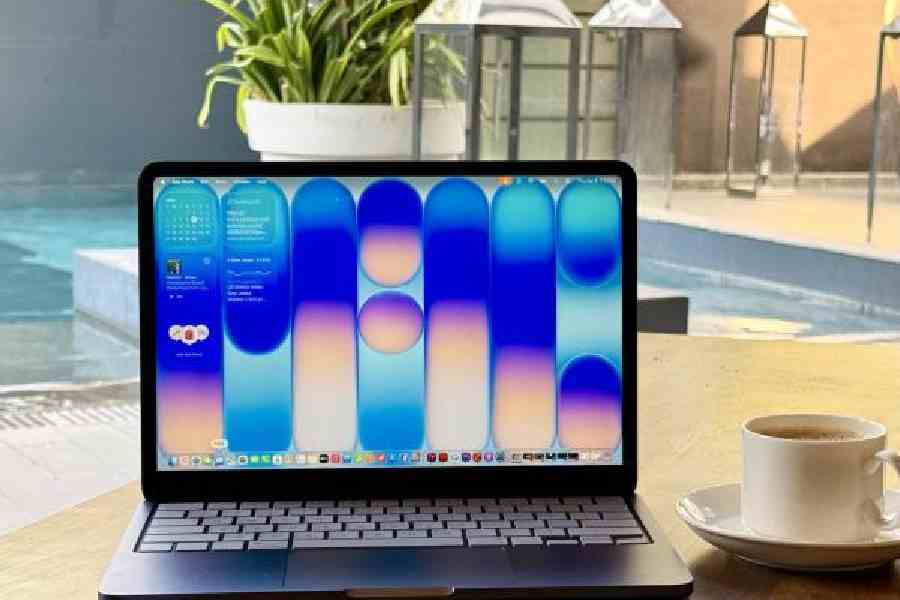
When Steve Jobs introduced the original Macintosh, he described it as a product not just for tech enthusiasts or those already comfortable with technology, but for the rest of us — people who want to use technology without having to learn it. And while that idea could technically apply to every Mac, the MacBook Neo perhaps exemplifies that philosophy most clearly. At the same time, it throws into sharp relief some of the long-standing issues with Microsoft Windows.
The original Macintosh was designed to be approachable, friendly and even a bit playful — the opposite of other computers, which had a reputation for being intimidating and complex. That is why it featured a built-in handle, despite being a desktop machine that was rarely moved. It served as an invitation to everyday users to engage with something they might otherwise have avoided. The MacBook Neo carries forward that same spirit.
MacBook Neo is, in many ways, the laptop the world needs right now. Across categories — from gaming handhelds to smartphones — prices continue to rise. Just when it began to feel as though technology was slipping out of reach, Apple surprised everyone by introducing a laptop that is relatively more affordable, particularly when student discounts are factored in.
Many people have used MacBooks for years, to the point where they have become a staple in both work and personal life. They are lightweight, free of bloatware, do not aggressively push artificial intelligence, and remain impressively efficient. The Neo is no exception.
It can take a workout
The MacBook Air and MacBook Pro have long catered to distinct audiences — the everyday office user and the professional content creator. Students, meanwhile, have largely leaned towards the MacBook Air, even when it felt like overkill for routine tasks such as browsing, running lightweight applications or paying monthly bills. Rather than simply trimming weight, Apple has struck a careful balance with the Neo, combining power, usability and build quality.
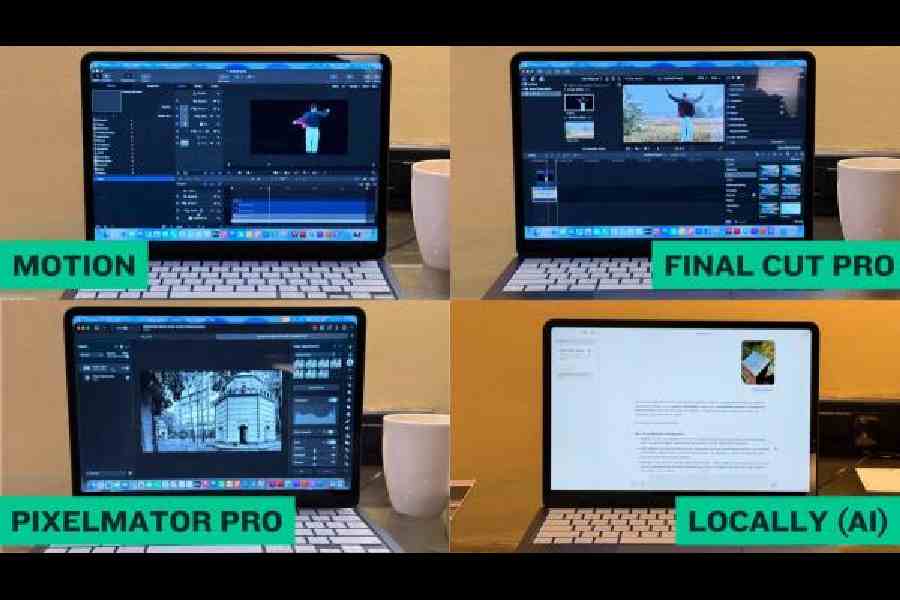
Working on MacBook Neo (clockwise from top left): Motion to edit out a character from a video, Final Cut Pro to place the edited character from the video on top of another video that was shot separately (followed by more editing), Locally can run AI models on device, and Pixelmator Pro, the photo, video and vector graphic editor. Picture: The Telegraph / Mathures Paul
Let’s address a few obvious questions. Is this a laptop we would recommend to friends and well-wishers? Absolutely. Will it hold up over the long term? Certainly. Will it slow down with time? Unlikely.
The review unit in question is the base model, with 256GB of storage and no Touch ID. That, in many ways, is the point — to reach a lower entry price (you can also buy the 512GB with Touch ID).
MacBook Neo arrives in packaging that is unmistakably Apple: clean, white and refreshingly simple. It even includes a USB-C cable and a power brick, which is a reassuring sight in an era where such essentials are sometimes omitted.
It is available in three colours — Citrus, Blush and Indigo — alongside silver. Apple has gone a step further by extending the colour to the keyboard and feet, lending the device far more personality than the usual black or white.
Pick it up, and it feels light yet solid. The all-metal construction seen on other MacBooks remains intact. Compared with many Windows laptops, the Neo feels especially sturdy, particularly at this price. The design is simple and functional: two USB-C ports and a 3.5mm headphone jack. The hinge is smooth enough to open with one hand, adding to the premium feel.
The footprint is slightly smaller than that of the 13-inch MacBook Air, making it more portable. It slips easily into smaller bags and is comfortable to use in tighter spaces.
What you get is a multi-touch trackpad. You still get precise clicks, right-click gestures and smooth scrolling. It uses a physical clicking mechanism rather than Force Touch, but adjusting takes only a few minutes.
The keyboard is equally impressive, closely mirroring the experience on the Air and Pro. It is not perfect — there is no backlighting — but that is a compromise many will accept at this price. Thanks to the aluminium chassis, there is no deck flex, and the keyboard feels solid and dependable.
Battery life is another highlight. On the Air or Pro, charging is something you rarely think about for a couple of days, and the same largely applies here. The Neo can comfortably last two full workdays on a single charge, even with steady use.
When the Neo was first announced, there was speculation that its interface might resemble iPadOS. It does not. It offers the full macOS experience, identical to that on any other MacBook.
Some critics argue that by competing with more affordable PCs, Apple is diluting its premium positioning. That is not accurate. Instead, Apple has elevated expectations at the entry level, forcing competitors to rethink what “affordable” should feel like.
Compromises do exist, of course. But compromise does not automatically mean poor quality. In the Neo’s case, most will go unnoticed by the majority of users — such as the absence of MagSafe charging or a backlit keyboard.
The 13-inch display is adequately sized and uses the sRGB colour profile. At least seven years of software updates is commonplace in the Apple world, which is excellent news for those seeking longevity.
The beauty of the MacBook Neo lies in its broad appeal. It is not just for students or educators... it is for anyone. Since Apple’s transition from Intel to its own silicon in 2020, Macs have become more powerful than ever. Yet much of that power remains underutilised by the average user.
If you are chasing features such as a 120Hz display, extreme brightness or Thunderbolt 4/5 ports, this is not your machine. But if you want a dependable device that handles everyday tasks without fuss, the Neo fits the bill... and will continue to do so for years.
According to a 2025 CNET survey, 52 per cent of laptop users primarily use their devices for creating and viewing documents. In the US, adults rely on smartphones for organisation (66 per cent), note-taking (48 per cent), gaming (47 per cent) and streaming (44 per cent). Laptops, meanwhile, remain essential for work and education — documents (52 per cent), creative tasks (33 per cent), test-taking (31 per cent) and studying (33 per cent), test-taking (31 per cent) and studying (33 per cent). These are all areas where the Neo performs comfortably, albeit with some limitations on the creative front.
Apple has equipped the Neo with the A18 Pro chip. Given that this chip was reserved for its highest-performing iPhones, the decision makes sense. In several areas — particularly single-core performance — it surpasses the M1, and it is significantly faster in AI-driven tasks such as background removal in Keynote or super-resolution in Pixelmator Pro.
It is also more efficient. Apple has managed to use a smaller battery than the 13-inch MacBook Air while still delivering up to 16 hours of video playback, not far behind the Air’s 18 hours. It generates less heat than M-series chips, allowing it to sustain performance for longer before throttling.
There is more. The chipset supports hardware-accelerated ray tracing — a rarity at this price point — and handles demanding video workflows surprisingly well.
For instance, using Apple’s Creator Studio apps, including Final Cut Pro and Motion, we tested a clip of Benicio del Toro dancing. Within minutes, we isolated the subject, composited it into footage of rural Bengal, and created a playful edit that worked brilliantly on Instagram, complete with a Hemant Kumar soundtrack. It is precisely the kind of creative flexibility that younger users will appreciate.
Yes, the device can become slightly warm when connected to external displays, but it maintains performance reliably over extended sessions.
For everyday users, the graphics performance is more than sufficient. As for storage, opting for 512GB is advisable, particularly if you plan to store media or project files.
There is also a longer-term perspective. For students buying this laptop today, it is powerful enough to last through university and beyond. By the time they graduate and enter the workforce, upgrading to a MacBook Air or Pro will feel like a natural progression — and, perhaps, a clever piece of customer retention by Apple.
What Apple has done here is somewhat unusual. Instead of chasing peak optimisation at any cost, it has focused on manufacturing efficiency, affordability and repairability. iFixit even noted that the Neo is among the most repairable MacBooks in over a decade.
The battery is screwed in rather than glued, ports are modular, and the display is easier to replace — all of which is encouraging for users who value longevity.
Ultimately, most people will not dwell on memory bandwidth, SSD speeds or colour profiles. They will notice the design, the feel and the seamless experience. For many, this will be their first MacBook, and it makes a compelling case.
Something is blocking those Windows
All of this naturally raises a question: what is happening with Windows laptops? Apple controls its entire pipeline — hardware and software — and that vertical integration remains its greatest strength, enabling both efficiency and performance. If Apple decides to introduce a set of features, it can design its chipset specifically to support them.
Secondly, Apple can produce highly efficient laptops while keeping prices relatively accessible. The margins on devices such as the MacBook Neo may be slimmer because the company generates revenue through services — iCloud, Creator Studio, Apple TV and Apple Music. Users are often willing to pay for additional storage and software.Creator Studio, for example, was introduced in January. For ₹399 per month (or ₹3,999 annually), users gain access to Final Cut Pro, Logic Pro, Pixelmator Pro, Motion, Compressor and MainStage, along with AI features and premium content in Keynote, Pages and Numbers.
The real strategy lies not just in selling hardware but in drawing users into the Apple ecosystem. Once someone becomes accustomed to the MacBook Neo, it is only a matter of time before the iPhone 17e, AirPods, iPad and Apple Watch SE follow — and eventually, upgrades to more advanced Apple products.

The alphabets and numbers have high contrast on the keys to make them visible when working under uneven lighting. Picture: The Telegraph / Mathures Paul
In contrast, the Windows ecosystem is fragmented. Numerous manufacturers compete, customising Windows with their own interfaces. Yet, at its core, the experience remains largely the same — the Copilot key, the Control Panel quirks and familiar update issues persist.
Apple, by comparison, develops its software to work seamlessly within its own hardware ecosystem. Most users do not want the hassle of troubleshooting why an update behaves differently across machines. Android faces a similar challenge, needing to function across hardware from multiple vendors, which can lead to inconsistencies.
It is a bit like walking into Bar-B-Q, starting with Sui Mai, and instinctively ordering another beer before selecting 10 more dishes — expecting consistent quality each time. Apple delivers that consistency in a world where even broader systems — political and economic — often feel unstable.
The chipset story further highlights the divide. Apple designs its own silicon, while Windows laptops and Android phones rely on chips from companies such as Qualcomm, Intel and MediaTek. While both aim to deliver comparable performance, results can vary. Meanwhile, multiple laptop manufacturers depend on a limited pool of chipmakers, who may not always move at the desired pace. Apple avoids this bottleneck entirely.
Anyone who has set up a new Windows laptop will recognise the pain points. The process can be tedious, with updates taking 30-45 minutes. Then come additional requirements — antivirus software, paid applications and, often, pre-installed bloatware from third parties. Much like smartphones that ship with Facebook preloaded, these decisions are driven more by commercial partnerships than user experience.
Microsoft does attempt to streamline things with its Surface lineup, but those devices are far fewer in number compared to offerings from Dell, Asus, Lenovo and Samsung.
Windows and Android remain strong platforms, but both must cater to a wide range of original equipment manufacturers. Inevitably, that leads to compromises. And then there is the small but telling detail — the sticker clutter on many Windows laptops, which makes keyboards look unnecessarily busy.That is where the MacBook Neo stands apart. It simply works straight out of the box. One login with an email ID is all it takes.
The call
The MacBook Neo does not tread on the toes of the broader MacBook lineup. It is not a replacement for the MacBook Air. The Neo is more affordable and runs on the A18 Pro chip rather than the M-series, yet it still supports high-end external displays — up to 4K at 60Hz — with a single cable that also charges the device.
During our time with the Neo, editing a five-minute video clip on Final Cut Pro was smooth. Add more layers and effects, and you will notice some slowdown — which is to be expected. Performance improves as you move up to the Air and Pro. The webcam is not exceptionally high resolution, but 1080p HD is perfectly adequate, and the microphone performs well during video calls.
The standout feature of the Neo is how fluid everything feels. You can open 30 or 40 apps simultaneously, and the system remains responsive. The battery, too, holds up admirably. Even for casual gaming, it performs well.
If you are weighing the drawbacks — no keyboard backlight and a smaller trackpad — you likely know enough to consider the Air instead. But if your needs centre on everyday computing — documents, browsing, streaming and note-taking — the Neo could well be your new companion.
Slim, light and quietly stylish, the Neo turns heads without an eye-watering price tag. It has all the makings of a device ready to take off.