The mouth is not an isolated island. It is a mirror, a window, and sometimes an early warning siren for the entire human body. So, today, I want to pull back the curtain on a silent, often ignored epidemic that walks through my clinic doors every single day: chronic bad breath, or halitosis, and the bleeding gums that so frequently precede it.
It starts so innocently. You notice a tinge of pink in the sink when you spit out your toothpaste. You think, “Perhaps I brushed too hard today”, and you move on with your morning. But that pink sink is a warning. It is the first fraying thread of a much larger tapestry that connects your oral health to your heart, your brain, your bones, and even the very fabric of your personal life.
Why Bleeding Gums are Never ‘Normal’
Let us begin with that simple droplet of blood. If your hands bled every time you washed them, you would rush to a doctor in absolute panic. Yet, millions of people tolerate bleeding gums for years, assuming it is just a minor inconvenience.
In the mouth, blood is a sign of inflammation. When food particles and bacteria are allowed to settle at the gumline, they form a sticky, invisible film known as plaque. If not meticulously removed, this plaque hardens into tartar — a concrete-like substance that regular brushing cannot budge. Your body recognises this build-up as a foreign invader and dispatches white blood cells to fight it. This constant battleground results in chronically inflamed, engorged, and easily ruptured gum tissue.
This state of early inflammation is what we call gingivitis. When left unchecked, gingivitis doesn’t just stay on the surface. It begins to burrow deeper, altering the very ecosystem of your mouth. The oxygen-rich environment shifts into a dark, stagnant haven for anaerobic bacteria. These specific bacteria thrive without air, hiding deep within the natural pockets between your teeth and gums. As they consume organic matter, they excrete volatile sulfur compounds.
Put plainly: they produce gas that smells remarkably like rotten eggs. This is the biological origin of chronic bad breath. It is not just a cosmetic failure; it is the olfactory signature of an active, ongoing bacterial infection in your jaw.
From Bad Breath to Structural Ruins
This bacterial colony triggers a destructive cascade known as periodontitis, an aggressive disease that systematically dismantles the supporting structures of your teeth. As the infection deepens, your body’s immune response becomes desperate. In a misguided attempt to isolate the infection, the immune system begins to dissolve the very tissues holding your teeth in place. The periodontal ligament — the microscopic hammock that anchors each tooth to the jawbone — is slowly eaten away.
The BONE LOSS Disaster
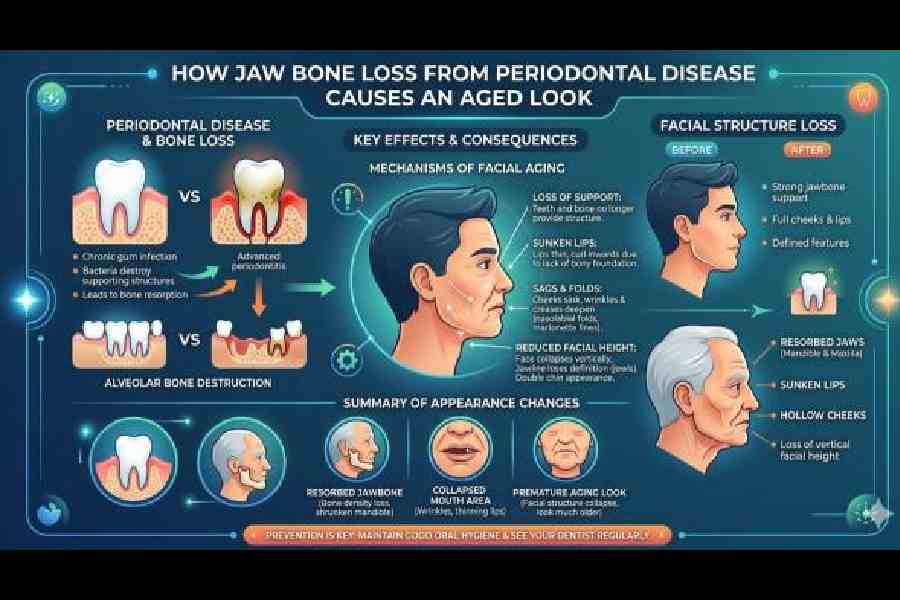
What many patients do not realise until it is too late is that periodontitis targets the underlying alveolar bone. The jawbone requires the mechanical stimulation of healthy teeth to maintain its density. When bacteria destroy the attachment between the tooth and the bone, the bone begins to resorb, or melt away.
Losing bone in the jaw is a structural disaster. Once that foundation liquefies, teeth lose their stability. They begin to shift, tilt, and create gaps where there were none before. Eventually, you are left with loose teeth. Eating a favourite meal becomes a gamble; biting into something as simple as an apple becomes a hazard.
The Thief of Youth: Structural Collapse
Beyond the immediate threat of losing teeth, there is a more insidious, structural transformation that occurs when the jawbone melts away. Your jawbone serves as the literal scaffolding for your lower face. When periodontitis causes this bone to resorb and shrink, the vital support system for your overlying soft tissues completely collapses. Without the solid foundation of bone and teeth to push outward, your cheeks begin to hollow out and sink inward, and your lips lose their fullness, thinning and turning downward into a perpetual frown. The distance between the tip of your nose and your chin progressively shortens, causing the skin to fold, bunch, and sag prematurely. This creates deep jowls and pronounced wrinkles around the mouth — a definitive facial collapse that lends a aged, frail appearance that anti-aging creams or cosmetic fillers can’t fix.
The Discovery of Pyorrhea
In advanced stages of this disease, the pockets around the teeth become literal reservoirs of infection. It is not uncommon in my practice to gently press on a patient’s inflamed gums and witness pyorrhea — the active discharge of pus from the gumline.
Imagine carrying a pocket of pus anywhere else on your body; you would consider it a medical emergency. Yet, because it is hidden inside the oral cavity, masked by mints and mouthwashes, many live with it for years, swallowing those bacteria and their toxic byproducts with every single breath they take.
The Invisible Emotional Toll
The physical destruction caused by periodontitis is profound, but as a clinician, the emotional and psychological devastation I witness is often much harder to bear. Bad breath is a unique affliction because it carries a heavy, unspoken social stigma. It is often incorrectly equated with poor personal hygiene, laziness, or neglect.
When an individual realises — or worse, is told — that their breath is offensive, their world shrinks. I have watched fiercely confident professionals, teachers, and executives slowly retreat into themselves. They begin to speak with their hands over their mouths. They avoid close-proximity conversations, step backward during meetings, and stop smiling in photographs.
From the Mouth to the Vital Organs
As profound as the emotional impacts are, the systemic implications of poor oral health are downright sobering. The mouth is not a sealed box; it is the gateway to your bloodstream.
When your gums are chronically inflamed and bleeding, the delicate blood vessels within that tissue are exposed and broken. Every time you chew food, brush your teeth, or massage your gums, millions of aggressive oral bacteria are literally forced into your systemic circulation. This condition is known as transient bacteremia. Once these bacteria enter the bloodstream, they travel throughout the entire body, acting as catalysts for severe, life-altering medical emergencies.
The Cardiac Connection
For decades, cardiology and periodontics were viewed as entirely separate fields. Today, we know better. There is a direct, undeniable link between periodontal disease and cardiovascular health.
When oral bacteria like Porphyromonas gingivalis travel to the heart, they attach themselves to the fatty deposits (atherosclerotic plaques) in the coronary arteries. The presence of these bacteria triggers a local inflammatory response, causing the arterial walls to swell and narrow. Furthermore, these bacteria produce proteins that can cause blood platelets to clump together, significantly increasing the risk of a blood clot forming.
If a clot blocks a narrowed coronary artery, the result is a sudden heart attack. In individuals with pre-existing heart valve abnormalities, these circulating oral bacteria can attach directly to the lining of the heart valves, causing a potentially fatal infection known as infective endocarditis.
The Brain At Risk
The damage does not stop at the heart. Those same circulating bacteria and the inflammatory cytokines they trigger can cross the blood-brain barrier.
Chronic oral inflammation introduces a steady stream of inflammatory markers into the brain’s delicate ecosystem. This sustained neuroinflammation has been heavily implicated in the acceleration of cognitive decline and the development of diseases like Alzheimer’s.
Additionally, the increased tendency for blood clots and arterial narrowing caused by oral pathogens significantly elevates the risk of ischemic strokes.
The Path to Reclaiming Your Health
The incredible thing about periodontal disease is that, in its early to moderate stages, it is entirely manageable and often highly reversible. You can halt the bone loss, eliminate the bad breath, and protect your heart and brain, but it requires moving beyond the mindset of quick fixes.
What to Do at Home
- Meticulous mechanical cleaning: Brush twice a day using the correct technique — angling the bristles at a 45-degree angle toward the gumline where plaque hides.
- Daily interdental cleaning: Brushing only cleans about 60 per cent of the tooth surface. The remaining 40 per cent lies between the teeth. If you are not flossing or using interdental brushes daily, you are leaving nearly half your mouth uncleaned.
- Ditch the masking agents: Understand that cosmetic mouthwashes, mints, and cardamoms only mask the odour for a few minutes; they do nothing to eradicate the deep bacterial reservoirs causing the issue.
- The Role of Professional Care: There is only so much that can be achieved at home. Once plaque has hardened into tartar, no toothbrush in the world can remove it. It requires the specialised tools and trained eyes of a dental professional.
Modern dentistry has advanced modalities from ultrasonic debridement to targeted laser therapies that sterilise periodontal pockets without the need for traditional, painful surgery, reclaiming your oral health is more accessible and comfortable today than it has ever been.
A Final Word
As you turn the pages of today’s paper and plan the week ahead, take a quiet moment to listen to what your body might be whispering to you. If your gums bleed when you brush, if you notice a persistent taste in your mouth, or if you find yourself subtly pulling back from a loved one during a conversation, please do not dismiss it. Taking care of your mouth is not an act of vanity; it is a profound act of self-preservation.
Dr Kamlesh Kothari, MDS, DNB, DICOI, is a dental implant specialist, cosmetic dentist and maxillofacial surgeon. He is the founder and clinical director of Aesthetica, 2/7 Sarat Bose Road, Vasundhara Building. He can be reached at +91-9830183000, +91-33-40035900, www.aesthetica.co.in, and on Instagram @drkamleshkothari