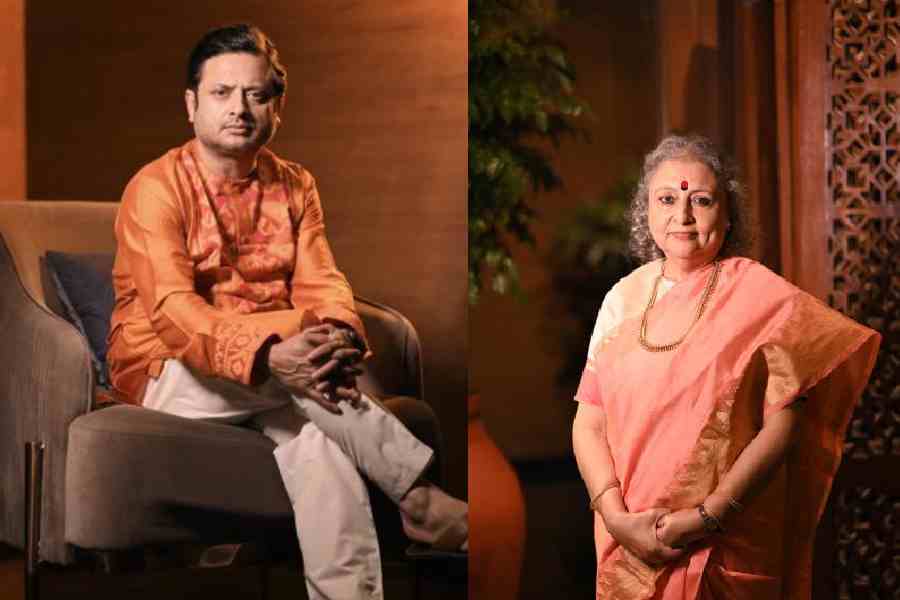
Directors Nandita Roy and Shiboprosad Mukherjee venture into the world of suspense and mystery with Phool Pishi O Edward, releasing in theatres today. Beneath its whodunnit structure, the film examines the fragile dynamics of family, buried emotional wounds and the silence that often shapes relationships within Bengali households. Through the lens of a mysterious death, the narrative also explores themes of organ donation, sacrifice, power and resentment, while retaining the warmth and emotional intimacy the filmmaker duo is known for. In this t2 chat, Roy and Mukherjee discuss blending Bengali familial storytelling with suspense, and why human behaviour remains central to the mystery.
What drew you towards making a murder mystery like Phool Pishi O Edward?
Nandita: What drew us towards Phool Pishi O Edward was not merely the murder mystery, but the deeply human story at its core. For us, the mystery becomes meaningful only when it is rooted in complex emotions, fractured relationships and uncomfortable social truths.
Shiboprosad: At the heart of the film lies the dynamics of a family — love, sacrifice, power, resentment and silence — all of which exist beneath the surface of this seemingly engaging whodunnit. We were also deeply intrigued by the subject of organ donation and the gender disparity surrounding it in our society. Very often, women become the silent givers, while men remain the primary recipients, and that reveals a certain patriarchal structure within families. What interested us was exploring these realities through the language of an entertaining mystery drama rather than a socially heavy narrative.
The film feels deeply Bengali while also carrying the mood of a classic whodunnit. How did you balance those two sensibilities?
Shiboprosad: I think the beauty of a whodunnit lies in the fact that its structure is universal, but its soul can be deeply local. We never wanted Phool Pishi O Edward to imitate a Western murder mystery. The intention was always to create a story that feels unapologetically Bengali in its emotions, humour, relationships and cultural textures, while still retaining the thrill and intrigue of a classic whodunnit.
The zamindar house, the family politics, the layered interpersonal equations, the food, the music, the rhythm of conversations — all of these are deeply rooted in Bengali sensibilities. At the same time, the suspense element gives the narrative a larger cinematic pull.
Nandita: What helped us balance the two was focusing on human behaviour rather than genre mechanics alone. Every suspect in the film is emotionally driven. The mystery unfolds through relationships, hidden wounds and family dynamics, which makes it feel intimate and familiar even within the framework of a suspense drama. In many ways, the film is both a tribute to classic detective stories and a celebration of Bengali familial storytelling.
Your earlier films often focused on warmth and relationships, whereas this one feels filled with mistrust and hidden motives. How different was that creative experience for you?
Nandita: I think mistrust has always existed in our films, right from our very first film, Icche. It is one of the most fundamental human emotions and naturally finds its way into relationships, families and society. Perhaps our films are often remembered for their warmth and emotionality, but beneath that warmth there has almost always been conflict, loneliness, silence or emotional fracture.
Take Praktan, for example — if there was no mistrust, no emotional disconnect, then why would characters like Ujaan Mukherjee (Prosenjit Chatterjee) and Sudipa (Rituparna Sengupta) separate despite loving each other? The emotional core of many of our stories comes from people struggling to understand one another, carrying unspoken hurt or questioning the relationships they inhabit.
Shiboprosad: With Phool Pishi O Edward, those emotions simply take the shape of a murder mystery. Creatively, it did not feel alien to us because we have always been interested in exploring the complexities of human relationships and the social structures around them. I feel we are sometimes labelled only as filmmakers who make ‘warm films’, but almost every film we have made has quietly questioned society in some way — whether it is parenting, marriage, gender roles, class divide or emotional neglect. This film continues that journey, just through the language of suspense and mystery.
You had mentioned being a fan of Agatha Christie. Were there any specific Christie novels or storytelling techniques that influenced Phool Pishi O Edward?
Nandita: I have always enjoyed Agatha Christie’s writing and the world of classic detective fiction, but Phool Pishi O Edward was never conceived as an homage to any particular Christie novel. The resemblance perhaps lies only in the fact that both explore human behaviour through the framework of a mystery.
At its core, this is a deeply contemporary story rooted in our own social realities, relationships and cultural context. The emotional conflicts, the gender dynamics, the family politics and the subject matter all emerge from present-day concerns rather than literary inspiration. So, being an Agatha Christie fan is more of a happy coincidence than a direct influence on the film. Our attempt was not to recreate a Western-style whodunnit, but to tell an original Bengali mystery that feels intimate, relevant and emotionally truthful to our society today.
Why specifically the name “Edward” for the cat? Does the name carry symbolic, emotional or narrative significance?
Shiboprosad: The name ‘Edward’ came to us quite instinctively. Interestingly, my team pointed out that even Alia Bhatt’s cat is named Edward, which we found amusing. There is something timeless, slightly eccentric and oddly memorable about the name ‘Edward’. The way Sohini’s character – Phool Pishi - speaks about the cat, cares for it and almost treats it like a member of the family, the name naturally acquired an emotional warmth and personality of its own.
We also liked the contrast of having such a distinctly classic name within a deeply Bengali setting. In a way, Edward is not just a pet in the film — he becomes a silent presence moving through the emotional and mysterious layers of the story.
The visual design of the film is extremely rich, from candlelit interiors to costumes and jewellery. How important was visual detailing in creating the psychological mood of the story?
Nandita: Visual detailing was extremely important because in a film like Phool Pishi O Edward, the atmosphere itself becomes a character. We wanted the audience to constantly feel a certain emotional tension beneath the beauty of the world they were entering. The candlelit interiors, old-world textures, costumes, jewellery, fabrics, colours — all of these were carefully designed to create not just visual richness, but also psychological depth.
The story is set within a zamindar household where appearances often hide emotional fractures and buried truths. So the visual world had to reflect that duality — elegance on the surface, unease underneath.
Shiboprosad: Nanditadi, especially, takes immense interest in these details. She has a very sharp eye for textures, authenticity and visual storytelling. I also want to thank Animesh Ghorui (DoP), Anupam Chatterjee (costume designer), Mridul Baidya and Saswati Karmakar (production designers) for bringing this world to life.
With such a large ensemble cast, how did you ensure every character retained mystery and individuality?
Nandita: In Phool Pishi O Edward, every character has an emotional arc, an individual journey and a secret inner life, which is what helps sustain both the mystery and the emotional engagement of the film. Whether it is Arjun Chakrabortyy, Raima Sen, Anamika Saha, Rajatava Dutta, Koneenica Banerjee, Ananya Chatterjee, or the younger actors like Shyamoupti Mudly, Soumya Mukherjee, Rishav Basu and Raju Dhar — each character carries their own emotional baggage, motivations and perspective within the story. While everyone becomes a possible suspect in the audience’s mind, they also remain emotionally real and distinct as individuals.
Shiboprosad: And at the centre of it all is Sohini Sengupta’s character — the curious, observant aunt who arrives to attend her nephew’s wedding, only to find herself confronting a mystery far larger and more personal than she anticipated. Through her eyes, the audience slowly enters this complicated world of hidden truths and fractured relationships. What makes her journey special is that, beyond solving the mystery, she herself experiences emotional closure by the end of the film.
The title Phool Pishi O Edward sounds almost playful and eccentric despite the dark atmosphere of the film. Was that tonal contrast deliberate?
Nandita: The title felt so eccentric and unusual in the beginning that we ourselves briefly considered changing it. It did not sound like the conventional title of a dark mystery drama, and perhaps that is precisely what intrigued us about it over time.