Around 56 lakh fewer voters and a record-breaking surge of nearly 14.6 lakh first-time voters are two features of the Tamil Nadu election that is happening on Thursday.
Through the special intensive revision (SIR), the electorate size has been reduced from 6.41 crore recorded in October 2025 to the current 5.73 crore. The last Assembly Election in 2021 saw 6.29 crore people registered, approximately 56 lakh voters more than this year.
The "X-factor" in the election is the massive influx of first-time voters.
According to Election Commission data, 14,59,039 young people have been enrolled. Interestingly, the year that saw the highest voter turnout, 2011, also saw a massive net addition (11.5 lakh) compared to 2010.
Although the Election Commission did not then publish a standalone dataset strictly separating the 18-19 age bracket in the way they do now, political analysts pegged most of the newly registered voters as first-time voters as well.
Another defining feature of the 2026 voter roll is the continued dominance of the female electorate. According to Election Commission data, women voters in Tamil Nadu once again form the majority -- 2.93 crore, which is 10 lakh more than the registered 2.83 crore male voters.
Women voters outnumbered men first in 2016 with 2.16 crore registered voters, exceeding male voters by 3 lakh. That year, 2.13 crore male voters had registered. This trend continued in 2021 with 2.31 crore female voters against 2.25 male voters.
Naturally, this "silent majority" has, since, 2016 remained the primary focus of campaign manifestos, with parties recognising that the road to Fort St George is paved by the female vote.
Historically, third gender have been clubbed under a binary male/female breakdown, until in 2011 when a separate 'Other' category listed 1,394 voters (of which 71 voted).
In 2021 the Third Gender category was listed separately where 7,192 registered (and 1,500 voted). This year, under Third Gender, 7,728 have registered.
The benchmark for voter enthusiasm in Tamil Nadu remains the 2011 Assembly Election, which recorded a historic 78.01 per cent (78.29 per cent, including postal ballot) turnout. That year, a combination of intense anti-incumbency and a surge in registration created a peak that subsequent elections – 74.81 per cent in 2016 and 73.63 per cent in 2021 – have struggled to breach.
The state's democratic infancy in 1952 (as Madras State) saw turnout languish at approximately 52.1 per cent. The landmark 1967 election, which heralded the Dravidian era, was the first to cross the 75 per cent threshold.
Technically, even if the Election Commission announces a turnout of, say, 75 per cent on Thursday, in sheer numbers it beats the 73.63 per cent polled last election. However, in reality, a 75 per cent turnout today means 33 lakh fewer people voted than in 2021.
For the 2026 election to actually match the civic participation volume of 2021, Thursday's turnout must breach the 80.6 per cent mark.
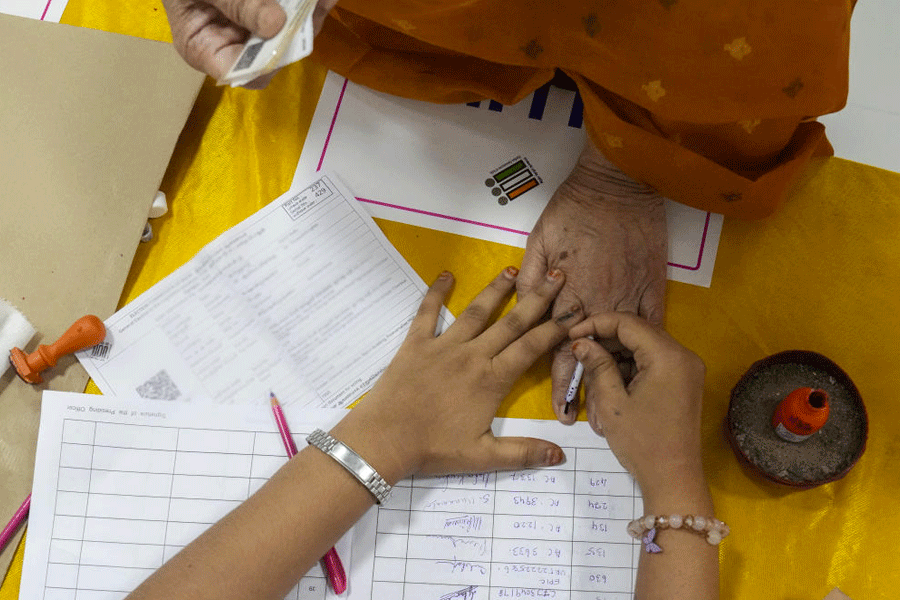
As voters dip their fingers in the indelible ink on Thursday again to elect the 234-member Tamil Nadu Assembly, they carry the weight of a history that stretches back to the very first vote in 1952. Whether the massive logistics -- including 1.06 lakh Ballot Units and 300 companies of the Central Armed Police Forces -- will facilitate a record-breaking 80-plus per cent turnout will be known as the day unfolds.
The Election Commission has deployed 1,06,418 ballot units along with 75,064 control units and VVPAT machines.