From a modest release across just a handful of screens to a remarkable 50-day theatrical run, Adamya has scripted a journey that many films aspire to but few achieve. Powered by strong word-of-mouth, an organic surge on social media, and a growing audience connect, the film steadily found its voice — and its viewers. Its impact was further underscored when stalwarts like Aparna Sen, Prosenjit Chatterjee, Rituparna Sengupta, Sudipta Chakraborty and Abir Chatterjee praised the film, reaffirming its resonance within the industry as well.
At the heart of this journey is director Ranjan Ghosh, whose vision and belief in storytelling have shaped Adamya into what it is today. As the film continues its inspiring run, Ghosh speaks to t2 about its unexpected growth, the power of audience connection, and the road ahead.
Adamya started with just a handful of screens and went on to complete 50 days in theatres — did you anticipate this kind of organic growth?
Honestly, no. When you begin a film like Adamya, you prepare yourself for invisibility more than success. When we began our theatrical journey, I carried with me a very quiet set of expectations. Not pessimistic, but grounded. Films like this are not designed for scale — they are designed for intensity. So, to witness it grow from a handful of screens into a 50-day theatrical presence, and that, too, at a single-screen theatre (Padmasree), has been, in many ways, surreal. I won’t pretend I anticipated this. In fact, I had prepared myself for an almost fleeting life for the film. But what unfolded instead was something far more organic, almost like a slow-burning conversation that refused to die down.
What do you think triggered the shift from a limited release to wider audience acceptance?
I think what truly triggered this was something we often underestimate today — trust in human recommendation. The first few viewers who encountered the film did not just “watch” it; many of them “carried it forward”. They spoke about it, argued about it, questioned it, and in doing so, invited others into that experience. That kind of word-of-mouth is deeply personal — it doesn’t come from obligation, but from a genuine need to share. There was also, I believe, a certain curiosity at play. A single-character film is, by design, an anomaly. It disrupts the conventional grammar of storytelling that audiences are used to. And sometimes, that disruption itself becomes a point of entry.
How did it feel watching the film expand purely through word-of-mouth rather than a big commercial push?
It felt deeply validating, almost emotional. There’s something profoundly democratic about word-of-mouth — it cannot be bought or manufactured. Watching the film expand purely through word-of-mouth has been one of the most moving aspects of this journey. In an industry where scale is often equated with success, Adamya grew in whispers. Every additional screening felt earned in a very visceral way. There was no aggressive push, no overwhelming visibility. As a filmmaker, you rarely get to witness your work travel like this, almost independent of you. It felt as though the film had found its own rhythm, its own pace of breathing. That’s a rare feeling for a filmmaker.
The film’s promotion leaned heavily on social media — what strategies worked best for you?
We treated social media as an extension of the film’s voice. Our approach was also shaped by this philosophy of authenticity. We didn’t want to “sell” the film in a conventional sense. Instead, we tried to extend its emotional world into the digital space. That meant sharing fragments — behind-the-scenes moments, personal reflections, the emotional labour that went into the making. I found that audiences responded far more to sincerity than to strategy. When you speak honestly about your work, without over-packaging it, people tend to engage with it differently. The audience itself became the most effective promoters. Their posts, their interpretations, their emotional responses carried far more weight than anything we could have designed.
Did audience reactions online influence how you viewed your own film after release?
In subtle ways, yes — but not in a way that altered my intent. Rather, it expanded my understanding. Once a film is released, it ceases to belong entirely to the filmmaker. It enters the collective consciousness of its viewers, each of whom brings their own experiences, fears, and interpretations to it. I came across readings of Adamya that were far deeper than what I had consciously embedded, and others that were completely unexpected. There is a drone shot in the climax — Palash being chased by a dozen high-power flashlights — someone compared the light patterns to the tentacles of an octopus! See what I mean…? This process is both humbling and enlightening. It reminds you that cinema, at its best, is not a monologue — it is a dialogue.
How important do you think digital buzz is today for independent or content-driven cinema?
In today’s landscape, digital buzz has become indispensable, especially for independent cinema. But I think it’s also important to differentiate between noise and resonance. Digital platforms have undoubtedly democratised visibility. They allow smaller films to reach audiences without the backing of massive marketing machinery. However, visibility alone is not enough. A film may trend for a day or two, but what sustains it is the depth of engagement. In the case of Adamya, digital buzz acted as a bridge — it brought people to the theatre. But what made them stay, what made them recommend it to others, was the experience itself. So, I see digital buzz as a catalyst, not the core.
Have there been any particularly memorable audience reactions or messages that stayed with you?
Yes, a message from a young viewer, a college student. She said she sat in silence back in her room for nearly an hour after watching the film. She didn’t describe it as “enjoyable” or “entertaining.” She simply said she couldn’t shake it off. For me, that is perhaps the most meaningful response one can hope for. I was never trying to create something that people would consume and move on from. I wanted the film to linger, to disturb, to provoke introspection. When someone tells you it stayed with them in silence, you feel a quiet sense of fulfilment (smiles).
What do you think audiences are taking back with them after watching the film?
I hope they take back a sense of discomfort. And questions. Adamya does not offer closure in a traditional sense. No easy answers; no neat resolutions. Instead, it invites viewers to sit with discomfort — with ideas of morality, decay of the conventional political system, systemic failure, and the limits of human endurance. I believe that discomfort is important. In a world where we are constantly seeking distraction, to sit with something unresolved can be a powerful experience. If the film manages to create that space for even a few viewers, it has served its purpose.
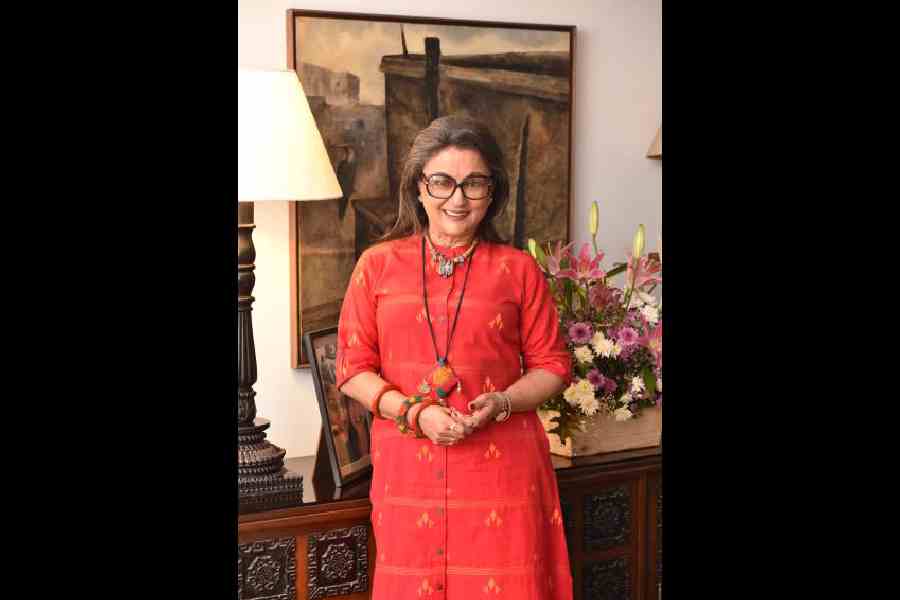
Aparna Sen, Prosenjit Chatterjee, Rituparna Sengupta, Sudipta Chakraborty and Abir Chatterjee have praised your film — how meaningful was that for you?
It meant a great deal. With Rinadi, there is a history that goes beyond professional admiration. There is mentorship, there is an emotional continuum. Also, she is Adamya’s presenter. Abir has been the first ‘hero’ of my filmmaking career (Abhijit from Hrid Majharey, 2014). He, too, brought with him a warmth and openness that made the experience feel less like an evaluation and more like a shared engagement with the film. And not just them.
Prosenjit Chatterjee made time from his hectic schedule and came over to watch the film with his son Trishanjit. He was overwhelmed and termed Adamya as “Ranjan’s personal revolution!” Sudipta Chakraborty brought almost all her students, watched the film, shared our posts and gave Aryuun (Ghosh, actor who played the protagonist Palash) the longest tearful hug. The following day, she gave us the warmest treat we ever got! Earlier last year, Rituparna Sengupta had thrown a birthday party for Aryuun – she wanted us to enter the fray of the theatrical release with a mouthful and a heartful! Ritudi had seen the film earlier and had launched the trailer and poster.
How do you view recognition from within the film fraternity versus audience appreciation?
Both matter, but they function differently. When your peers respond to your work, it often speaks to craft — the technical and narrative decisions that went into shaping the film. There is a certain rigour in that recognition. Audience appreciation, on the other hand, speaks to emotional connection. It tells you whether the film has travelled beyond its own making and entered someone else’s life, however briefly. Both are important, but if I had to place them in a hierarchy, I would say that audience connection ultimately gives a film its longevity.
Has the success of Adamya changed your approach to future projects?
I would say it has done something subtler — it has reinforced my instincts. I have never repeated any of my films. Each one is starkly different from the other. Adamya has validated my philosophy that the very essence of a filmmaker’s journey lies in its risk. It was never designed to conform. So, if anything, this experience has encouraged me to lean even more into the unknown, to embrace uncertainty with my entire being.
Do you feel more encouraged to back unconventional narratives after this response?
I think so. This response has been a quiet affirmation that audiences are far more open, far more curious, than we often give them credit for. There is space for silence, for minimalism, for discomfort, and most importantly, for honesty. Adamya has given me the courage to continue exploring those spaces without diluting them for the sake of acceptance. To me, Adamya has been less about achievement and more about affirmation — of my belief in a certain kind of cinema — not driven by scale, but by sincerity. I am reticent by nature, and if this journey has taught me anything, it is that even in a landscape dominated by noise, there is still room for a quiet, sincere, and persistent voice to be heard.