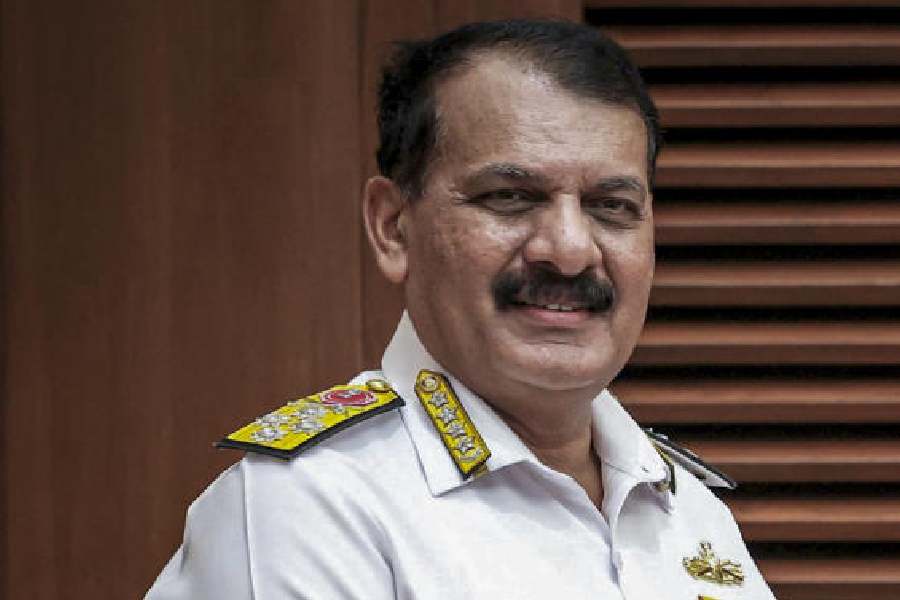
The Indian Navy has significantly enhanced its anti-submarine warfare capability, underwater surveillance, and network-centric operations to counter emerging maritime challenges posed by the growing China-Pakistan nexus in the Indian Ocean region, Navy Chief Admiral Dinesh K Tripathi said on Saturday, citing conflicts in West Asia to argue for greater military integration.
In an exclusive interview to PTI, Admiral Tripathi said the Navy remains prepared to deal with any "two-front" challenge in the maritime domain and emphasised that ongoing conflicts in West Asia underscore the direct link between maritime security, energy security and economic resilience.
His remarks come amid the growing presence of China's PLA Navy in the Indian Ocean region and Beijing's deepening maritime cooperation with Pakistan, including the transfer of submarine capabilities and the modernisation of the Pakistani Navy.
"We are fully aware that the Indian Ocean Region is witnessing increasing strategic contestation and greater extra-regional presence, moving us from an 'era of cooperation' into an 'era of intense competition'," he said.
"As a professional maritime force, the Indian Navy monitors all regional developments very closely, and our approach remains strictly capability-based and threat-informed."
There has been a significant increase in maritime collaboration between Pakistan and China in recent years. Last month, the two countries announced the commissioning of the first of four Chinese-built diesel-electric attack submarines for the Pakistan Navy, as Beijing continues to play a major role in strengthening Islamabad's naval capabilities.
Responding to a question on India's maritime security challenges, Admiral Tripathi said the Navy continuously assesses the evolving strategic environment and adapts its force structure, operational concepts, deployment patterns and preparedness levels accordingly.
"Our efforts are not aimed at any specific nation, but rather at ensuring the absolute security of India's maritime interests and contributing to a stable, free, open and inclusive Indo-Pacific. The Navy's answer to any complex or two-front challenge is credible deterrence backed by capability," he said.
"To achieve this, the Indian Navy has significantly enhanced its surveillance architecture, maritime domain awareness, anti-submarine warfare capability, underwater surveillance, long-range maritime reconnaissance, network-centric operations across sensors and shooters, and integrated operational response capability," he added.
Admiral Tripathi said the Navy's mission-based deployments across critical choke points and shipping lanes ensure sustained operational presence, persistent surveillance and rapid response capability across the region.
"Importantly, deterrence is not built merely through numbers. It is built through credible capability, operational readiness, technological integration, sustained presence, and the ability to impose costs, if required," he said.
The Navy Chief expressed confidence in the force's modernisation plans, including the Project 75 India programme for six stealth submarines and the broader objective of expanding to a 200-plus ship Navy.
After outlining the maritime challenges closer home, Admiral Tripathi also pointed to the lessons emerging from ongoing conflicts in West Asia and the Russia-Ukraine war.
"The first and most critical lesson is that maritime security is directly linked to economic security, energy security, and national resilience," he said.
"Disruptions to shipping routes, energy flows, and maritime logistics chains have immediate strategic and economic consequences, affecting insurance costs, shipping patterns and the strategic balance across entire regions."
The Navy Chief argued that these developments strengthen the case for greater military integration and a dedicated maritime theatre command bringing together capabilities of the Army, Navy, Air Force and Coast Guard.
"Jointness and integration are no longer optional -- they are an absolute operational necessity in the modern battlespace. Future conflicts will demand seamless coordination across land, sea, air, cyber, space and information domains," he said.
According to Admiral Tripathi, no single service can operate effectively in isolation under increasingly complex conditions, making tri-service integration central to India's future defence architecture.
He, however, stressed that theatre commands must be driven by operational effectiveness and enhancement of military capability rather than organisational restructuring alone.
"Regarding a dedicated maritime theatre command, the maritime domain, by its very nature, inherently requires the integrated application of naval, air, land and coast guard capabilities," he said.
'Short war' myth debunked
The Navy Chief also said the character of warfare is undergoing a profound transformation, with the maritime battlespace now extending from the seabed to space, while cyber, electromagnetic, informational and cognitive domains have become equally important.
To prepare for future conflicts, he said the Navy is aggressively incorporating artificial intelligence, quantum technologies and autonomous systems, while refining operational concepts, space-based communications and cyber resilience.
Reflecting on recent operations, Admiral Tripathi described Operation Sindoor as a demonstration of the Navy's combat readiness, operational reach and deterrence capability, noting that the deployment of a Carrier Battle Group in the northern Arabian Sea helped shape the strategic environment during tensions with Pakistan.
He said the operation also highlighted the growing importance of tri-service synergy and validated the need for deeper integration among the armed forces.