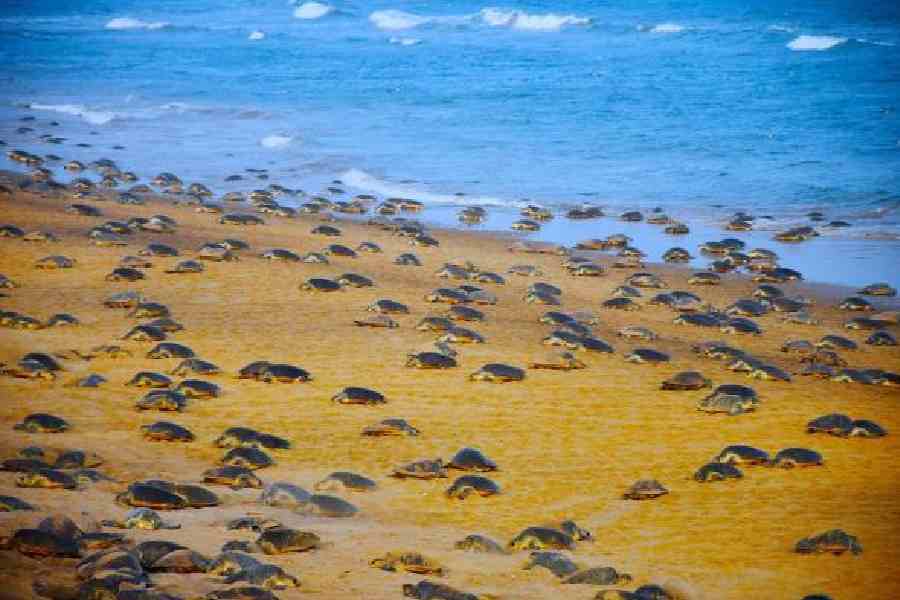
Every year, the quiet coastline of Odisha becomes the stage for an extraordinary natural event. What unfolds is the spectacular phenomenon of mass nesting of olive ridley turtles, known as arribada (Spanish for ‘arrival’). This occurrence, where lakhs of female turtles come ashore simultaneously to lay eggs, is a remarkable sight to behold.
Odisha hosts India’s only and some of the world’s largest nesting grounds at Gahirmatha Beach, the Rushikulya river mouth, as well as Devi. In recent years, numbers have surged impressively, with nearly seven lakh turtles recorded in a single season at Rushikulya alone, reaffirming the global ecological importance of this coastline.
A personal encounter with an ancient ritual
By March, the nesting season is at its peak, tapering off towards the end of the month. Thanks to the good offices of my friend, Dhriti Banerjee, director, Zoological Survey of India (ZSI), I set off by road from Calcutta to witness the mass nesting phenomenon at Rushikulya.
Olive Ridleys typically nest between February and March after moderate to long migrations across the ocean. While this reptilian species mates in water, females come ashore to lay their eggs along the beach.
Arriving at the Rushikulya nesting beach before dawn was an unforgettable experience, one that will remain ingrained in my memory. As my accompanying friend, Dr.Anil Mohapatra, a senior scientist with ZSI, explained, of the three mass nesting sites along the Odisha coastline, Rushikulya was the last to be discovered, in 1994.

Dr Anil Mahapatra (right), a senior scientist with ZSI, with Shiladitya Chaudhury (centre), Shiladitya Chaudhury
The road from Berhampur had fallen silent long before I reached the coast. By the time I stepped onto the sand, the world had reduced itself to three elements — wind, darkness, and the low, insistent murmur of the Bay of Bengal. There were no crowds, no spectacle yet. Just an emptiness that seemed to be waiting. Wildlife teaches you patience. So I waited. And then the moment arrived.
At first, it was merely a suggestion — dark shapes breaking the rhythm of the waves. Within minutes, the shoreline began to fill, as if the sea itself was exhaling life onto land. Olive ridley turtles, by the hundreds, then thousands, were hauling themselves ashore in an ancient ritual, transforming this quiet stretch of coastline into one of the most significant wildlife gatherings on Earth.
I had seen large migrations before — the thunder of wildebeest across the Mara, the slow authority of elephants moving through Amboseli — but this was different. This was quieter, more intimate, and yet overwhelming in scale. There was no drama in the conventional sense. And yet, everything about it felt urgent.
They crawled past me, around me, sometimes brushing against my boots, their shells catching faint glints of moonlight. The beach, once smooth and untouched, became a living canvas of tracks and motion. I remember lifting my camera, framing a shot, and then lowering it again. There are moments when photography feels secondary — when witnessing becomes more important than capturing.
But instinct took over. I began to shoot: low angles, long exposures, silhouettes against the surf, the rhythmic motion of flippers carving into sand. In the dim light, their eyes glistened — not with emotion as we understand it, but with something older, something programmed into their very being.
Soon, the digging began.
A female would select her spot and begin to excavate with her hind flippers. The movement was methodical. Sand flew in soft arcs behind her as a flask-shaped chamber took form. Around her, dozens of others were doing the same. Some collided, some dug into existing nests, erasing what had been laid just hours before.
It was chaotic and yet entirely natural. As my eyes adjusted, I watched shapes emerge continuously from the water. The sand appeared alive. Thousands of olive ridley turtles were scattered across the beach within a short span. Some dug nests with rhythmic precision, others covered their eggs, and many slowly made their way back to the sea.
It felt like a carefully choreographed performance where each participant arrived, played its role, and retreated. Despite their numbers, the turtles moved with calm determination, guided by an ancient biological rhythm refined over millions of years.
Watching a female nest is both intimate and humbling. She climbs out of the water, drags herself across the sand, selects a spot, and digs a flask-shaped pit. Then, in a trance-like state, she lays around 100–115 eggs.
Once done, the turtle carefully covers the nest, camouflaging it to protect against predators, before returning to the ocean. The entire process takes roughly 30-45 minutes, yet it carries immense ecological significance. Each clutch contributes to the survival of a vulnerable species, even though only a small percentage will hatch successfully.
Many eggs are lost — trampled by other turtles or preyed upon by predators such as the Brahminy kite, golden jackal, and wild boar. The eggs require no parental care; within about 45 days, they hatch naturally under the warmth of the sun. One can only imagine the sight of hatchlings emerging and instinctively crawling towards the sea in large numbers.
Conservation and community
At Rushikulya, the faint, earthy smell of beach soil, the gentle rhythm of waves, and the soft scraping of flippers create an almost surreal atmosphere. What elevates this phenomenon is not just its scale, but the role of local communities in preserving it. Beyond state wildlife officials, local fishing communities play an active role in conservation. During the nesting season, motorised fishing boats are withdrawn from the sea, with only traditional, non-mechanised boats permitted in certain areas. This significantly reduces accidental turtle deaths caused by propellers and fishing nets. This comes at a cost. For many fishing families, these months are among the most productive. Yet, there is a shared sense of responsibility. Locals recognise the global significance of these beaches and take pride in protecting them.
Fishermen often assist authorities by reporting turtle movements, safeguarding nesting zones, and discouraging harmful activities. Women and children act as informal custodians, ensuring nests remain undisturbed and that visitors maintain distance.
Perhaps the most striking outcome is the near absence of poaching or egg collection — once a concern in many coastal regions. Here, turtles are not seen as a resource, but as seasonal visitors deserving protection. This shift is the result of sustained awareness, trust-building, and community participation.
Scientific efforts also play a crucial role. As Anil Mohapatra explains, selected turtles are tagged during the nesting season. These non-invasive tags help track migration patterns, nesting frequency, and survival rates. In some cases, satellite transmitters reveal journeys across vast stretches of the Indian Ocean, connecting ecosystems across countries. Such research informs conservation strategies, helping authorities mitigate threats such as fishing activity and shipping routes.
For me, witnessing the mass nesting at Rushikulya a few weeks ago was an opportunity to step away from urban life and encounter something timeless. Olive ridley turtles, classified as ‘Vulnerable’ by the IUCN Red List, have seen their global populations decline by 30-50 per cent. They are also protected under Schedule I of the Wildlife Protection Act, 1972.
These ancient creatures have inhabited the planet’s oceans for over 100 million years. Each year, they return to these shores, guided by instinct, defying environmental and human pressures.
There is something profoundly humbling about watching life unfold at such scale. It is a reminder that while we may be visitors to these shores, the turtles are simply returning home, as they have done for millions of years.
Shiladitya Chaudhury is a communication consultant and a restaurateur with brands like Oudh 1590, Chapter 2 and Chaudhury & Company. His passion for wildlife photography takes him to the remotest of jungles.Cameras used: Sony A7Mark 3 with 200-600 lensand Sony RX10 Mark 4