Rock Around The Clock by Bill Haley & His Comets
There’s a story behind every fresh sound in music. And one such story was playing on April 12, 1954, at a studio in the iconic Pythian Temple building in New York.
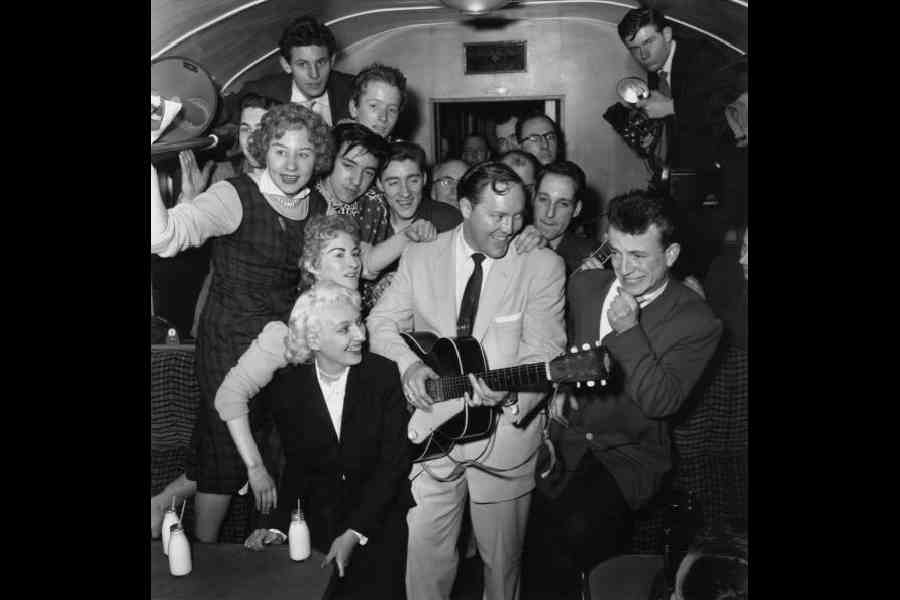
A young man named Bill Haley (1925-1981) and his “comets” — musicians — recorded Rock Around The Clock, a peppy, jive-friendly number with distinct beats. Bill was the lead vocalist, session musician Danny Cedrone played the solo guitar. Bill and Danny had collaborated before, in 1951, on Rocket 88, when Bill’s group was called Bill Haley and His Saddlemen. Rocket 88 was a modest hit. And now, Bill Haley & His Comets had released Rock Around The Clock.
Had rock and roll — the love child of rhythm and blues and jump blues, with jazz and boogie-woogie, country and gospel music as godparents — finally arrived with this song? Not quite. Another modest hit. And in June 1954, Danny fell down a flight of stairs and fatally broke his neck.
It took a year and a film to make it a chartbuster. Widely considered the definitive rock and roll song to top the Billboard charts and launch a worldwide craze for this new sound, Rock Around The Clock had to piggyback on the 1955 smash-hit teen movie Blackboard Jungle for reach.
Directed by Richard Brooks and starring Glenn Ford as a navy veteran-turned-teacher and Sidney Poitier as a rebellious but musically talented Black kid, the film released on March 25, 1955. Taking a hard look at teen troubles at a tough inner-city school, it sparked protests and conversations in equal measure across the US.
Overnight, Rock Around The Clock, used in the opening credits and several times in the film, became a youth anthem. Bill Haley & His Comets became massive stars who’d belt out superhits like See You Later Alligator. But more importantly, they set the stage for the rock and roll revolution. Elvis Presley, Chuck Berry and Little Richards were already peeping in from the wings — The Beatles, Led Zeppelin, Queen, The Rolling Stones, Dylan, MJ... would follow.
Not just in the US and the UK, rock and roll became a legitimate global cultural phenomenon. It became a voice for youths, colour and class no bar. It bridged social divides and became a rallying cry for change.
Even in India, where pure rock and roll admittedly never caught on, Bollywood brilliantly fused it with Indian raga-based music to convey the aspirations of youth caught in what’s largely a conservative society. Dum maaro dum, anyone? Think R.D. Burman, Bappi Lahiri, or more recently A.R. Rahman, Pritam or Amit Trivedi.
Rock Around The Clock had simple lyrics by Max C. Freedman and James E. Myers: One, two, three o’clock, four o’clock rock/Five, six, seven o’clock, eight o’clock rock/Nine, ten, eleven o’clock, twelve o’clock rock/We’re gonna rock around the clock tonight....
But have a closer look. The song’s title is prophetic. And one line slays as it speaks to all of us: If the band slows down, we’ll yell for more. Since then, rock and roll’s never stopped rockin’.