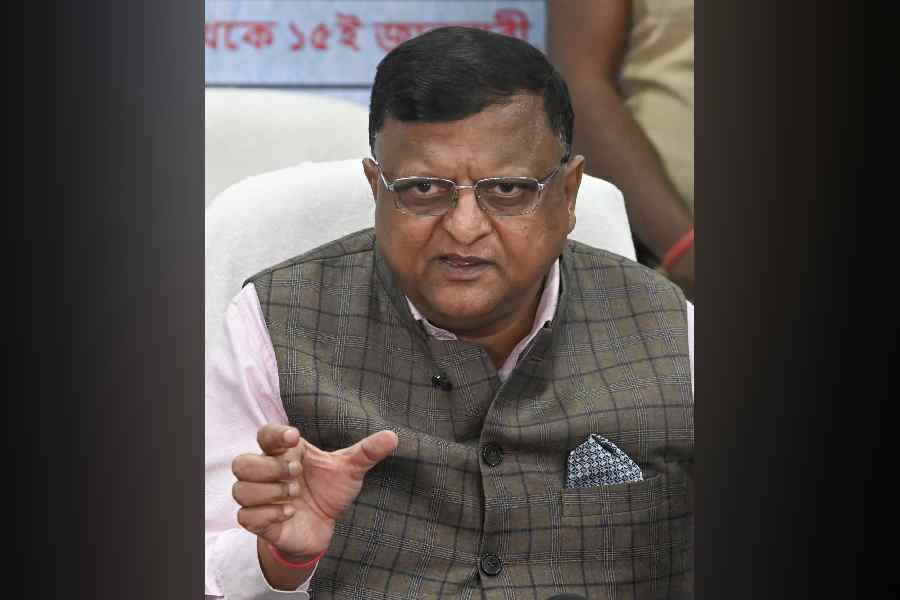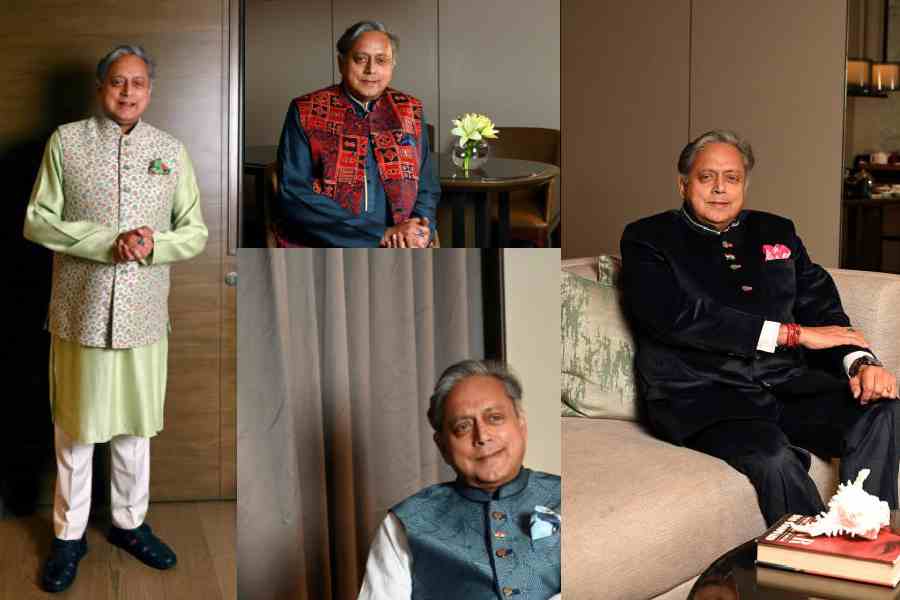
Amidst bustling political engagements, talk session commitments, and a whirlwind of flights between cities, MP Shashi Tharoor managed to carve out some time for a t2 exclusive fashion photoshoot during his brief visit to Calcutta last Saturday for an event. When we entered his room at JW Marriott Kolkata with designer Jyotee Khaitan, who was dressing him up for the event and the shoot, it felt like the reunion of two old friends. There were warm hugs, mutual admiration, an exchange of nostalgic anecdotes, and lively banter.
As Tharoor breezed through outfit changes, Jyotee offered her approval with encouraging words. At one point, he humorously remarked, “You’ve made a model out of me. What to do!” Later, during our conversation, the two reminisced about the beginnings of their friendship, recalling Tharoor’s attendance at Jyotee’s shop-in-shop launch at DLF Emporio’s Kimaya (in New Delhi). “I have always seen him to be this fashionably eager,” Jyotee remarked.
Even though the visit was brief and Jyotee dressed him up for the event, Tharoor impressed us with his flair for style by carrying his curated collection of pocket squares. “I’ve been passionate about pocket handkerchiefs for quite a while now, so I brought a variety with me,” he shared. “I wasn’t sure what Jyotee would get, but it turned out they matched perfectly!”
Jyotee’s planned changes for Tharoor included a seamless flow from easy-fit kurtas with bundis to elegant bandhgalas, reflecting his signature style. He reminisced to t2 about his long-standing love for kurtas, starting right from his student days. “To me, it’s a bit of anti-colonialism. Why should we wear western designs when our kurtas are not only comfortable but also perfect for the heat? They allow for breathability, and the added pockets couldn’t be more convenient.” Tharoor recounted how, during his UN career, he favoured kurtas but felt pressured to don suits due to prevailing European attitudes. “But it was itching when I came back to India again. I have barely worn my suits. I mean I must have worn them occasionally when I was in foreign settings where it was the most appropriate thing to wear,” shared Tharoor.
Over to Tharoor...
ON THE POLITICS OF ATTIRE
In Kerala, in particular, the uniform is a white bush shirt and the Kerala mundu or dhoti. I think it is illogical. Dhoti is very good but why not pair it with a kurta? I didn’t want the all-white look. In our culture, white is the colour of mourning, and I’ve never been keen on always wearing white. In my first election, everyone told me I had to dress like that, so I did. However, right after winning, I never went back to white bush shirt and dhoti or anything else like that again. I love dhoti but it lacks pockets. It’s very comfortable in the heat, but it’s not practical. I need my pants because of the pockets. I am like that naughty boy in the William books of Richmal Crompton who had 2,000 things in his pockets. I am always like that! (Laughs) The kurta and pants combination for me works very well.
When I’m in Kerala, I also enjoy wearing angavastrams in colours of the Indian flag. I’ve always believed that clothing conveys a certain message about your beliefs and personality. I prefer to be colourful, and I’ve explained this to colleagues who raised objections. Over the last few decades, people of India wear all colours. Only a small minority opts for all-white attire. In fact, all-white became a political uniform. Ever since I left school, I am allergic to uniforms. The rationale for dressing in white was that we’re supposed to represent the people, but nowadays, people express themselves in vibrant colours, whereas politicians stick to white!
As Jyotee pointed out her fondness for politicians in kurtas paired with denim, Tharoor humorously chimed in, “I stopped wearing that only because I lost the battle of the bulge!” Jyotee also shared a memory of how everyone in Calcutta was on the hunt for a specific orange bandhgala that Tharoor wore to a party. “I think saffron is a wonderful Indian colour. The issue now is that people often associate colours with politics. If I wear a red kurta, they assume I’m joining the communists, and saffron is linked to the BJP. It’s silly,” Tharoor remarked, recalling the outfit Jyotee mentioned.
APPEARANCE AND PUBLIC IDENTITY
In the beginning, I’ll be very honest, I used to literally pull on whatever I could find and go. No one was there to advise me otherwise. But somehow, because I was a bit unusual, I was dressing differently from other politicians, I started getting noticed. I remember the first time some publication… 10-15 years ago… wrote style icon or whatever. I was a bit genuinely surprised. But once you feel that people are looking at you, you become a little more self-conscious.
Now, I have a team of young people in their 20s working with me in Delhi. They often assist me in picking out what to wear and I sometimes seek their approval or disapproval. I’m fortunate to have some very smart young women managing my social media, and they also provide me with valuable feedback on my style choices.
SIGNATURE STYLE
I am amused to see how many people have picked up two of my practices. One is the pocket handkerchief in the bundi or the bandhgala, and the other is the jhandal. When I was at the UN, I was always representing its image on TV. So, I used to wear a UN lapel pin. When I returned to India, I began to think what to represent with. It was just a year or two after Naveen Jindal won his case allowing Indians to display the flag for personal use, so I decided to wear the jhandal lapel pin. Naveen even gifted me a few.
For formal occasions, the tradition has always been to wear a bandhgala. That bandhgala is usually in a fairly sober colour. I have personally been willing to honour that tradition. As for the bundi, that’s now become the classic thing. In fact, it used to be called the Nehru jacket. Now, the same thing is called the Modi jacket. As far as I am concerned, it’s now pretty standard. It’s actually a very useful thing. In hot weather, you can leave it unbuttoned. Plus, the pockets are very useful for my pens, lozenges, and visiting cards.
THE EVOLUTION OF PARLIAMENTARY FASHION
I don’t know if there’s a parliamentary fashion. It was, as I said, 90 per cent all-white. That is gradually changing. I won’t claim too much credit, though; when I did it 17 years ago, nobody else was doing it. But after Modiji came and wore colourful clothes, others felt emboldened, especially in his party. Rahul Gandhi’s style is a T-shirt. Everybody does their own thing. I don’t think there’s a parliamentary style anymore as such.
I think the most interesting thing to admire in India is authenticity. But authenticity, in my view, should be combined with colour and style. I am very happy to see a Bengali in a Bengali dhoti and a South Indian in a South Indian dhoti and a North Indian in a kurta pyjama. But it doesn’t have to be unimaginative.
I think it’s clear that among the Bengali MPs, one who stands out for her style is Mahua Moitra. The movie stars from the TMC are obviously always being noticed on what they wear. But I will say that when you look at Bengal, culture is so deeply inbred into the state... clothes are part of culture, just like its cuisine, music, art, everything.
Concluding our conversation on a lighter note, I asked him whether there’s anyone from history that he would like to dress up as. “I suppose in many ways Nehruji is the one. The only thing is I’m not at all keen on the tight churidars he used to wear and nor am I terribly keen on the Nehru cap. Zakir Husain also was a very elegant president of India in his classic sherwani style,” he shared.
Location: JW Marriott Kolkata