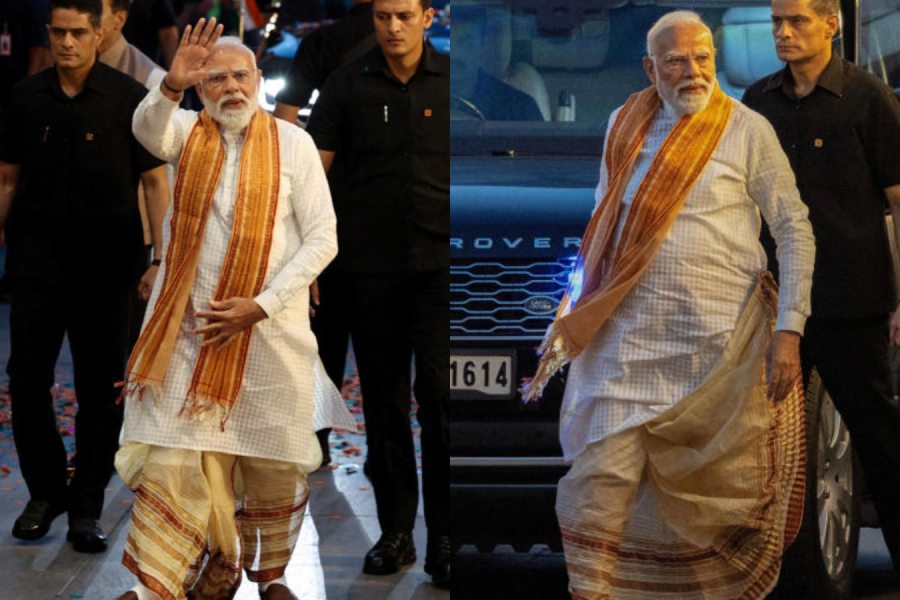
Prime Minister Narendra Modi on Monday addressed party workers at the BJP headquarters in Delhi, dressed in a quintessential Bengali ensemble, following the party’s landmark victory over the Trinamool Congress in the West Bengal Assembly elections. My Kolkata spoke to experts to decode the social, cultural and sartorial significance of his look.
The dhuti: Craft, drape and authenticity
Modi wore a classic handspun ‘kochano dhuti’ — a distinctive Bengali drape known for its structured micro-pleats and elegant silhouette.
“Notably, one end of the finely pleated fabric was tucked into the pocket, a nuanced detail that reflects both authenticity and a keen understanding of regional styling,” explained drape artist and digital creator Rohit Bose.
However, the detail carried meaning beyond cultural specificity. Sujata Biswas, co-founder of fashion label Suta, described it as a classic, old-school ‘Bengali Babu’ move.
“It’s practical so you don’t trip, but it also shows he understands how the garment is lived in. It felt authentic, not staged. He chose a Tussar silk dhuti — that natural golden fabric associated with auspicious occasions. Pairing that sheen with a bold red border (paar) was a strong nod to ‘Bongo-Gourab’ (Bengal’s pride). It’s essentially the ultimate ‘power suit’ of the East,” she noted.
The uttoriyo: An understated pairing with symbolic weight
Modi draped a Bengali uttoriyo around his neck, noted couturier Abhisek Roy. Biswas pointed out that the uttoriyo featured buti motifs, the tiny dotted patterns seen in Jamdani. “It was a nice tip of the hat to the weavers in places like Phulia and Shantipur who keep these traditions alive,” she added.
“The way he carried the dhoti and the uttoriyo is commendable. It is certainly significant for the Prime Minister to wear something region-specific on the national stage,” Roy said.
The kurta: Simple, signature and significant
Modi’s go-to style is a white kurta — full-sleeved or sometimes half-sleeved — paired with a sleeveless jacket (often called the Modi jacket) or a blazer, with churidar trousers completing the ensemble. He chose a white kurta on Monday, perhaps to keep the look neutral, said Roy. While elegant, a more striking, Bengal-inspired colour might have complemented the dhuti better, he added.
Biswas noted that it’s not just a kurta, it’s what Bangalis call a ‘panjabi’. Brown mojaris completed the look.
“The dhoti, paired with a crisp white kurta and a stole, created a look that was understated yet dignified. Such choices not only highlight India’s rich textile and draping heritage but also demonstrate how traditional garments can be presented with contemporary finesse on a national stage,” Bose concluded.
A pattern of regionally rooted fashion
Modi has made several notable sartorial statements over the years — from wearing a Mithila silk paag in Bihar to donning a veshti during a visit to Tamil Nadu. His wardrobe choices have consistently reflected not just the occasion, but also the cultural and regional identity of the places he represents.