
BE LIKE THE FOX: MACHIAVELLI'S LIFELONG QUEST FOR FREEDOM By Erica Benner, Allen Lane, Rs 1,099
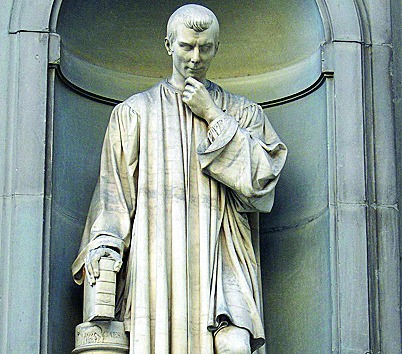
It is unfortunate that 'Machiavellian' should have come to mean 'cunning, unscrupulous', for Niccolò Machiavelli (picture), while an astute player in life and politics, was a scholar, a thinker, and arguably an idealist. In his overlapping roles of politician and civil servant, he played a major part in the affairs of his native Florence. He also analysed those affairs in the light of ancient history, one of the chief components of Renaissance humanist education, and worked this analysis into a clear-sighted, realistic appraisal of current affairs and general statecraft. Political treatises before his time spouted textbook ideals. Machiavelli's innovation was to base political models on firm data and practice.
Italy was then a patchwork of dissimilar and often warring states. Foreign powers like France, Spain and the Holy Roman Empire played major parts, not to mention the Pope with his double clout, spiritual and secular. Florence was formally a republic, implying (as always at the time) rule by well-heeled upper-class males. (Machiavelli had problems with the income test; his outstanding abilities partly redressed the balance.) Much of the time, effective power lay with successive generations of a single family, the Medici; or, on the rebound, the religious demagoguery of the monk Savonarola. (We may compare events nearer our clime and time.) Though arguably Renaissance Italy's single greatest hub of art and culture, Florence was politically turbulent and economically lacklustre. (Calcuttans may compare...) Florentine life could be fraught, especially for its administrators and diplomats. As intellectual reward, they had exceptional scope to study the deeds and misdeeds of man as a political animal.
Erica Benner plots Machiavelli's political thought against the sensational events of the age. The result is a compelling narrative of battle, intrigue and human involvement, held together by the story of a perceptive and sensitive individual, his personal and mental life evolving through his engagement with the times. It reads like a bildungsroman, a novel describing the growth and maturing of an individual, though here based on historical fact.
Benner's treatment of these matters is not beyond question. The events she describes are sensational enough, but she injects a little synthetic adrenalin from time to time. The book is steeped in scholarship; but given her narrative mode, her hidden references are often hard to pin down. She never falsifies her sources, but she can tweak them a little: giving a general remark a particular application or vice versa, citing half a remark (for example, Machiavelli on Savonarola) without the balancing residue. Was it necessary to start with the story of a serving-girl in the Machiavelli household, found with child by Niccolò's uncle? These minor problems do not reduce the value and appeal of Benner's narrative. Despite long acquaintance with Machiavelli, I was never led to place his political thought against the lived reality of his times as this book made me do.
Machiavelli's Florence was a long-standing but unstable republic, surrounded by openly authoritarian states. The same could be said of ancient Athens. Rome was a republic before it came under imperial rule. To humanists like Machiavelli, the history of these ancient states bore rich testimony to both democratic and authoritarian rule. Melding this scholarship with his intimate knowledge of contemporary politics, Machiavelli produced insightful studies of both models: the autocratic in The Prince (short and sharp, hence widely read and celebrated); the republican in his Discourses on the Roman historian Livy: long, detailed, analytic - tougher meat. He also wrote a history of Florence and many shorter works, to which Benner pays laudable attention.
Machiavelli was personally committed to the republican ideal. Hence some scholars (including Benner) detect a subtext of irony and reserve in The Prince, making it an arm's-length study of autocratic rule, dedicated by political compulsion to the Medici of the day. (He ignored the gift, and the work was not printed in Machiavelli's lifetime.) We can read The Prince in this way; but how then are we to take the resonant closing plea for a unified Italy with the same Medici ruler at the helm? Is the work an implicit admonition to him to govern on more democratic lines? That would be a risky ploy for Machiavelli, then in the political doghouse; but The Prince bristles with reminders that ultimately, the most autocratic ruler needs to muster public support by whatever means.
There is a detailed, learned and reasoned advocacy of republicanism in the Discourses. It also projects the figure, chiefly derived from Cicero, of the enlightened statesman of a democratic polity, highest exemplar of what Machiavelli calls virtù - not simply moral virtue, but balancing that with shrewd tactics, intrepidity and self-assertion. But the ideal autocrat of The Prince is also a man of virtù.
It is hard to read the mind of a man who lived 500 years ago. But perhaps we should revisit Benner's construct of a Machiavelli who, through taxing and confusing times, unfailingly advanced the republican ideal. That was emphatically his private bent, which he pursued diligently while circumstances allowed. He was not above a decent compromise with opposite trends when those prevailed. He seems temperamentally most akin to certain civil servants of later times: people of education, judgment and even introspection, but whose private values do not hobble them from a shoulder-shrugging pursuit of whatever course their situation might dictate. What is special to Machiavelli is the genius with which he reads that situation for his own times and for posterity.
With Aristotle and Marx, Machiavelli forms a seminal trio of Western political thinkers. Their thought bears lessons for all lands and ages. For India today, Machiavelli's crucial message might be that democracy and autocracy are not mutually exclusive. A popular, even elected, government might turn dictatorial: these mingled dispensations, says Machiavelli, are the worst, neither fish nor flesh. Ultimately, in Benner's summary, "A well-ordered political economy that ensures a decent living for all [the] people is one of the main foundations of a city's military power." No wonder this dangerous revolutionary was banned for 333 years.