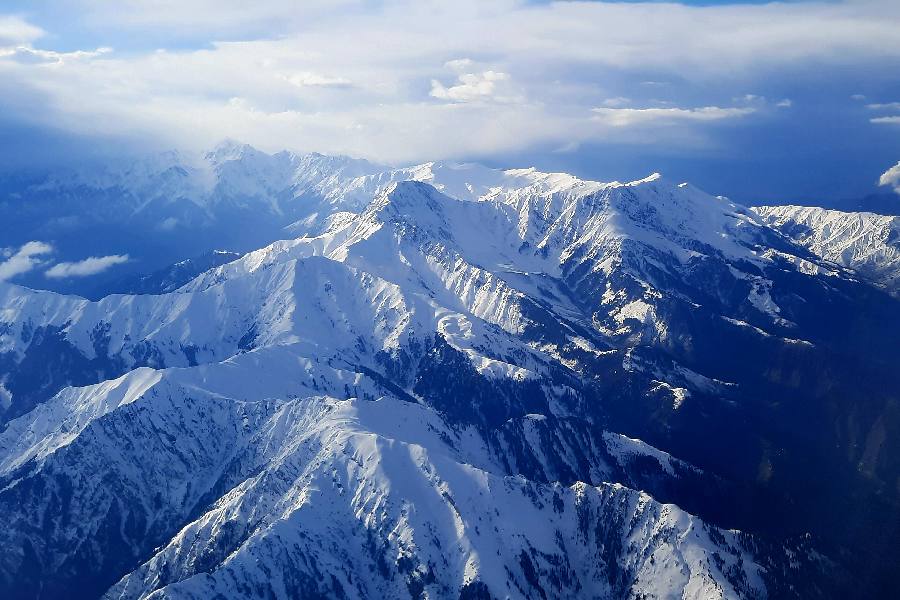
Springtime, especially April, is often considered unfavourable for mountain trysts. This month has already witnessed multiple incidents in the Himalayan region. Near the Atal Tunnel (connecting Manali with Keylong), sudden snowfall on April 10 blocked travellers while at Zoji La (a high mountain pass in Kashmir’s Ganderbal district), early April snowfall blocked the highway, leaving vehicles and tourists stranded. In Sikkim’s Lachen, landslides and snow between April 6 and April 12 impacted over a thousand tourists, prompting large-scale rescue operations.
Years ago, while travelling from Trongsa to Bumthang in Bhutan, we had a harrowing experience atop Yutong La, a pass at the highest elevation in that country (over 11,000 feet) when our car began to skid on ice. Overnight snowfall had blanketed the road entirely and overcast conditions reduced visibility to bare minimum. Not a single other vehicle was in sight. We would possibly have frozen to death when, miraculously, a truck appeared, scattering salt to melt the ice. We later learnt that the prime minister’s convoy was scheduled to pass that way. At that time, we had craved tunnels for travel ease.
Yet, in our quest for comfort, we have been rampaging on a living, shifting, fragile ecosystem like the Himalayas for years. Seeking connectivity and development, we drill, blast and hollow out what we consider ‘inert rock’ at will. The growing obsession with tunnelling through the Himalayas reveals a deeper absurdity: the belief that engineering can outwit geology and convenience trumps ecological reality.
The Atal Tunnel, a 9.02-kilometre-long passage carved through the Pir Panjal range at over 10,000 feet, is often hailed as an engineering marvel that cuts travel time by more than four hours. But recently, more than 1,000 vehicles were stranded near the tunnel after sudden snowfall, with hordes of tourists trapped for up to 20 hours in sub-zero conditions.
Even more telling is the geography that the tunnel cannot eliminate. There are over 46 identified avalanche-prone sites on the roads leading up to the tunnel. Yet, if the Atal Tunnel represents the illusion of control, Zoji La exposes its collapse. Late last month, a massive avalanche at Zoji La buried nearly 15 vehicles under snow, killing at least seven persons and injuring several others.
These are not isolated tragedies; they are systemic warnings. The Zoji La Tunnel, stretching over 14km at an altitude of around 12,000 feet, is part of a broader Rs 1.4 lakh crore push to build more than 30 tunnels across the Himalayan region. Each project promises "all-weather connectivity", but each is embedded in a landscape defined by its resistance to predictability.
The absurdity lies in the contradiction: tunnels are meant to bypass the dangers of mountain passes, yet the approach roads to these tunnels remain deeply vulnerable to avalanches, landslides, and extreme weather. They invariably intensify human presence in high-risk zones by bringing more vehicles, tourists and pressure into ecologically unstable regions.
Moreover, the very act of tunnelling destabilises what it seeks to master. Excavation generates massive debris, alters subterranean water flow and weakens the already fragile rock systems. In the Himalayas, which are still shifting, such interventions are brutally disruptive.
Development in the Himalayas cannot be measured solely by new roads or saved travel time. It must be judged by whether it respects the limits of the landscape. Until our leaders learn that lesson, we will continue to dig, not just tunnels through mountains, but graves beneath them. The magnificent Himalayas were not meant to be subjugated in this manner. The question remains: are our venerated, myopic legislators willing to listen?