
When was the beginning, the aarambh? When, as the Rig Vedic Hymn of Creation says, "even nothingness was not" in "darkness wrapped in darkness"? Was there, in the beginning, a dot, a bindu? Rather, the bindu? A bindu so inconceivably tiny that it would've been non-existent to the eye? So inconceivably dense that an entire universe heaved within it, straining to explode with a bang? A bang so inconceivably big that it would echo across aeons?
An innocuous bindu had been planted by a prescient teacher on a classroom blackboard some 80-odd years ago in an obscure school in Babaria, Madhya Pradesh, to train the concentration of a restless pupil with Nature rather than studies on his mind. By so doing he would, as everyone knows, embed a new consciousness in the sensitive boy. Though dormant for some decades, this simple - if not very usual -classroom experience would eventually give a creative anchor to Sayed Haider Raza. Indeed, the bindu - which has no calculable circumference - reborn as a circle - where neither beginnings nor ends can be located, thereby merging modern physics and Hindu philosophy, would appear with a concentrated interiority in the art of a maturing Raza. This was when, restless in the European art climate that enveloped him in France, he did what Kandinsky talked of in his book, On the Spiritual in Art back in 1946: turned "his gaze from the external to the deeper essence within him..." and sought his Indian roots.
But this inward retreat did not mean the rejection of the external. As you can see in Raza's recent works being exhibited at Akar Prakar till April 25, his distillation of Western modernism and traditional Hindu symbolism makes his art both universal and Indian at once. The palette of the Fauves, Malevich's Black Circle, Mondrian's reductionist geometry, Rothko's colour fields as a spiritual quest were all imbibed in his very being, so to speak. But it was only when he discovered his own answers to his own search did his unique, transcendental vision emerge.
And that was the aarambh of Raza as the world knows him today.
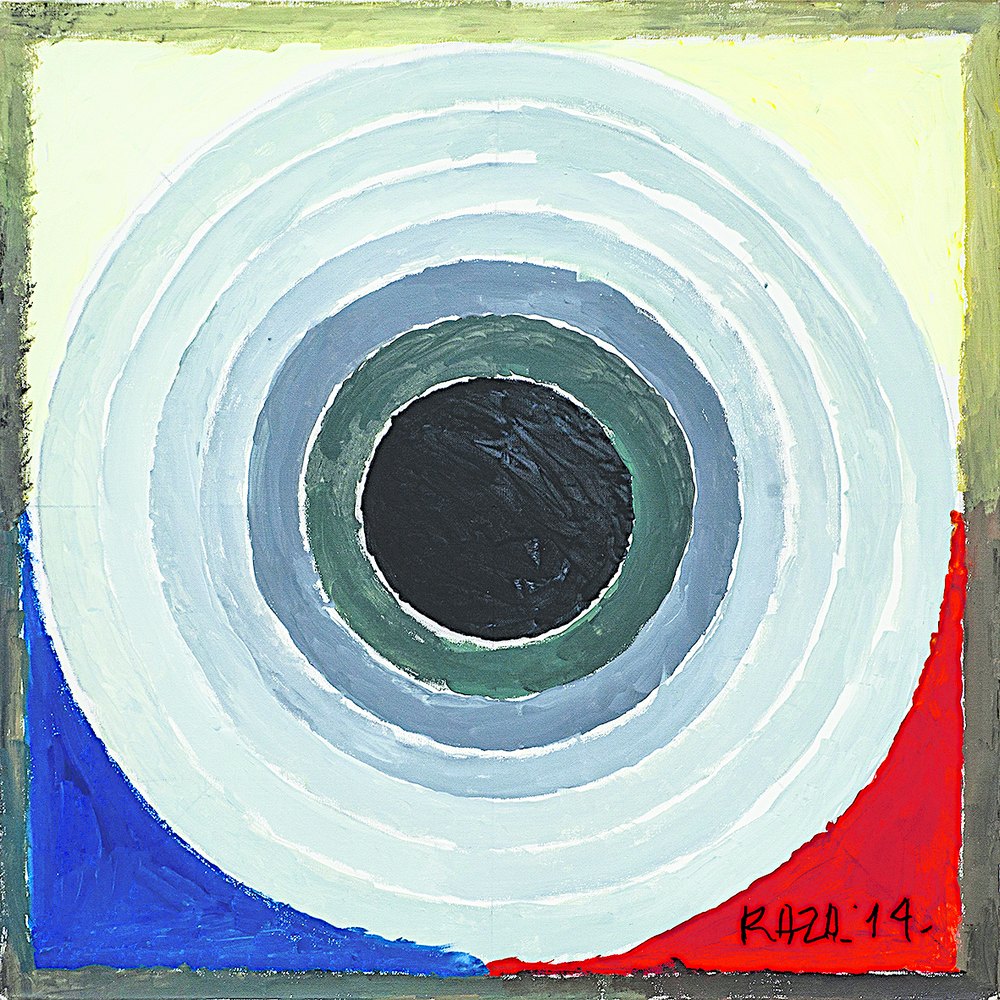
However, in calling its current show Aarambh, the gallery wishes to record something more immediate. The artist, who has been living in Delhi ever since he came back to India from France, had fallen ill in September last year. But he made a spirited recovery, even visiting Ajmer Sharif in November, and started working once more, thus making a new beginning. The five/six hours he's now putting in at age 93 have, in fact, enabled three shows to be mounted! Perhaps that was why the artist himself named a resplendent painting dated 2014 and on view here, Aarambh, a paean to the life force of Nature, to the harmony of the core duality, prakriti and purush.
Few Indian artists have understood and exploited, as Raza has, the physical sensation of colours and the subtle spell their inter-relations yield. It's not just the counterpoint of black or blues to reds, oranges and yellows that's often seen in his works, but also the sensuous earth tones, the barely-differentiated browns, the calming greys, the spectrum of blues that, imbued with the delicate nuances of a mystical light, radiate a range of suggestions. Tiryak, dated 2011 but included in this show, is an example of how a vertically-stacked arrangement of greys and black in bands, orbs and triangles is gravely meditative, and seems to absorb disquiet in a kind of final resolution. From 2014 comes Avarta, whose concentric circles, again in greys, referring to his amazing Shanti Bindus, speaks of a cooling off, as though all the heat of his earlier Bindu Vistar has long been released and a slowing down has begun.
But has it really, in his particular case? Raza's geometry, though constructed with rigour, has, nevertheless, always stood on a precarious balance in which energy is leavened by poise and sound by a deep silence. In which the patterns may seem to assume a reassuring, autonomous inviolability, yes, but the gnawing, hesitant, minute imprecision of the triangles, bands and orbs that leaves frayed trails of canvas white in between, insinuates traces of a mindful brush, sneaks in a sense of friction and motion, of edgy imperfection at the peripheries of his rectangular or circular mandalas. This is a signature of frailty that accepts - even embraces - fallibility, finitude, transience in the self-renewing enigma of life. Thus would Raza seem to reconcile the temporal with the timeless.