
ONCE UPON A DHARAMYUDH By Vibhor Tikiya, Srishti, Rs 150
The title suggests that the book under review is similar to the Mahabharat. However, after one has read Once upon a Dharamyudh by Vibhor Tikiya, one realizes that the similarity is that of ideology in the context of business ethics, not that of the storyline. It is the story of the way Dharam Synthetics Limited evolves. Weathering all kinds of storms, passing through difficult periods to the extent that at times one loses the hope of its survival, Dharam emerges as the kind of institution it set out to be. To quote the author, "It is a religion, the tenets of which are hard work, trust and honesty."
To start from the beginning, Dharam Synthetics Limited is set up by two brothers, Manohar and Chand, who travel all the way from Punjab to Bombay, as the city was known then, to give their dreams of making it big a concrete shape. They name their company after their father, whom they have lost to cancer. Their father and all that he stood for, matter a lot to both of them. The decision to move to Bombay, is a major one as it is a big and bewildering city where no one knows them and they have to start from scratch in circumstances that are unfamiliar and not quite friendly, but their determination sees them through.
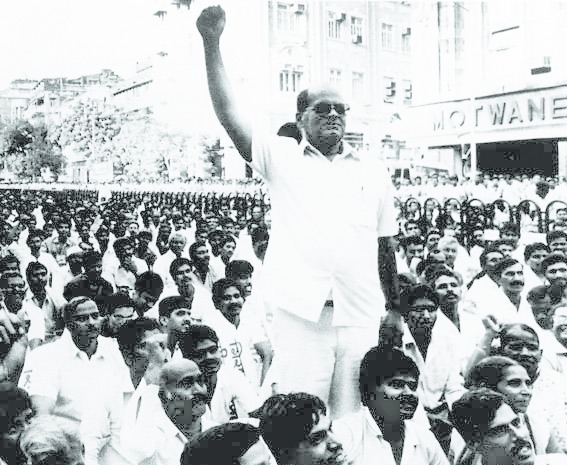
To put it in the right perspective, the novel is an oblique chronicle of the evolution and growth of the textile industry in Bombay, before Datta Samant emerged as a trade union leader and the Bombay textile strike of 1982 was called by textile mill workers under his leadership. Around two and a half lakh workers took part in the strike which was an unprecedented event in the industrial history of India. Mills closed down in Bombay, relocated to Gujarat and those who suffered most were the workers. Earlier, most of the mills had been in prime locations in Bombay which the owners sold to developers at a great profit, so they had nothing to lose.
Dharam also faces labour problems after relocating to Gujarat, quite a major one which is complicated by corrupt labour courts and politicians who are equally corrupt. Uday Shankar Chaubey, the leader of the workers in Dharam, is the stereotypical angry young man who hates all capitalists, especially Prakash, who is the owner of Dharam. One finds his rage a bit unreal and feels he would have been more realistic if he had been given some positive qualities.
The fire (one feels it is a metaphor for radical changes), though it destroys the factory, has consequences which go in Prakash's favour as it helps him to break the trade union movement in his factory and, more importantly get rid of Uday. It is not the time to ask who is right and who is wrong, it is a question of survival for Dharam and all those whose lives are bound up with it. The end is predictable, one wonders whether it is like that in real life.
The author narrates the story in a simple straightforward way, with a few lines from the Gita preceding every chapter. It is an interesting novel that makes one sit up and think as to how one should conduct oneself in a certain situation. It is also a story of growth and evolution, that of an institution, that is Dharam, and also that of the individuals that are part of it, mainly Prakash and his two employees who see him through good times and bad: Sanjay and Jha. It would not be easy to say who is Krishna and who is Arjuna if one were to apply the Mahabharat analogy specifically, so one need not do that. What this reviewer felt was that the novelist could do with a little brushing up of the character of Uday. He seems too aggressive, too unyielding to be human. Of course, there are reasons behind his unrelenting behaviour, yet one feels he could have had a redeeming feature or two to make the reader sympathetic towards him. Maybe that would have given the novel a better balance between capital and labour, the two inseparable constituents of any industry.