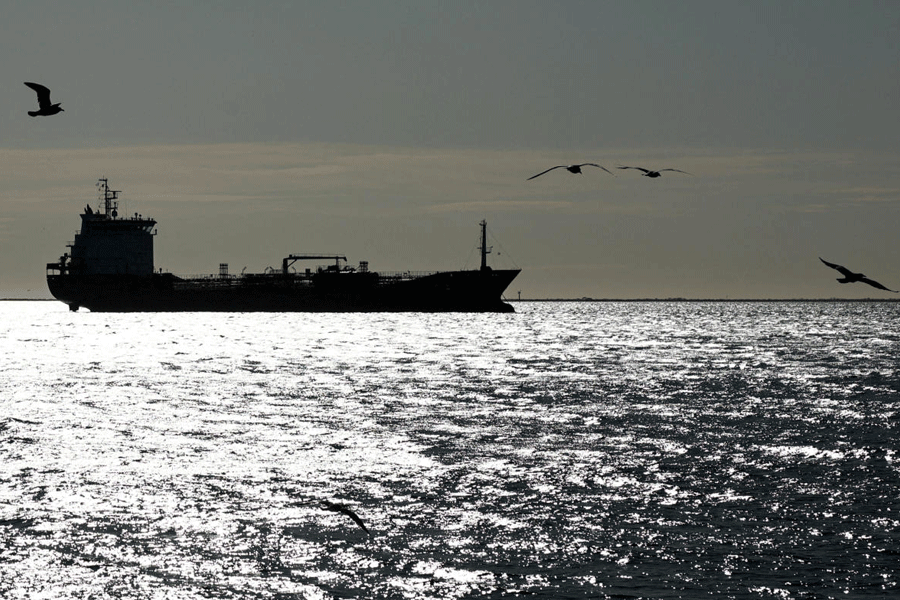
It may be second time lucky for India and Iranian oil. A very large crude carrier, the Jaya, loaded with two million barrels of crude, is now headed for Paradip on India’s east coast, according to tracking data.
If it docks as expected, possibly today, it will mark the first time in seven years that Iranian oil has landed on Indian shores.
The Jaya, which was bound for Southeast Asia, appears to have changed course mid-journey. “The trajectory suggests the cargo bound for Southeast Asia was redirected to India,” says Sumit Ritolia, senior analyst at Kpler, a leading tracker of global energy flows.
Another tanker, the Ping Shun, had been due to deliver Iranian crude to Vadinar a few days ago but steered away at the last minute and headed for China.
New Delhi has not bought crude from Tehran since May 2019, when US sanctions forced a halt to imports.
But with global supplies tight as a result of the war in the Middle East and prices surging, Washington has briefly eased sanctions, allowing purchases of Iranian oil at sea until April 19.
The conflict has choked tanker traffic through the Strait of Hormuz, a route that carries a significant share of the world’s oil.
The cargo aboard the Jaya has been purchased by Indian Oil Corporation, the country’s largest refiner.
Oil and Natural Gas Corporation chairman Arun Kumar Singh, meanwhile, has warned that India “must chase wherever oil or gas is in our country at any cost, go after every drop of oil and gas it can find at home”.
He says the war is a wake-up call and describes energy self-reliance as an “existential necessity”, particularly at a time when domestic production is struggling to keep pace with rising demand.
In the meantime, senior ministers have been travelling to secure supplies.
Ship-tracking data suggests more cargoes may be on the way. Another tanker, the Jordan, is signalling India as its destination.
A vessel carrying Iranian LPG, the Sea Bird, docked in Mangalore a few days ago.
Even so, the flow from Iran to India has been more limited than expected. Analysts note that while Iranian crude floating at sea is near record highs, well above 180 million barrels, relatively few cargoes are making their way to India.
South Asia is among the worst affected by the disruption to traffic in the Strait of Hormuz. India, along with Pakistan and Bangladesh, has long depended on Gulf producers that were just a few days away by sea.
In a move that underlines the pressure on domestic energy supplies, the government has given special permission for four vessels carrying Iranian crude to dock at Sikka on the country’s west coast. The request came from Reliance Industries, which runs the world’s largest refining complex there, according to Reuters.
Under normal rules, these ships would not be allowed anywhere near an Indian port. Much of Iran’s oil moves on what is known as a “shadow fleet”, tankers that often lack insurance and safety clearances. Letting them dock requires government exemptions.
According to industry sources, the shipping ministry has issued a one-time clearance for the four vessels, citing the emergency created by the shutdown of the Strait of Hormuz.
But Reliance is reportedly still weighing whether to actually process the Iranian crude, wary of falling foul of international sanctions or Indian regulations. The cargoes may be allowed in, but that does not automatically mean they will be refined.