|
|
| Equal respect |

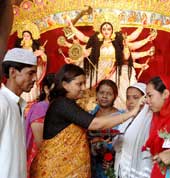
On November 12 was Diwali. A few days later is Id-ul-Fitr. And a week or so later Guru Nanak?s birth anniversary. Ideally, all the three communities ? Hindu, Muslim and Sikh ? should be sharing these joyous occasions together. Muslims lighting oil lamps in their homes and joining their Hindu and Sikh friends lighting sparklers, letting off crackers and tucking in mithai. On Id-ul-Fitr, Hindus and Sikhs greet their Muslim brethren after namaaz, embrace them twice and say Eid Mubarak and on Guru Nanak?s birthday, all communities exchange greetings. It was for good reason he is remembered as Nanak Shah Fakeer ? Hindu ka Guru, Mussalman ka peer ? Nanak the King of holy men; Guru of the Hindus, mentor of the Muslims.
Far from this idealistic state becoming a reality, we have become apprehensive about religious holidays of the different communities coinciding or being close to each other. Our prayers betray our fears: ?I hope they will pass off peacefully and there is no danga-fasaad.? I am convinced that if there are enough people who share my sentiments, we could turn things round and make religious festivals events to emphasize Bapu Gandhi?s vision of sarva dharma sambhava ? equal respect for all religions. All said and done, the three festivals I have referred to emphasize different ways of achieving the same goal, that is, of inculcating humanity in men. Diwali is the festival of lights symbolizing the end of the darkness of ignorance: the month of fasting during Ramadan is designed to purge evil thoughts from our minds and its culmination is celebrated on Id-ul-Fitr by giving zakaat (charity). The festival is also known as Id-ul-Saghir, or, the minor feast, as well as a feast of alms-giving to the deprived. And Guru Nanak stressed the need to translate truthfulness into a way of life:
Sachon ore sabh ko (Truth above all)
Oopar sachh aachar (Above truth, truthful conduct).
One does not have to display one?s religiosity by renouncing the world, wearing saffron garments or turn into a sadhu. No need to call off the work one is doing to become a better human being.
Religion lieth not in the patched coat the
Yogi wears
Not in the staff he bears
Nor in the ashes on his body.
Religion lieth not in rings in the ears,
Not in a shaven head,
Nor in the blowing of conch shell.
If thou must the path of true religion
See,
Among the world?s impurities, be of
Impurities free.
Of all the impurities we collect in our dealing with peoples of other faiths, the worst are prejudice and ill-will against them. Joining the festivals of all religious communities will go a long way in ridding us of them.
Noises through the night
A few days before Dussehra, a shamiana was put up alongside one of the walls of my garden. I assumed some wedding was in the offing because at times crackers exploded. But there were no coloured lights, nor sounds of brass bands. I was intrigued. One night, when I got up at 3 am to go to the loo, I heard what sounded like bhajans being sung by a couple of very tired, sleepy voices. I peered over the wall. The audience consisted of about ten people, half of them sprawled on the ground and fast asleep. However, the loudspeaker was turned on full blast to disturb the sleep of the entire mohalla. With some irritation, I recalled this happening in Kasauli, when the peace and quiet of the starlit valleys were shattered by some badly-sung bhajans being broadcast from a remote village through loudspeakers. Do all night jagrans have any sanction in our sacred texts, the Vedas, Upanishads, and epics like the Ramayana and Mahabharata? When and why did this ritual gain popularity? I consulted some of my learned Hindu friends: all of them assure me that there is no reference to them in the sacred texts, nor in either of the two epics. I also looked up Benjamin Walker?s two-volume dictionary, Hindu World. Neither jagran nor jagrata are mentioned.
My own conjecture is that the practice of singing bhajans as a means of approaching the divinity and bonding communities came with the Bhakti movement around 16th century AD. I have no idea when all-night singing of bhajans came into vogue. I will be grateful if any of my readers could enlighten me on the subject.
However, loudspeakers were not heard of till late in the last century and have been more abused to create noise rather than being used for legitimate purposes. We have been hearing about laws forbidding their use after 10 pm. No one, including the police, dares to stop people who consider disturbing their neighbourhood to be their birthright. Most of them are illiterate or semi-literate; that does not lessen their religious zeal. I think they indulge in it to spite the better-educated and better-off. I have also come to the conclusion that my growing deafness has something to be said in its favour.
Parking wisdom
A blonde walks into a bank in New York City and asks for the loan officer. She says she?s going to Europe on business for two weeks and needs to borrow $5,000. The officer says the bank will need some kind of security for the loan, so the blonde hands over the keys to a new Rolls Royce. The car is parked on the street in front of the bank, she has the title and everything checked out. The bank agrees to accept the car as collateral for the loan. The bank?s president and its officers all enjoy a good laugh over the blonde?s using a $250,000 Rolls as collateral against a $5,000 loan. An employee of the bank then proceeds to drive the Rolls into the bank?s underground garage and parks it there.
Two weeks later, the blonde returns, repays the $5,000 and the interest, which comes to $15.41. The loan officer says ?Miss, we are very happy to have had your business, and this transaction has worked out very nicely, but we are a little puzzled. While you were away, we checked you out and found that you are a multi-millionaire. What puzzles us is, why would you bother to borrow $5,000??
The blonde replies: ?Where else in New York City can I park my car for two weeks for only $15.41 and expect it to be there when I return??
(Contributed by Vipin Buckshey, New Delhi)