
Finally, after protracted negotiations in Brussels, Eurozone leaders have agreed to offer Greece a third bailout, thereby averting the risk of Greece leaving the Eurozone.The European Union has suggested that it will be providing up to 86 billion euros of financing for Greece over three years. Although this includes an offer to reschedule Greek debt repayments "if necessary", there is no provision for the reduction in the Greek debt that the Greek government had sought. Greece will have to pass reforms demanded by the Eurozone -which include measures to streamline pensions, raise tax revenue and liberalize the labour market. Many in Greece would be wondering what the point of the referendum held last week in Greece was.
The Greek government had decided that the only way forward to resolve the dilemma facing Athens is to hold a referendum on the controversial bailout deal with foreign creditors. The Greek prime minister, Alexis Tsipras, faced a very difficult decision and he decided to go to the people for an answer. And Greek voters delivered a defiant response to Europe. Political leaders and heads of government from across Europe had lined up to warn the Greeks that a "No" vote would be a vote to leave the euro. That did not deter them. More than 60 per cent of the Greeks voted "No" to reject Eurozone's cash-for-reform proposals, although Prime Minister Tsipras continued to insist that it is not a mandate against Europe.
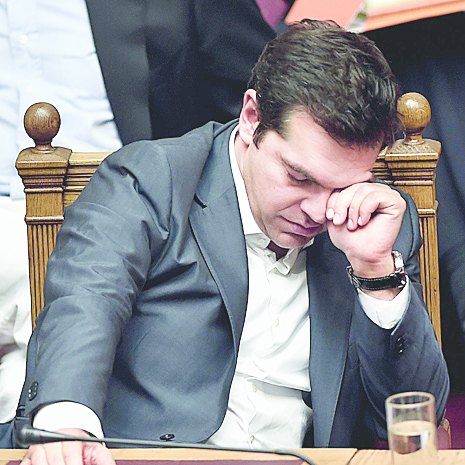
But the final deal struck between Athens and the Eurozone members has left many Greeks humiliated. Many are using the word, "surrender", to describe Greeks government's response. The Greek prime minister will have to rush key measures on pension reforms and tax increases through a divided country -which will be a bruising process.
Greece had rejected an offer from its creditors to extend the country's bailout deal as too little and likely to cause recession. The country's international creditors had made the new proposal so that it could avoid defaulting on its debt - provided it agreed to reforms. The proposal of global creditors would have released around 15.5 billion euro of funding, 1.8 billion euro of which would have been available to bail Greece out. But the Greek government rejected it forthright, saying that it "cannot be accepted". As a result of Greek default, Greek banks did not open for days after the European Central Bank froze their liquidity lifeline. Credit agencies have reduced the ratings on Greek banks so they're almost junk. Even if they have collateral to give, they may not be able to get new funding.
The relationship between the Greek government and the EU has been deteriorating over the last few months, with the war of words now reaching an unprecedented level. The Greek prime minister has accused the lenders of blackmail, saying, "Europe's principles are not based on blackmail and ultimatums." The German chancellor, Angela Merkel, however, had been urging Athens to accept what she has called an "extraordinarily generous" offer. Rejecting the charges of the Greek government, Jean-Claude Juncker, the president of the European Commission, maintains that the deal "is about the Greek people, not the government" and that "there was no ultimatum. We are not running business by announcing ultimata."
The leftist government of Tsipras was elected on the promises of no more austerity measures. So it is finding it difficult to get the right balance between managing a deeply flawed economy and promises to its voters. The ordinary Greeks are tired of the austerity measures imposed on them over the last five years. The critics point out that the EU is finding it difficult to believe in the commitments of the Greek government because it has wasted five years of the bailout without making serious attempts to fix the structural problems that beset the economy - and in many cases, it is actually going backwards. Other European countries like Ireland and Spain, which were facing similar problems, are now on the road to recovery because they have managed to reform their economies over the last five years. But five years into its austerity regime, the Greek government once again had to go cap in hand to its creditors and ask for more money.
The differences between Greece and its international creditors were stark. Greece had refused to accept cuts to pension payments or public sector wages while the International Monetary Fund has been pushing for deeper spending cuts, not just more tax rises. A key point of friction was a special benefit paid to some low-income pensioners that creditors wanted scrapped. Creditors also wanted a wider VAT base; Greece has said that it will not allow extra VAT on medicines or electricity bills, and had also resisted calls for VAT hikes on hotels and restaurants. Athens wanted a concrete commitment to debt relief, something its creditors are not offering.
The future of the EU is clearly at stake. But increasingly it is becoming much more than that. Geopolitics is not far away. Washington has been expressing concerns about the effects of Greece's exit from the euro on the global economy, but lately, President Barack Obama himself has come out to put pressure on the Greek government by asking the Greek prime minister to make "tough political choices". Obama's intervention is underscoring fears in Western capitals that Greece could be driven into the arms of Russia. Leaving the euro could force Greece to seek Russian aid and that would entail a price. Although it is not readily evident if Moscow can bail Athens out, given the scale of the crisis facing Greece, Greek's gravitation towards Russia is a possibility that the West cannot afford to ignore. Tsipras has already threatened European unity over Russia's actions in Ukraine by calling for an end to sanctions.
Moreover, Greece has a history of coups and there are fears that leaving the euro could prove to be politically debilitating. Voters turned to Syriza amidst dissatisfaction with traditional parties. If Syriza leads Greece out of the euro, or gets a deal deemed unacceptable, voters may turn even further away from the mainstream, towards communism or right-wing parties.
The Greek economy is in free fall, and the banks - without further liquidity assistance from the European Central Bank - will collapse. Indeed, the economic situation has deteriorated so sharply that any bailout deal will have to be toughened. Although Greece is a minor economy, if it exits the eurozone, repercussions will be felt in the rest of Europe and the world economy. This is not the kind of news the global economy would welcome at a time when it is just about managing to get out of recession. It is for this reason that the world has been watching the drama unfolding in Europe with bated breath. Although the crisis seems to have been averted for now, the European project has done some lasting damage. The divisions between France and Germany are out in the open and the future of the EU looks more uncertain than ever before.
The author is Professor of International Relations, Department of Defence Studies, King's College, London