Snow flurries circled in the air that winter in Tabriz in northern Iran where the old man sitting outside his old shop of curios was plucking the rhubarb. I stopped to listen.
“Where are you from?” he paused to ask.
“Al Hind, Hindi.” By then I knew that India and Indians were called Hindi in Farsi.
“Ah,” he grinned, plucked the strings and played Mere Saamne Wale Khidki Mein, the all-time Kishore Kumar favourite from Padosan.
I was thrown. As a student of history there was some reading of the Persian and Indian civilisations behind me but I didn’t know it could be so alive that Moharram of 2010 when we were on our way to the Gaza Strip by road, on assignment for The Telegraph.
The old man was Azeri – Tabriz is the capital of Iran’s East Azerbaijan province – where we were waiting to cross over the Bazargan border in the Alborz Mountains into Turkey by the side of Mount Ararat in Armenia.
Iran throws you in many ways. That snowy morning in Tabriz is one of the pleasantest.
Quite contrary to what the US and Israel are now going through: the Shah Mat (checkmate) in the Persian Gambit.
Iran claims it gave birth to the game of chess. Though the Persian word for the game – Shatranj – is probably a derivative of the Sanskrit Chaturanga.
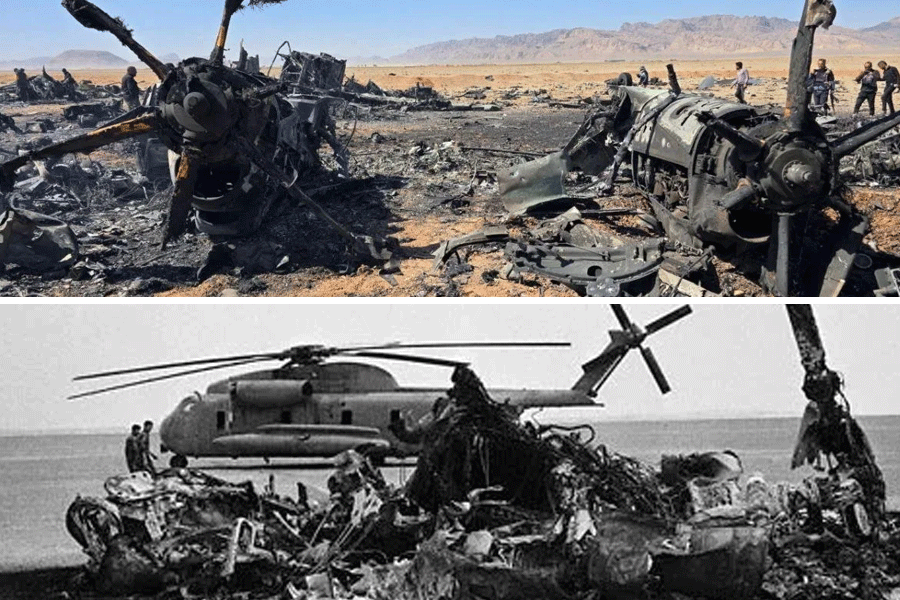
Part of that lesson should have been learnt from the debris of the Chinook helicopters that were still lying that winter in the Dasht-e-Kavir, the Desert of Salt, by the side of the road between Tehran and Tabriz.
The tale of the talons, Operation Eagle Claw, was an American effort in April 1980 to rescue 54 hostages held in the US embassy in Tehran – that the Israelis bombed in this war. Eight helicopters flew into the desert to establish a staging post. Five made it. Three, said the Americans, had developed technical problems. The Iranians – the Islamic revolution of Ayatollah Khomeini was in the previous year – claimed to have shot them down.
This time, the Americans and Israelis despatched more aircraft, four C-130Js customised for special operations, MH-60 Little Bird (Jolly Green 2) helicopters, MQ9 Reaper armed drones, ostensibly to rescue a gallant colonel who had ejected from his crashing F-15E Strike Eagle, had climbed a 7,000-foot mountain with a broken ankle and hidden in a cave while beeping his status under fire to his would-be rescuers from his personal locator beacon.
Two aircraft, said the Americans, “got stuck in the mud”, not unlike the “technical issues” of 1980’s Eagle Claw.
Identity papers and personal belongings found from that operation after two C-130Js and the Jolly Green 2 helos were blown-up – either by Iranian fire or because they were scuttled – indicate the American-Israeli effort was for a longer haul, beyond the rescue of the pilot.
You don’t leave your calling-cards behind in a quick-in-fast-out combat manoeuvre. The staging ground was less than 100 km from the nuclear facility at Natanz.
The failure of the operation broke the Trumpean spirit and the Orange went into a paroxysm of public rants, using expletives and promising to destroy a civilisation, in rhetoric that shocked even his own MAGA constituents.
In the Shah Mat for now, till the next geopolitical boardgame, the Iranians are clear winners. The clear loser is Israel (and by summit association, the ‘Motherland of the Fatherland’, India).
Through the devastation of the bombings and missile strikes across more than 7,000 targets in Iran, on its leadership, on its schools, universities, bridges and hospitals, Tehran has scripted the heroic story like that of the Bolsheviks in the Battle of Stalingrad during the Second World War – a smile through agony.
How? In the 10-point Iranian proposal that Trump has now called “workable”, Tehran has:
- all but taken its nuclear programme off the table
- established supremacy over the Strait of Hormuz
- removed sanctions on sale of its oil that could yield up to $60 billion a year
- imposed a toll on tankers in the “f****n’ Strait” that may result in moolah worth $90 billion.
Iran is a big country, not as big as India, but more than the size of Western Europe, blessed with geography and topography. In the Moharram of 2010, as I drove from Zahedan, near the trijunction with Afghanistan and Pakistan, to the Bazargan border into Turkey, through Shiraz and Qom and Tehran where I too had to walk over the US and Israeli flags to enter the crowded university auditorium for a quote from then President Mahmoud Ahmadinejad, the Zagros mountains were always on my left as we drove north.
Sometimes the top of mountains were white with snow while the hard frozen sand through much of the desert was caked brown.
Surrounding Iran, before this war there were 26 US military bases (45, according to Julian Assange). At least 13 of them are now shut. That includes the headquarters of the US 5th fleet in Bahrain, from where I had once flown to the aircraft carrier, the USS Carl Vinson, that patrolled the Persian Gulf with its strike group. At night in the Gulf, the wellheads of Iran’s rigs in the South Pars field burnt orange.