Every year, the Economist Intelligence Unit publishes its Global Liveability Index. Cities get ranked based on stability, healthcare, culture, environment and infrastructure. In 2025, Copenhagen was at the top. Melbourne, from where I write this, sits near the summit and reliably so. Delhi and Mumbai both ranked among the lowest of the cities assessed globally. At the bottom are Karachi, Dhaka, Tripoli and Damascus. My city of birth, Srinagar, doesn’t appear. And, yet, some of the most liveable years of my life were spent in Srinagar.
Liveability, come to think of it, has two registers. The first is what indices like the EIU’s measure: the material conditions without which everything else becomes a daily struggle. The second is harder to name: the quality of aliveness a place generates. Whether it holds you. Whether it permits you, in some basic, unspoken way, to be yourself. Whether it’s threaded through with enough shared history, enough human texture, enough soul, that being there makes you more fully present; not just housed, fed, and connected, but genuinely alive to where you are. No index captures this second register. But anyone who has lost it knows exactly what it is.
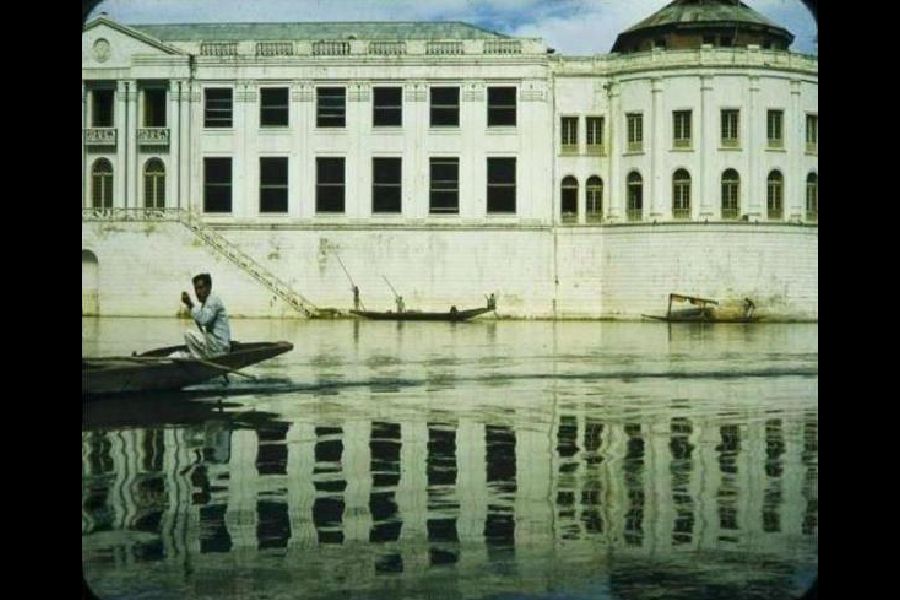
Growing up in Srinagar in the 1960s and the 1970s was extraordinary. The city would have even then ranked low in infrastructure and even in modern healthcare. But on most other parameters, it would stand out. Air so clean it felt almost unfair in retrospect. Water you could drink directly from the Chashma Shahi spring or the Lidder in Pahalgam without a second thought. The surroundings, in a period of political quiescence with a robust cultural calendar, would ensure that the city did well even in the EIU’s first register. What would make Srinagar stand out, however, was its weight on the second.
Consider these markers: cycling to Burn Hall — the old missionary school run by the Irish Mill Hill order — where Father Farrow taught English with a Wren and Martin rigour that brooked no argument. Lunch came from home, still warm, wrapped in cloth in massive tiffin-carriers. Before television arrived: games, orchards at Zakura, apples off the tree, milk from cows we knew by name. Those years were liveable not because they were comfortable — they weren’t, especially in a joint household of varying temperaments — but because every hour felt inhabited. Not affluent. Not smart. But fully, unselfconsciously alive. From our first-floor windows, the Shankaracharya temple floated above the city in the early morning light, its silhouette barely there, as if the hill itself were dreaming it. Below, the azaan rose before dawn, and before it had faded, the temple bells had begun, and somewhere between them — without contradiction, without negotiation — the Gurbani. Three calls to the sacred, woven into a single morning. That was Srinagar’s second register: not a policy achievement, but a civilisational one.
Srinagar today is a different matter. Violence, congestion, pollution, and the slow strangulation of its waterways have made it, by most objective measures, one of the least liveable cities in the subcontinent. Dal Lake — once the pulse of the valley — has shrunk. The streets where I cycled are gridlocked. A pervasive sense of fear and suspicion, the unresolved polarisation of decades of senseless violence, fills the air. What was lost wasn’t just infrastructure and harmony. It was something harder to name: the simple ease of being alive in a place.
In the 1980s, students at Jawaharlal Nehru University in New Delhi — technically in the capital, but distant from it in every way that mattered — will recall how it scored on the second register. JNU was its own habitat: a subculture sealed off from the city by the ancient Aravalli hills, by its own internal weather of argument and solidarity, by the almost wilful indifference of its inhabitants to everything that lay beyond its gates. Water arrived twice a day. Electricity cuts were routine; air-conditioning was a fantasy. The food in the hostel messes was consistently inedible. The mosquitoes delivered regular bouts of malaria and dengue with something approaching professional commitment. And yet, those years were among the most vitally liveable. Conversations ran past midnight at dhabas. Arguments about politics, philosophy, and poetry felt urgent, even dangerous and, therefore, precious. Friendships formed under conditions of productive scarcity. Few stepped
outside in all the years spent there —
it was a complete universe, self-sufficient in ways that had nothing to do with comfort. This, again, is the second register: not comfort, but depth. JNU had
almost none of the first and an abundance of the second. Srinagar once had plenty of both.
I’m writing this from Melbourne, which has over the past decade become something like a second home — and which, I should confess, has begun to make me feel inhabited in ways I didn’t expect. The city wears its EIU rankings with quiet satisfaction. The trams, the parks, the Saturday morning rhythms of our home in Kew, the fair-trade coffee that people here take entirely seriously — these things are real. But what surprises me, still, is how often Melbourne generates the second register too: the particular quality of light on the Yarra in the late afternoon when the city seems briefly to have forgotten it is a city; a conversation about the poet, Evelyn Araluen, that runs long at a table that wasn’t expecting it; and something I hadn’t anticipated — the sensation, at the NGV one wet Tuesday, of standing before the extraordinary painting of the indigenous artist, William Barak, and feeling, quite suddenly, that I was
in the presence of a civilisation that had its own deep register, its own accumulated centuries of being alive in a particular place. It reminded me what the second register feels like when it is genuinely present.
And yet it cannot entirely compensate for losing Srinagar. That is not only private grief but something more collective: the loss of a particular way of being there in a particular place. The philosopher, Simone Weil, wrote that to be rooted is perhaps the most important and least recognised need of the human soul. What she understood — and what the index-makers don’t — is that rootedness is not sentiment. It is a form of sustenance. Exile, whether forced or circumstantial, does not merely displace the body; it quietly empties the world of its depth. One continues to live, but in a thinner register. I would add only this: that the second register is not merely lost when a city fails — it can also, slowly and with great effort, be built. Melbourne is proof of that. The grief is that Srinagar, which once needed no such effort, will have
to begin again from the memory of a
lost past.
Amitabh Mattoo is Dean and Professor, School of International Studies, JNU; and Honorary Professor at the Faculty of Arts, University of Melbourne