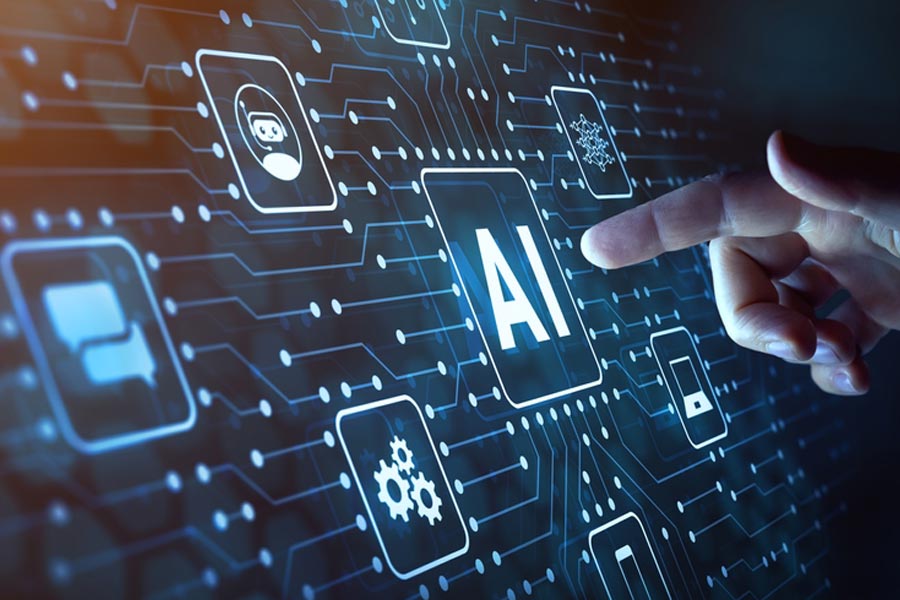
In the last 10 years, the world has experienced many unprecedented breakthroughs. One of them, on the technological front, is the advent of large language model-based Artificial Intelligence.
Every invention and technological advancement comes with its own boon and bane. AI is not going to be an exception. What is distinctive about AI is its ability to mimic certain human qualities with far more efficiency. Actions that required human intervention can now be delegated to AI. On the occasion of Teachers' Day, when my students were busy conveying their respect and gratitude, I was occupied with the thought whether teachers, too, would be replaced by AI.
The use of technology in teaching is not new. Technology has made teaching accessible, overcoming various barriers. When the internet opened the floodgates of information, search engines like Google earned the sobriquet of the modern 'guru' or teacher. The wealth of information on the internet, however, did not make teachers dispensable — because teaching is not only about imparting information and learning is not limited to information-gathering. Having a meaningful dialogue is an important part of the teaching-learning process. Dialogue serves both as a means and as an end in teaching. In his book, Pedagogy of the Oppressed, the famous Brazilian educationist, Paulo Freire, had strongly criticised the practice of teaching where learners' role is confined to being a silent recipient of knowledge. AI, thus, will do a better job
than a teacher in a classroom with little or no space for students to engage in a dialogue. AI not just caters to information; it collates and coheres information from various sources and conveys the same in a conversational manner. For a student, the attraction of AI is that it gives the learner an opportunity to engage with the technology, to prod it further without the fear of being silenced.
But teaching is not restricted to accessing content. Context is far more important than content. Context gives meaning to content. AI may present the content in a comprehensive manner — this, too, may suffer from the biases it is fed — but it falters in contextualisation. The reason is that context is a contested terrain, with multiple claimants. It does not end with the churning out of information and thus eludes a straightforward answer.
Contextualisation also involves interpretation and critical cognition; it demands looking at things from multiple perspectives. It is one thing to learn about Michel Foucault’s 'regime of truth’ and quite another to understand how it works and affects us in a post-truth world. Similarly, to read and understand Marxism in the age of thriving capitalism and widening inequality is not simply about having access to the content on Karl Marx and his ideas.
AI is helping students compose critical essays for their examinations and assignments; students are eagerly making use of it. But the moot question is whether AI can make students ask the right questions. Can it train young minds to debate and challenge the
status-quo? Social science education is supposed to make one critically aware of social realities. Freire termed it as "conscientization": a critical consciousness that eventually leads to the dismantling of oppressive structures. Social scientists play the role of interpreters of social maladies and in doing so they often face the wrath of power. AI is yet to reach that level where it can awaken critical consciousness to bring change to society. For this reason, AI would not be able to replace a social science teacher as long as social science as a discipline is allowed to do what it is meant to.
My claim is not a reflection of self-assuring hubris to establish my indispensability as a teacher. When I asked AI the same question it also agreed, saying that it can make teaching-learning more transformative but it lacks a human's interpretive faculties. There is intelligence in AI, but we must not forget that it is artificial.
Nirupam Hazra is Assistant Professor, Department of Social Work, Bankura University, West Bengal