|
|
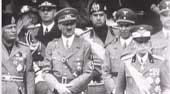
| The war heroes? |

MUSSOLINI
By Peter Neville,
Routledge, Rs 320
Benito Mussolini has often been portrayed as a tin pot dictator, playing second fiddle to Hitler. However, till 1930, Mussolini was the idol of extreme right-wing forces all over Europe. Peter Neville attempts a sympathetic understanding of the dictator by bringing into focus both his private life and public achievements. Contextualizing Mussolini and comparing him with the founder of Nazism, says Neville, will lead to a balanced view.
Neville says that his father?s socialist leanings had a strong influence on young Mussolini, who started his career as a schoolteacher. He succeeded as a journalist and in 1912, became the editor of the prestigious socialist newspaper, Avanti. When World War I began in 1914, Mussolini declared that Italy should join the war for territorial aggrandizement. As a result, he was expelled from the communist party. Neville considers this a turning point in Mussolini?s life. From then on, Mussolini?s tilt towards extreme right wing politics became more pronounced.
Both Mussolini and Hitler served in the trenches and both men realized that soldiers? frustration and economic woes could be exploited for acquiring power. The Fascist movement started in Italy in 1919, and in 1921, Mussolini became leader of the Fascist party. In 1922, Mussolini was appointed prime minister given the overwhelming support for Fascism?s ultra-nationalist agenda.
Neville says that since Mussolini, unlike Hitler, was not the leader of the largest single party in parliament, Mussolini?s Fascist state was characterized by compromises with the traditional elite. Hence, Mussolini had to retain the monarch as commander-in-chief of the armed forces and had to provide autonomy to the Vatican. This disappointed hardcore Fascists and threatened Mussolini?s position. So, with the aid of the state institutions, Mussolini crushed his adversaries. His crackdown was however not as severe as Hitler?s.
Mussolini initiated some positive schemes. He destroyed the mafia in south Italy, increased jobs for the middle class and abolished strikes, which won him the support of industrialists. However, the main support came from urban white collar workers. Neville?s analysis thus supports Seymour Martin Lipset?s categorization of Fascism and Nazism as petite bourgeois movements. However, Fascism, says Neville, was not characterized by the biological determinism of Nazism.
Mussolini?s decline started when he teamed up with Hitler. The Rome-Berlin Axis in 1936 was to gain a colonial empire in Africa cheaply. The Anti-Comintern Pact signed next year between Japan, Germany and Italy was Mussolini?s attempt to tighten the screws on Britain. Its logical culmination was the Pact of steel with Germany in 1939. Even then, asserts Neville, Mussolini had no ambition of going to war with France and Germany. In September 1939, Mussolini was horrified to find out that Hitler was determined to wage war. By this time, Mussolini had become the junior partner in the Axis alliance and even feared that if he disobeyed the Fuhrer then Germany might invade Italy. The onset of Total War made him unpopular in Italy. In April 1945, the Duce was eliminated.
This slim volume would be useful for a thorough understanding of Mussolini. It is important to note that all right-wing movements must not be grouped together. Mussolini was not intrinsically bad, unlike Hitler and Stalin. But, writes Neville, Mussolini had to pay the price, because he supped with the devil.