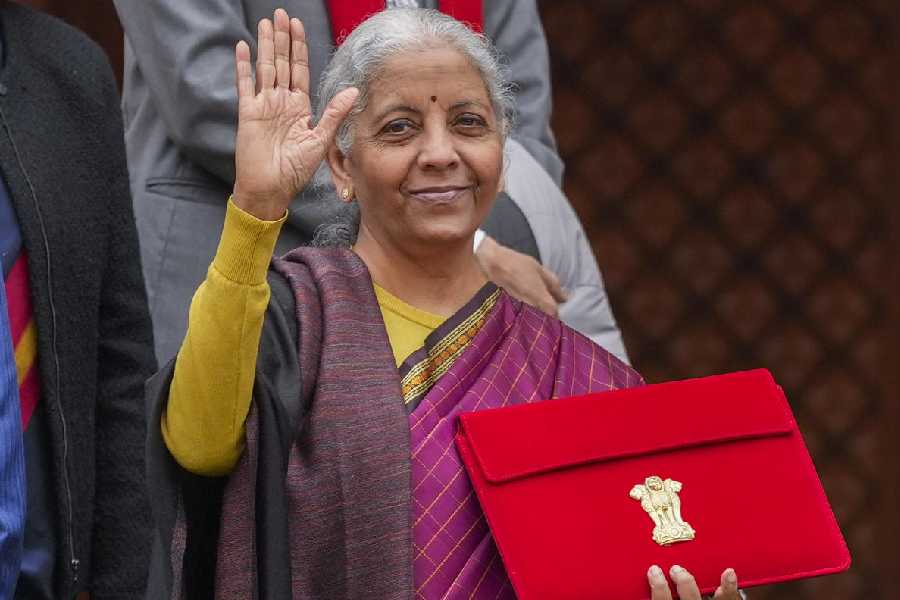
The current international situation calls for greater reliance on domestic manufacturing. At the same time, it requires flexibility to integrate into emerging international trade networks. This year’s Union budget attempts to respond to both these issues. For greater self-reliance, the finance minister, Nirmala Sitharaman, has singled out a specific set of industries, ranging from biopharma and rare earths to electronics and semiconductors, that would receive policy support. These industries would have to depend on cutting-edge technologies like Artificial Intelligence and are unlikely to generate much new employment. Hence, alongside these initiatives, Ms Sitharaman has allocated resources for stimulating new career pathways and employment opportunities in sectors like tourism, healthcare, education and gaming. On the international trade front, lacerated by global headwinds, she has tinkered with and tweaked duties for a long list of imports and facilitated exports in many ways. Doing business in this sector should certainly be easier now. Overall, the new projects initiated in Part A of the budget appear to be focused on the economic reality of a changing global order, and not on domestic populism with a plethora of welfare schemes. However, the finance minister has an added challenge. She cannot take her attention away from improvements in consumption and the quality of life for the common person. The budget’s response to the Indian economy’s persistent red flags — youth unemployment, inequality, tepid consumption and so on — remains poor.
On the taxation front, there have been no changes in rates and incidence; the new Income Tax Act comes into play from April 1, 2026. However, a lot of granular changes were announced pertaining to tax collections and deductions at source. Numerous simplifications have been done and safe harbours announced regarding penalties for non-compliance. Regarding customs duties, the objective was clear — make exports more competitive and allow greater imports of materials and components that would promote exports or augment domestic manufacturing. It appears that Ms Sitharaman has assumed that the nominal growth of the economy would be well above 7%. The budget has also been able to restrict the fiscal deficit to 4.4% of GDP for the revised estimates for 2025-26, and bring it down further to 4.3% in the budget estimates for 2026-27. The revenue deficit has been unchanged at 1.5% from the revised estimates for this year to the budget estimates for the next year. Overall, the budget attempts to put India as part of the changing global order with its focus on AI and rare earth metals. Giving an unprecedented 21-year tax holiday for Indian data centres is another indication of the changing times. That the global order is changing is beyond doubt. What was not discernible though is whether there is a need for the Indian economy to belt-up for a long period of uncertainty and disorder.
The Union budget is, however, not limited to being an economic doctrine. It often bears glimpses of the political imperatives of the ruling regime. In this respect, this year’s budget’s silence on poll-bound Bengal is revealing.