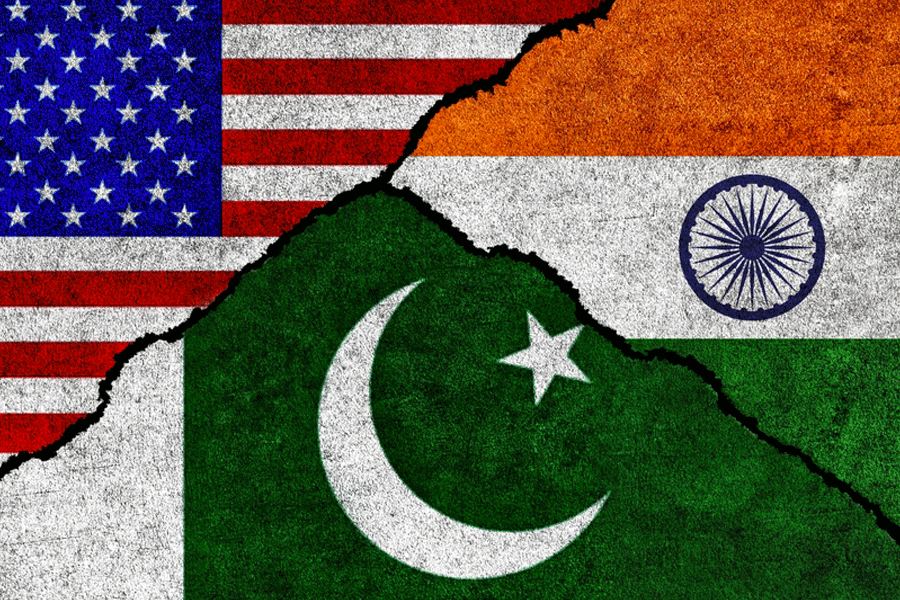
India-Pakistan relations continue to pose a risk of nuclear conflict despite neither side seeking open confrontation, the US Intelligence Community has warned in its Annual Threat Assessment presented to the US Senate.
The 34-page report noted that while both countries aim to avoid escalation, the presence of terrorist actors keeps the region vulnerable to sudden crises.
“India-Pakistan relations remain a risk for nuclear conflict given past conflicts where these two nuclear states squared off, creating the danger of escalation. The terrorist attack last year near Pahalgam, in the Indian Union Territory of Jammu and Kashmir, demonstrated the dangers of terrorist attacks sparking conflict,” the document said.
“President Trump’s intervention de-escalated the most recent nuclear tensions, and we assess that neither country seeks to return to open conflict, but that conditions exist for terrorist actors to continue to create catalysts for crises,” it said.
On South Asia more broadly, the report highlighted the continued presence of ISIS-K (Islamic State – Khorasan Province), which retains ambitions to carry out external attacks, even as the Taliban has stepped up countermeasures.
“The Taliban has conducted extensive raids against ISIS-K targets, probably thwarted some attacks, and driven some ISIS-K leaders to relocate to neighbouring countries,” it said.
The assessment also raised concerns over Pakistan’s advancing missile capabilities, noting that its military is developing increasingly sophisticated systems that could extend strike capabilities beyond South Asia, potentially including intercontinental ballistic missiles that may threaten the United States.
It further pointed to strained ties between Pakistan and the Taliban, marked by periodic cross-border clashes and rising tensions over militant groups operating from Afghan territory.
“Relations between Pakistan and the Taliban have been tense, with intermittent cross-border clashes, as Islamabad has become increasingly frustrated with anti-Pakistan terrorist groups’ presence in Afghanistan while Islamabad faces growing terrorist violence,” it said.
The report detailed a recent escalation, stating that on February 26, the Afghan Taliban carried out strikes on Pakistani military positions along the border in retaliation for earlier Pakistani airstrikes. Pakistan, in turn, launched counterstrikes, including on Kabul — marking the first time it has targeted Afghanistan’s urban centres.
“The fighting has continued since it erupted. Pakistan’s army chief warned this month that lasting peace requires the Taliban to sever ties with militants targeting Pakistan. The Taliban’s public posture has been to call for dialogue, but it has denied harbouring anti-Pakistani militants,” the document said.