These days, foreigners are suspect everywhere. Accusations continue to proliferate: cultural Otherness, border-violation, usurpation of jobs, electoral transgressions… it goes on and on. These feelings straddle the globe, rising to crescendos in North America, large stretches of western Europe and much of the Indian subcontinent. As various kinds of intensive revision claim the quest for illegal voters in India, a very different group has also come under intense suspicion from the ruling dispensation — foreign scholars who think, write, and research about South Asia. While attacks on the work, presence, and activities of White scholars such as Wendy Doniger, Francesca Orsini and Audrey Truschke have been widely noted, just as evident has been the violation of the rights of Indian-origin diasporic scholars such as Nitasha Kaul and Vinayak Chaturvedi, whose citizenly rights have been questioned repeatedly, not only intellectually but also legally and often abruptly at airports. (That so many of these ‘controversial’ figures are women is also impossible to miss.) For obvious reasons, the foreign thinker on India is a different category from the much-vilified domestic liberal, even though they overlap significantly.
As the Rashtriya Swayamsevak Sangh turns 100, its elaborate architecture of the image of India as a Hindu rashtra requires the scaffolding of a historically and spatially expansive vision. But it is now widely known that purist self-constructions of nation or culture are rarely as indigenous as they imagine themselves to be. At the dawn of the 21st century, before the 9/11 terror attacks on New York City, the American scholar, Michael Hardt, and the Italian philosopher, Antonio Negri, had argued that religious fundamentalism of any stripe indicates no old tradition. Fundamentalism is a postmodern phenomenon, a violent polemic against modernity, capitalism, and globalisation. Perhaps a more ‘modern’ project, Hindutva, is likewise understood as a significantly colonial, and particularly Victorian, venture and its sanitary morality rooted in a prudish Protestantism. A new book that recently came my way reinforces the foreignness of forces behind the ideas of Hindutva as well as Hinduism. It shows how crucial White Westerners were to the crafting of the idea of India and Hinduism, and even to the nationalist conjunction of the two.
A clear argument running through Somak Biswas’s thought-provoking book, Passages Through India: Indian Gurus, Western Disciples and the Politics of Indophilia, 1890-1940, is that the romantic engagement with India by White Westerners was primarily rooted in “upper-caste Hindu imaginaries”. For Biswas, this engagement comes into existence and rises to prosperity through the influential networks around three key figures: Swami Vivekananda, Rabindranath Tagore, and Mohandas K. Gandhi. His claim that all three of these figures shared pride in “Aryan civilisational greatness” is provocative. But it is equally important to note that this greatness found forceful global championship in the thought and the work of notable Western followers of these figures, most significantly C.F. Andrews and Sister Nivedita, who upheld “belief in Aryan superiority, borne by contemporary ‘scientific’ claims about the distinctiveness of this ‘racial stock’”.
Sabarmati and Santiniketan occupy significant space in a nationalist vision of India, and Biswas also notes a couple of other institutions, including Ramakrishna Mission founded by Vivekananda and the Gurukul Kangri set up by Munshi Ram. The iteration of celibacy that defines these institutions, most strikingly in the Ramakrishna Mission through Ramakrishna’s famed aversion of women and gold, particularly hit home for me as someone who has written about homosexual relationships in a boarding school run by this mission and have faced some vigorous responses in return. Gandhi’s controversial practices of celibacy are also discussed in the book, but what stands out is not only the RKM’s quest of support for Hindu Mahasabha leaders but more importantly, the invocation of Sister Nivedita as an icon of Hindu nationalism in V.D. Savarkar’s Hindutva: Who is a Hindu?
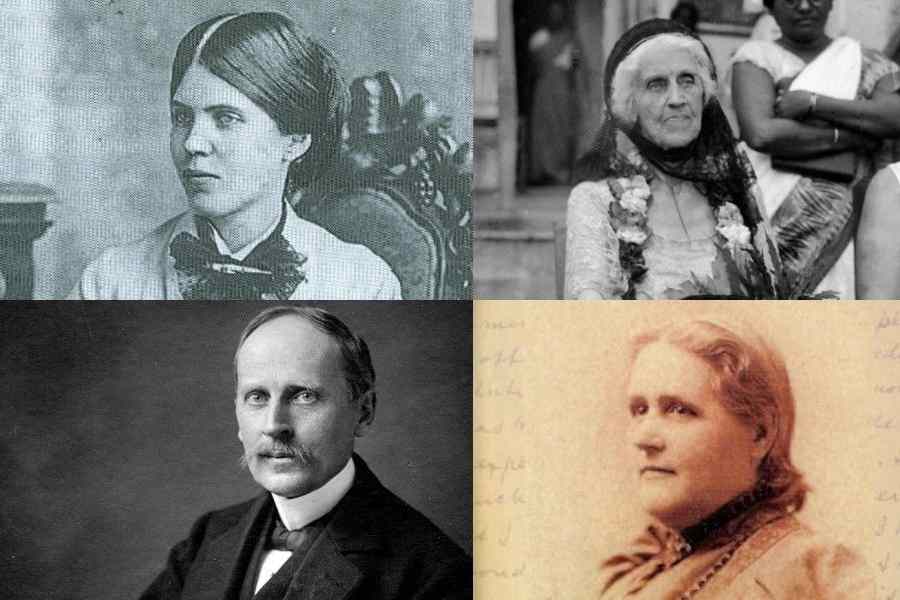
Apart from Nivedita and Andrews, Western patrons and Indophiles such as Sara Bull, Josephine MacLeod, William Pearson, Sarah Waldo as well as scholars such as Romain Rolland shaped various networks that not only projected India globally but also ended up celebrating Hindu nationalism. Vivekananda’s Western travels globalised Vedanta by enforcing a “subtle form of Hindu supremacism”. Though there are intricate layers to Vivekananda’s version of Hinduism, including his attempt to universalise it beyond Brahminical control, contemporary Hindutva’s appropriation of Vivekananda is hard to dismiss as mere political opportunism. The high-Brahminical posturing of the image of the vishwaguru today has a distinguished ancestry ironically reinforced by a White-Western network of patronage and Indophilia.
A striking insight uncovered by Biswas is the emergence of Vedanta as “a bhadralok cultural project — a bourgeois discourse for middle-class Hinduism that justified its members’ material aspirations.” The irony of this was embodied in my own experience writing about the centrality of aspirations for engineering and medical careers in a monastic boarding school. But the wide and lasting impact of Vedanta as a bhadralok project can be fully realised from the way the early liberalism of Bengali thinkers gave way to the strident cultural nationalism by the end of the nineteenth century. This is the complex shift within which Biswas places Bankim Chandra Chattopadhyay. A full realisation of the political faith behind Bankim’s song “Vande Mataram”, which has recently tremored through the rhetoric of national imagination, is impossible to understand without attention to the emergence of bhadralok Vedanta.
It is a truism that the Western scholars vilified by Hindu nationalists today are completely different from the White Indophiles, patrons, thinkers and activists who helped globalise Hinduism, and to a fair degree, Hindutva, by building networks around their Indian gurus. Scholarship on South Asia, by Indian and Western scholars alike, has been transformed through critiques of historicism and dominant positions in gender, caste, class and nationalism. No doubt it is this transformed identity that galls the Hindu Right. But as I realised last semester, when I taught an excerpt from Meera Nanda’s recent book, Postcolonial Theory and the Making of Hindu Nationalism, in my university-wide introductory class on liberal arts education at Ashoka University, the complicity between ‘enemies’ can be just as complicated as that between ‘allies’. Is the changing trajectory of Hindutva’s relation with ‘foreigners’ an index of its future as its most significant organisation steps into its second century?
Saikat Majumdar’s most recent book is The Amateur: Self-Making and the Humanities in the Postcolony