India is making a hard pivot back to Russian oil, ramping up purchases, as the Middle East war turns into a direct threat to global energy supplies.
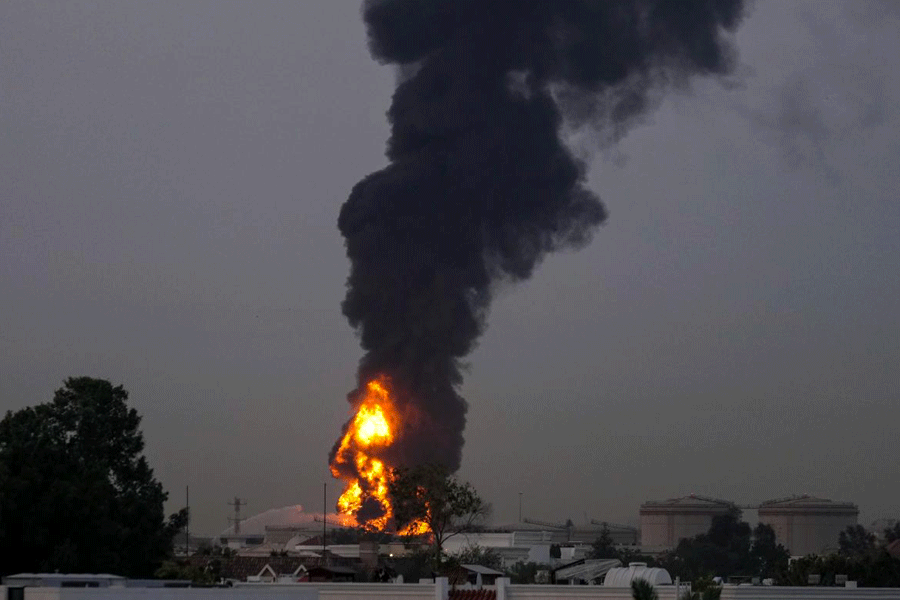
Fears of a full-blown fuel crisis have intensified after Iran on Wednesday fired a ballistic missile into Qatar’s Ras Laffan Industrial City, home to the world’s largest LNG export complex, and warned that other oil and gas sites across Saudi Arabia and the UAE are now “legitimate targets.”
India imports around 27 million tonnes of LNG annually, of which about 10-11 million tonnes per year comes from Qatar. India was already grappling with an LNG squeeze as Qatari shipments passed through the crucial Strait of Hormuz where traffic has been severely disrupted.
Now, though, the conflict has hit the supply at its source with experts saying the ëxtensive damage to the Qatari plant, which accounts for a fifth of global gas shipments, may mean it could take months, possibly years, for supply to be fully restored.
Markets are already reacting to the dramatic escalation in the Middle East conflict with Brent crude surging 7 per cent to cross $110 a barrel while gas prices climbed 6 per cent.
Tehran’s threat to hit refineries, gasfields and petrochemical complexes comes in retaliation for strikes earlier Wednesday on Iran’s South Pars gasfield, part of the world’s largest gas reserve. The attack has been widely attributed to Israel and the US which have refused to comment. The attack on the gasfield, which is the backbone of the country’s energy system, hit both production and petrochemical facilities.
Iran’s President Masoud Pezeshkian warned of “uncontrollable consequences” that could engulf the world and promised an “eye for an eye” response to the strike on South Pars.
With no diplomatic off-ramp in sight, analysts say hostilities could last into May at least.
Saudi Arabia, meanwhile, said it had intercepted missiles and drones in its oil-rich Eastern province and missiles fired in the direction of its capital Riyadh.
For India, the fast-unfolding energy crisis since the war began nearly three weeks ago has triggered a rapid shift back to longstanding ally Moscow.
“Russian barrels remain central to India’s crude import strategy,” said Kpler analyst Sumit Ritolia, noting that with Middle Eastern crude accounting for nearly half of India’s needs, “the most practical option was to return to Russian barrels.”
Underscoring that shift, a Russian tanker packed with oil for China has dramatically changed course mid-voyage and is now racing toward India. The tanker, Aqua Titan, was originally headed for the Chinese port of Rizhao after loading Urals crude from Russia’s Baltic coast in late January.
But in a sudden about-turn in the South China Sea, the Aframax vessel redirected to India and is now due to dock at New Mangalore on March 21, according to ship-tracking data.
The switch came just days after US President Donald Trump gave India the green light to scale up purchases of Russian oil already at sea, triggering a buying spree as Indian refiners scrambled to replace disrupted Middle Eastern supplies.
In the week following Washington’s waiver, Indian refiners snapped up 30 million barrels of Russian crude.
And the Aqua Titan is not the only vessel to change course. At least seven tankers carrying Russian oil have diverted mid-journey from China to India, according to energy analytics firm Vortexa, as cargoes are rerouted on the fly to meet surging demand from all of India’s major refiners.
After US pressure forced India to cut Russian purchases last year, Moscow crude fell to around 20 per cent of imports in February or one million barrels. China had emerged as the main buyer.
But now Indian imports have nearly doubled to about 1.8 million barrels per day in March, and could rise to 2.0 to 2.2 million barrels per day, close to last year’s peak levels.
“The primary driver at this stage is energy security,” Ritolia says.
At the moment, India accounts for more than a third of Russia’s seaborne crude exports, with cargoes shipped from Baltic and Black Sea ports. But it’s a long journey with tankers typically taking 30 to 40 days to reach India via the Mediterranean, the Suez Canal and the Red Sea.
Now, though, Trump has allowed more countries to be able to resume purchases of Russian oil and analysts say competition from Japan and South Korea for Russian crude could drive prices to $150 a barrel or higher.
With India importing around 85 per cent of its oil, sustained prices over $100 would stoke inflation and put more pressure on the rupee, already at record lows. Some economists have started cutting economic growth forecasts.
With traffic through the Strait of Hormuz stalled, oil exports from the Gulf have fallen by at least 60 per cent from prewar levels. Iran has continued exporting its own crude through Hormuz while warning it could attack vessels carrying rival Gulf oil.
The impact from the energy squeeze is already being felt across the economy with gas supplies to industry have been cut while households and transport have been prioritised.
With LPG supplies tightening and demand for transport fuels steady, Indian refineries are under pressure to maintain output.
At the same time, New Delhi is trying to steady relations with Tehran after criticism that it had tilted too far toward Washington and Israel. External affairs minister S. Subrahmanyam Jaishankar has been speaking with his Iranian counterpart, Abbas Araghchi, since the conflict began, while Prime Minister Narendra Modi spoke to Iranian President Masoud Pezeshkian earlier this month.
India has secured safe passage for two LPG tankers through Hormuz with talks under way for at least six more, a sign analysts say that suggests its diplomatic efforts may be working.
Jaishankar has said “every ship movement is an individual happening,” but that direct talks with Tehran “have yielded some results.” India remains one of only a few countries, alongside China and Russia, whose vessels have been able to pass through the strait since the conflict began.