Unfriendly path
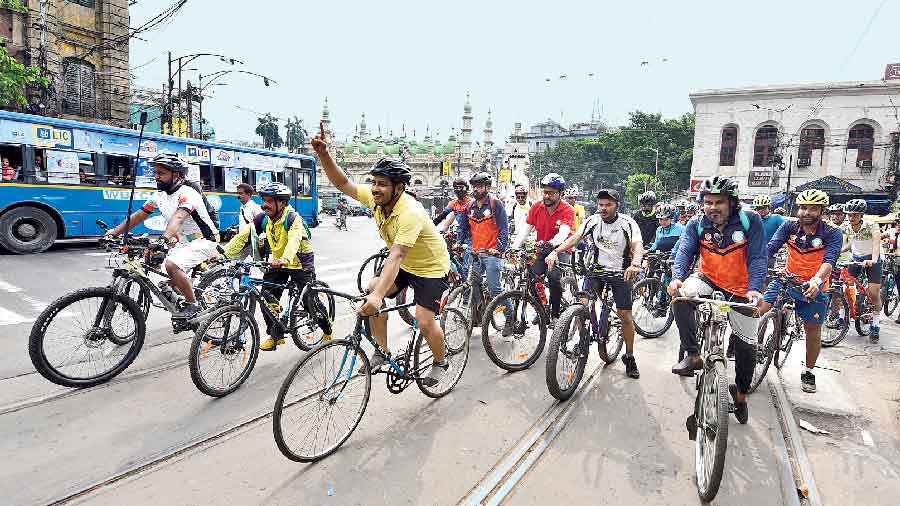
Sir — The prime minister recently urged Indians to save fuel. Yet a recent study on Delhi, Chennai, Dhaka and Accra found that poor infrastructure, policy neglect, safety risks and gender bias continue to discourage cycling. Urban planning still overwhelmingly favours motor vehicles through flyovers, tunnels and highways, while cyclists face encroached lanes, dust pollution and dangerous roads. Women cyclists encounter additional barriers, including harassment and social stigma. Sustained investment, safer infrastructure and broader transport reforms can help people save fuel and cut transmissions.
Aditya Mukherjee,
Calcutta
Historic dispute
Sir — The Madhya Pradesh High Court ruling declaring the Bhojshala-Kamal Maula Mosque site a temple has emboldened Hindu revivalist forces (“Bhojshala not mosque: HC”, May 16). Its direction to the Union government to retrieve and reinstall the Saraswati idol from a London museum appears partisan. Such rulings raise questions about the judiciary’s commitment to the Places of Worship Act, 1991, enacted after the Babri Masjid demolition to preserve the religious character of places of worship as of August 15, 1947. Courts must ask whether such judgments uphold secularism, a basic feature of the Constitution, and strengthen India’s secular democratic framework.
G. David Milton,
Maruthancode, Tamil Nadu
Sir — The ruling declaring the Bhojshala-Kamal Maula Mosque complex a Hindu temple has brought relief to many Hindus. Relying on survey conducted by the Archaeological Survey of India, the high court held that the site originally housed a Saraswati temple built during Raja Bhoj’s reign. The ASI report cited Sanskrit inscriptions, Hindu iconography and structural evidence suggesting later mosque construction over temple remains. The court ended the 2003 arrangement permitting Hindu and Muslim prayers on different days and vested supervisory control with the ASI. With the matter likely headed to the Supreme Court, restraint and patience from all sides would serve the country better than political accusations and inflammatory rhetoric.
S. Balakrishnan,
Jamshedpur
Sir — The Madhya Pradesh High Court ruling in the Bhojshala-Kamal Maula Mosque complex case is a major judicial intervention in disputes over the religious character of historical sites. Relying on the ASI survey, the court held that Hindu worship at the site had continued over time and ended the 2003 arrangement permitting Friday namaz. The verdict is likely to intensify ongoing litigations involving sites in Mathura, Varanasi and Delhi following the Babri Masjid judgment. At a time when such disputes increasingly shape public discourse, constitutional principles, communal harmony and the Places of Worship Act, 1991 deserve greater judicial attention.
Kakoli Das,
Calcutta
New tunes
Sir — Artificial Intelligence-generated campaign songs emerged as a defining feature of West Bengal’s election season, replacing much of the state’s once-vibrant wall graffiti culture. Satirical tracks, such as “Machh chor”, became viral political weapons, blending humour and local grievances with AI. Parties across the spectrum used AI-assisted music videos tailored for WhatsApp, Instagram and YouTube, sharpening political messaging through hyper-local narratives and emotional appeal. Songs about the R.G. Kar rape and murder case reflected public anger and disillusionment over justice and political appropriation. Bengal’s long tradition of political satire has survived but AI has transformed it into a faster instrument of persuasion, raising concerns over misinformation, emotional manipulation and the growing influence of synthetic political propaganda.
Abhisekh Dey,
Calcutta