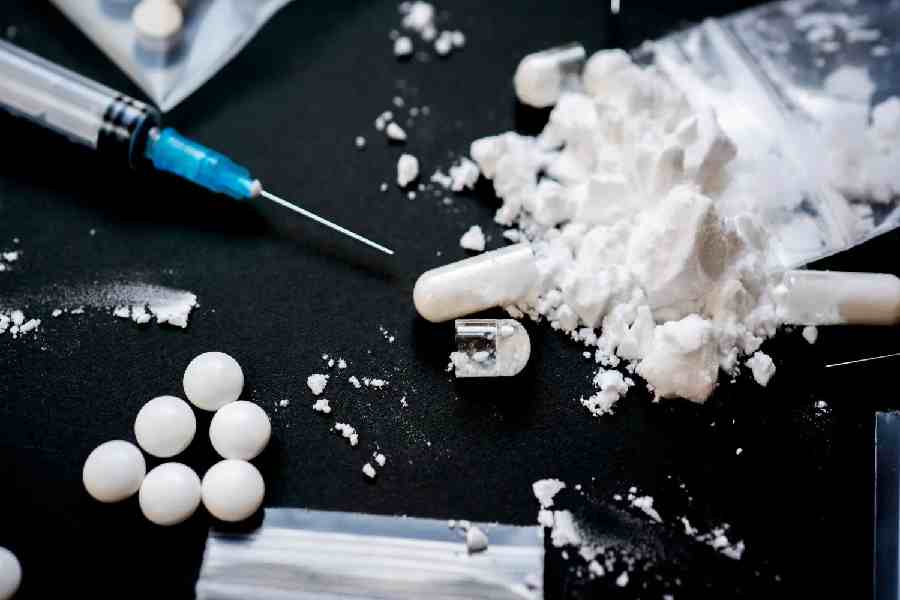
The presidential order in the United States of America facilitating medical and investigational use of psychoactive plant cannabis would have gratified Sir W.B. O’Shaughnessy, who first recommended it while teaching medicine in Calcutta in 1840. The order is momentous because only three days earlier, Donald Trump deemed that fentanyl be treated as a weapon of mass destruction and its export to the US an act of war, significantly escalating America’s old war against narcotic and psychoactive substances. Starting with the 1875 law targeting Chinese immigrants selling opium and, then, immigrant heroin peddlers during prohibition days, the US has incrementally enacted stricter laws against them.
Substance use is a universal old practice. Being ‘drowsed with the fumes of poppies’ for pain or ingesting weeds for inspirational transcendence, pundits say, are practices older than agriculture. But regular recreational usages have consequences, as chronicled explicitly in ‘Drug Literature’, from Thomas De Quincey’s Confessions of an English Opium-Eater to Jack Kerouac’s On the Road, amongst others. Such personal Faustian bargains and a certain lawlessness they brought in along with diseases and deaths could not be condoned socially. Countries got together, often led by the US, and built international collaborative legal frameworks to control narcotic and psychoactive substances of which cannabis provides the largest share. However, as Dr O’Shaughnessy had inferred, the phytochemicals in cannabis and their effects on the human nervous and immune systems have found beneficial uses in diverse medical conditions and also as a less harmful substitute in therapy for opioid dependence. Already Canada, the European Union, and some American states have legalised medical marijuana. Arguing that personal substance usages are not crime but preventable health problems, they have also decriminalised substance use.
Portugal decriminalised the use of narcotic substances in 2001 and has reported positive results in many metrics, including spending less on policing and more on health. Several countries have reported lesser demand for opioids after legalising the recreational use of marijuana. India selectively allows consumption of edible leaves (bhang) of cannabis plants banning flower tops (ganja) and resins (charas). Medical use is allowed (traditional ayurvedic formulations only by registered AYUSH practitioners) but remains underused. The Nasha Mukt Bharat Abhiyaan, an initiative by the ministry of social justice and empowerment, attempts ‘demand reduction’ through campaigns but has no programme for supervised use of cannabis to reduce recreational or medical use of opioids. Even after the 2014 simplification of the Narcotic Drugs and Psychotropic Substances Act, 1985, fear of legal hassles and lack of practicing knowledge keep doctors and hospitals away from judicious use of opioids, the backbone of pain management.
A pragmatic and balanced policy based on science, minimising fears of drug dependence and diversion to recreational use, can be selective use of opioids only in terminal care or through special clinics and liberalising palliation by medical marijuana.
Medical-grade marijuana and synthetic cannabinoids can now be produced in labs. The availability of cheaper synthetic drugs, often adulterated with unpredictable narcotic effects, is causing dependency and accidental deaths to many young professionals and students, compelling the University Grants Commission to mandate compulsory counselling and monitoring in all institutions. A greater and geopolitical vulnerability could be, after China’s corrective steps, India becoming the prime player in the production and the distribution of narcotics because that will be retaliated against as an ‘act of war’ as proclaimed.