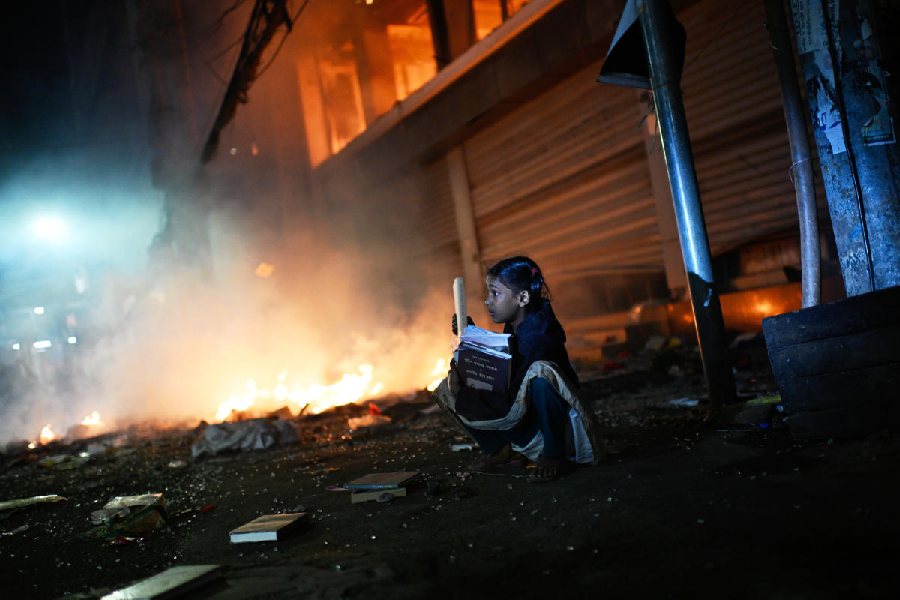
The unsettling images of violence and anarchy from Bangladesh should not be dismissed as the internal disorder of a neighbouring nation. They demand a deeper moral reading, one that goes beyond immediate political explanations. For South Asia, these images function as a warning signal — an indication of what happens when inter-community trust erodes and when the moral foundations of a society are allowed to weaken over time. Nations rarely descend into chaos suddenly; they unravel slowly, almost imperceptibly, at the points where fraternity frays and shared belonging is replaced by fear against one another.
This is not a problem unique to Bangladesh. South Asia as a region carries the heavy inheritance of partitioned histories, colonial disruptions, and unresolved social hierarchies. These legacies have left behind fragile national fabrics, stitched together by constitutional promises but strained by social realities. When political discourse begins to normalise suspicion among communities, when differences of identities are portrayed as threat rather than richness, the conditions for instability are quietly assembled. Violence then appears not as an aberration, but as the culmination of long-standing neglect and even unconcealed support.
Mahatma Gandhi understood this moral trajectory with remarkable clarity. For him, violence was never merely physical; it was the outward manifestation of an inward ethical collapse. Communal harmony, Gandhi insisted, was not an ornamental value to be invoked during crises, but the daily discipline that sustained a civilisation. He believed that the health of a society could be measured by its capacity for self-restraint, empathy, and dialogue. Once fear becomes a political resource and anger a mode of mobilisation, the moral centre of society begins to give way to what we saw in the Partition years in India and what is on display in Bangladesh now.
Contrary to some of the recent views gaining currency, Gandhi’s insistence on non-violence was not born of naïveté. It was grounded in a profound understanding of how easily violence reproduces itself — how today’s justification becomes tomorrow’s grievance. When communities are taught to view one another through inherited prejudices, every incident is magnified, every rumour weaponised. The social imagination narrows, and violence begins to appear as not only acceptable but also necessary. At that point, law enforcement alone becomes insufficient, for the problem has already moved beyond the reach of law. At another level, B.R. Ambedkar confronted this reality from a different, but complementary, perspective. As the principal architect of India’s Constitution, he was acutely aware that political democracy could not survive without social democracy. Liberty and equality, he argued, would remain fragile ideals unless they were held together by fraternity. Fraternity, for Ambedkar, was not an emotional appeal to unity; it was a structural necessity for all societies, particularly for those nations, which were inhabited by a diversity of people and communities. Without it, society would remain a collection of competing groups rather than a moral community. He cautioned on several occasions that constitutional arrangements, however progressive, could be rendered meaningless if social relations remained hierarchical and exclusionary. When communities are denied dignity, when historical injustices are left unaddressed, resentment festers beneath the surface. Political representation alone cannot heal these wounds. What is required is a sustained commitment to social justice and mutual recognition. Where fraternity weakens, Constitutions survive only as documents, while democracy loses its soul.
Jawaharlal Nehru added yet another dimension to this moral framework. He saw pluralism not as a concession extracted by minorities but as the very condition of modern nationhood. Nehru feared that nations driven by narrow cultural or religious identities would ultimately impoverish themselves intellectually and morally. Diversity, he believed, was not a problem to be managed but a strength to be cultivated. A society confident in itself does not fear difference; it learns from it. For Nehru, the erosion of pluralism was inseparable from the decline of reason. When societies abandon debate for dogma and complexity for slogans, they lose the capacity for self-correction. Dissent is no longer seen as democratic necessity but as disloyalty. In such an atmosphere, institutions weaken, public discourse coarsens, and the space for reconciliation steadily shrinks and may even disappear. What follows is not merely political instability, but a deeper civilisational regression.
The unsettling images from Bangladesh must, therefore, be seen within this broader ethical and historical frame for entire South Asia. They are not an invitation to moral judgement but to moral introspection across several nations, which, at one point of time, were part of the singular map. Across South Asia, unresolved grievances — rooted in inequality, identity, and exclusion — continue to shape public life and political discourses. Political expediency often exploits these fault lines rather than healing them. Short-term electoral gains are pursued at the cost of long-term social cohesion. The language of rights is invoked selectively, while the responsibilities of citizenship are quietly eroded.
Development and economic growth, important as they are, cannot be substitutes for social trust. Prosperity built on fractured foundations remains brittle and they fail to mask the ugly and obscene social realities of our times. Roads, bridges, and digital infrastructure cannot compensate for the absence of moral infrastructure — the shared belief that every citizen belongs, that every life carries equal worth. Without this ethical underpinning, progress becomes uneven, resentment deepens, and societies remain vulnerable to sudden ruptures.
Thus, all the nations of South Asia must acknowledge that repairing inter-community relationships is neither an act of charity nor a gesture of weakness. It is a political and moral necessity. It requires large-hearted leadership across national boundaries that resists the temptation to mobilise fear, institutions that apply justice without prejudice, and civic spaces that allow disagreement without dehumanisation. It also demands patience — the willingness to listen to uncomfortable truths and to confront historical wrongs without defensiveness.
Gandhi, Ambedkar, and Nehru walked different paths, spoke in different registers, and argued from different anxieties of their time. Yet, beneath these differences, lay a shared faith: that nations do not endure by overpowering their people but by restraining power itself; not by pressing society into sameness, but by securing justice; not by muting dissent, but by giving difference a dignified place within democracy. Their inheritance is not a relic to be admired from a distance, but a living, moral grammar — one that speaks with urgency today, as the region drifts ever closer to the perilous comfort of exclusion.
The imageries of disruptions, ruptures and violence coming from Bangladesh have a message for each one of us in South Asia: that let us first acknowledge that all of us today stand at a moral crossroads. For the nations of South Asia, the choice is not between order and chaos, but between fraternity and fracture. Bangladesh today also reminds us of the cost of ignoring this choice. History will not ask how loudly nations asserted the dominant identities of their people but how responsibly they cared for the fragile bonds that make collective life possible and desirable. The future of the region depends on whether those bonds are repaired or are allowed to break beyond repair.
Manoj Kumar Jha is Member of Parliament (Rajya Sabha), Rashtriya Janata Dal