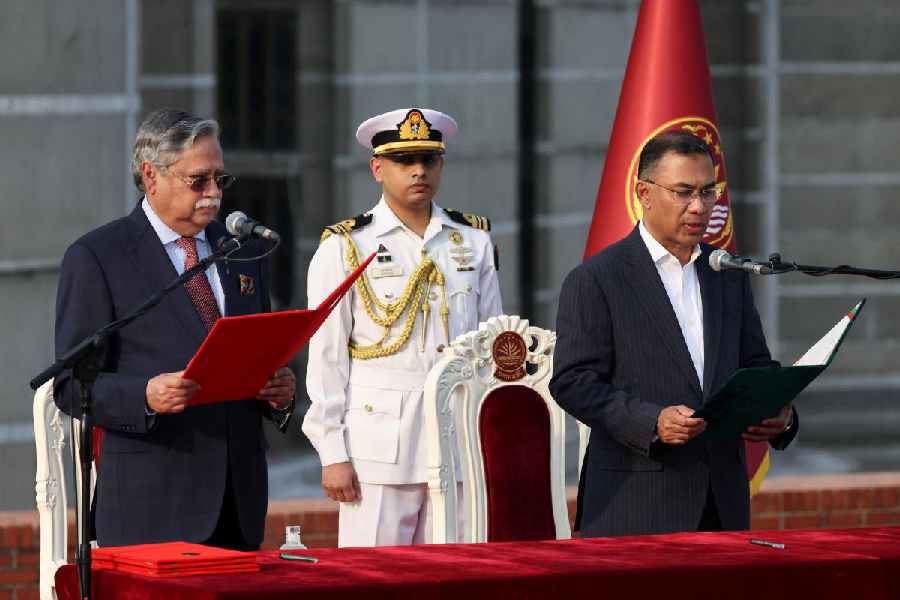
The oath-taking of the new prime minister, Tarique Rahman, and his cabinet and of 296 members of the new Parliament — two-thirds being first-timers —comes as a refreshing change from the 18-month rule of a non-accountable, interim regime. The new cabinet, consisting of 25 ministers and 24 state ministers, is a mixture of the old guard of the Bangladesh Nationalist Party and some unknown faces. The change sets Bangladesh on a new, democratic journey with, hopefully, accountable governance practice that has been unknown for quite a while.
An election is always a significant event in the life of a democracy. But this election saved us from dangerous uncertainties — political, economic and ideological.
The July uprising rescued us from a dictatorial regime and renewed the prospect of democracy. But it also unleashed groups taking the law into their hands which greatly corroded public confidence in institutions such as the police. The overall failure of governance of the interim government further triggered a confidence crisis regarding the overall security of the common people. Bangladesh’s image faced a severe crisis and the instability factor rose anew.
Muhammad Yunus’s interim government began with tremendous expectation — because of the man himself and of his global stature — but ended in tremendous disappointment, especially for the widespread misuse of the law that led to the detaining of thousands of political workers and leaders of the previous regime, including more than 100 journalists, on dubious charges of murder. The way our greatest historical achievement — the Mukti Juddho (Liberation War of 1971) — was allowed to be denigrated, including the destruction of Bangabandhu Sheikh Mujibur Rahman’s house, which was a private museum, shocked and bewildered us all. As a result, we desperately needed an elected government in place of the interim one.
The free, fair and peaceful election saved us from it all. Such was the lack of confidence in the interim government that questions like ‘will an election take place?’ and, if so, ‘will it be peaceful?’ kept cropping up in public discussions almost till the very end.
Immediately after the student-led uprising in 2024, there was a widespread expectation of fundamental change in our politics, especially preventing the return of any dictatorial regime through constitutional amendments by reducing the power of the prime minister, which, really, had no checks. The executive branch generally dominated both the legislature and the judiciary. The July National Charter, which is an accumulation of numerous suggestions for reform approved by all parties, has now been adopted through a referendum held simultaneously with the election. This will now have to be adopted by the new government to give the proposed reforms constitutional legitimacy.
As for the economy, while inflation control and reserve balance created an element of confidence, the failure to attract FDI and persuade local entrepreneurs to invest led to debilitating uncertainty. The best and most justified claim that the interim government can make is that its 18-month tenure ran without any severe economic crisis.
Perhaps the most concerning aspect of the student-led uprising and the activities of the interim government was the denigration of the values and the sanctity of our freedom struggle. The students seemed to be either not aware of or not committed to the values and the principles that are enshrined in our most glorious chapter. In fact, the history as we know it was either not believed in or distorted in the minds of a section of the student leaders who allowed the public denigration of 1971. This is mainly owing to Sheikh Hasina’s usurpation of history and making our independence struggle a family affair. As hatred for her regime and her person grew, so did the tendency towards the denial of Bangabandhu’s role in and the importance of our Liberation War.
Throughout the last 18 months and during the election, the Jamaat-e-Islami, which has emerged as the second-largest political party in Bangladesh today, never apologised to the people for its participation in the genocide and for assisting the Pakistani army in carrying out the brutal killings of innocent and unarmed people in 1971. Instead, the Ameer of JI made a bizarre statement in October 2025, saying: “from 1947 until this moment of October 22, 2025… for all the suffering caused by us, on whomever, wherever — we apologise unconditionally.” The continuous refusal to recognise 1971 and its position on the rights and the dignity of women in the public domain are widely regarded as the reasons for the JI losing substantial support from the section of voters who take pride in the Mukti Juddho.
However, today’s Bangladesh should be seen through the eyes of the latest election. People have voted for a centrist Bangladesh and not an extremist one. Yes, there has been a significant rise in the religious vote. But the indication is clear: the people want the government to be run under secular and modern laws and not by religious dictate. This verdict of the people is notable and can be seen as a determining factor in chalking out the future direction of our politics, which will more likely be inclusive and non-communal.
However, there are some inner messages that need to be discerned from the outcome of the election, the most important of which is the rise of the JI in Bangladesh’s politics. The BNP alliance won 212 parliamentary seats, while the JI got 68 seats and, along with its allies, 77. This is the JI’s best showing ever. It eclipses its earlier best performance of 18 seats in the 1991 election, held immediately after the fall of General Hussain Muhammad Ershad.
The more significant story here is that the JI got 31.76% of the popular vote compared to the BNP’s 49.97%. This is a massive rise in the JI’s support base. This development is important and is likely to have serious implications for Bangladesh’s future politics. This came about as a result of the JI’s brilliant organisational work that contained detailed planning and scientific organising, which were both innovative and effective. The JI developed networks that made inroads into various professional bodies like those of doctors, lawyers, engineers and, of course, students. Its showing in Dhaka city and its vicinity was also impressive. Out of 15 seats in the capital, it won six and its alliance one; it came very close to winning another five.
The big question that is floating around is about the future of the Awami League. Much will depend on its own thinking and initiative. If it continues to be in total denial of any wrongdoing, then its revival will be literally impossible in the near future. The party’s history in the pre-Bangladesh period (during the Pakistan phase, 1948-1971) is so rich and its role during our Liberation War so central that the Awami League enjoyed mass support till Sheikh Hasina’s oppressive regime destroyed it all. There is a good chance of its revival but it must admit and apologise for the atrocities committed during the July uprising.
An interesting new feature of the coming Parliament is the fact that two-thirds of new MPs are first-timers, including the leader of the House (Tarique Rahman) and the leader of the Opposition (Shafiqur Rahman). A total of 178 members of the Parliament will be from the business community, according to their pre-poll declarations.
Bangladesh begins a new journey. We have a shining history of dismantling oppressive regimes but not quite a bright example of replacing them with a democratic, accountable and responsive government. Our ruling political parties end up showing similar traits of the party just replaced. This history makes our people less and less hopeful of political renewal. But, as before, we are putting a lot of hope in the new leadership that has won power following such a massive uprising that cost us 1,400 lives. This puts tremendous responsibility on the shoulders of our new prime minister and the BNP that has gained a two-thirds majority in the new Parliament. We all hope he succeeds just as much for his future as well as for ours.
Mahfuz Anam is editor and publisher of The Daily Star