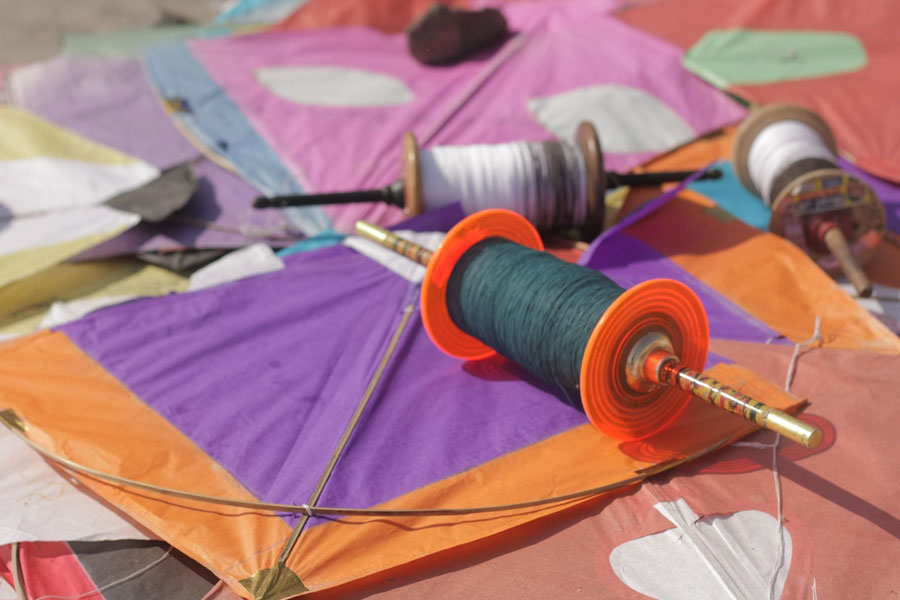
Lahore’s sky saw colourful kites return after more than two decades this month. From February 6-8, the Punjab government lifted a ban on the Basant festival, albeit with strict regulations in place. From QR-coded kites and string to heavy fines for violations, the Punjab government announced that the festival will be “completely safe, regulated, and strictly monitored” under the new Punjab Kite Flying Ordinance, 2025. The excitement over the revival of Basant was unlike anything I have seen in ages even though an entire generation has grown up without seeing this festival.
A bunch of us got together a few days before Basant to go to Mochi Gate in Lahore so that our friends’ children could experience the festivities and buy kites. We first went to Liberty Chowk in Lahore which was dolled up in Basant decor and festive lights. Lahore looked beautiful! We played old Basant songs, including Fariha Pervez’s “Dil hua bo kata”, Abrar-ul-Haq’s “Kudiyan Lahore diyan”, Jawad Ahmad’s “Uchiya majajan wali” and many of Daler Mehndi’s old hits. It was a fun car ride and even though my friend’s children questioned our taste in music we sang along loudly, hooting and having a ball because that is what Basant was all about in our younger days.
There were 14 of us — four couples, a friend from Karachi and five kids. We first stopped for dinner at the famous Saeen Shahi Kabab Tikka House and, after a scrumptious meal, we went off to buy kites from the market. Hundreds of people roamed around the streets even at midnight. There were long queues outside kite shops. The excitement was electrifying. We finally managed to buy some kites for the children and took auto-rickshaws and chingchis back to the parking lot. We ended our trip after having Kashmiri chai from Lakshmi Chowk. It was such a surreal experience walking around in Androon (old city) Lahore at night in the winter, people being helpful, telling us to take the less crowded streets.
Then came Basant and, with it, our friends from Islamabad and Karachi who were astounded to see that there was hardly a motorcycle that did not have a safety rod on it. These rods were mandatory and were being given for free by the government to protect the motorcyclists from kite strings. The rods are put in place in front of bikes so that kite strings do not entangle the motorcyclist or passengers. In the past, chemical strings led to the banning of the festival because it slashed the throats of people on bikes. This time, the chemical string was banned and proper procedures followed. Those who violated them were arrested and/or fined. Basant made headlines around the world: ‘Basant: Lahore kite festival returns after decades-long ban’, ‘How Basant became Lahore’s signature festival in Pakistan’ and so on. This festival is known both for celebrations and economic activity. Rooftops around the city (especially in Androon) were booked, hotels were overbooked, restaurants were running out of space and shops had run out of kites and string. There were people who were anxiously waiting for the clock to strike midnight so that they could go to their rooftops and fly their first kite in over two decades. For three days, we hardly slept. We hopped from one rooftop to another throughout the weekend with friends and family. The joy was real and raw. It made me think: have we forgotten what joy is?
My friend, Zebunnisa Burki, recently wrote about her 17-19-year-old students. She asked them: what gives you joy, outside of social media? “The room went quiet...this question seemed to throw them a bit. There was hesitation, a sense that joy was not an easy thing to offer up.” This made me realise that my generation still knows what joy is, even when we feel it fleetingly, but the younger generation has grown up in a warped world and a country that has seen so much pain and is still reeling from it. I hope that we never forget what joy is and that we get more reasons to celebrate.